

Iran holds runoff presidential vote pitting hard-liner against reformist after record low turnout

1 / 3
Iranian reformist presidential candidate Masoud Pezeshkian (C) gestures after voting in Tehran on July 5, 2024. (AFP)
2 / 3
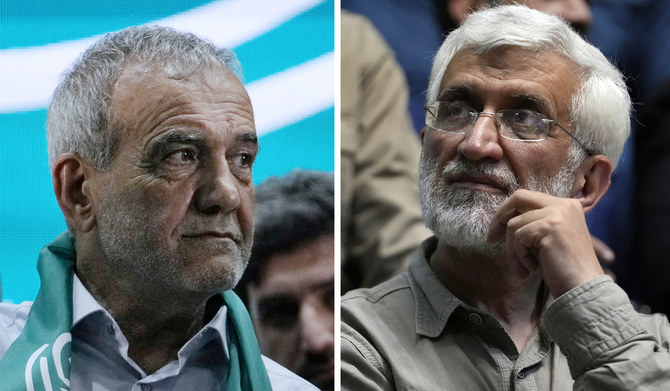
This combination of photos shows Iranian presidential election candidates Masoud Pezeshkian, left, a reformist lawmaker and a former Health Minister, and Saeed Jalili, a hard-line former senior nuclear negotiator, during their campaigns, in Tehran, Iran. (AP)
3 / 3
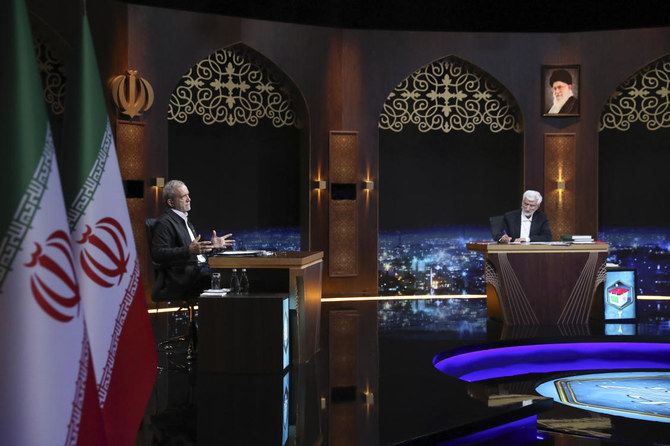
Iranian presidential candidate reformist Masoud Pezeshkian, left, speaks during a debate with hard-line candidate Saeed Jalili at the TV studio in Tehran, Iran. (File/AP)
Short Url
Updated 06 July 2024
Follow

Iran holds runoff presidential vote pitting hard-liner against reformist after record low turnout

  • Vote unlikely to change policies, may shape Khamenei succession
  • Authorities seek high turnout to offset legitimacy crisis
  • Supreme Leader Khamenei, not the president, has the last say

DUBAI, United Arab Emirates: Iran held a runoff presidential election on Friday that pitted a hard-line former nuclear negotiator against a reformist lawmaker. Both men had struggled to convince a skeptical public to cast ballots in the first round of voting that saw the lowest turnout in the Islamic Republic’s history.
Early results reported by Iran’s election authority on state television showed reformist candidate Masoud Pezeshkian narrowly ahead of hard-liner Saeed Jalili.
Mohsen Eslami, the election spokesman, said Pezeshkian had 2,904,227 votes trailed by Jalili with 2,815,566 votes, with 5,819,911 votes counted in 13,277 polling stations. There are some 60,000 polling stations and more than 61 million eligible voters.
Government officials up to Supreme Leader Ayatollah Ali Khamenei have predicted a higher participation rate as voting got underway, with state television airing images of modest lines at some polling centers across the country.
However, online videos purported to show some polls empty while a survey of several dozen sites in the capital, Tehran, saw light traffic amid a heavy security presence on the streets.
Polls closed after midnight, after voting was extended as had become tradition in Iran.
Khamenei has insisted the low turnout from the first round on June 28 did not represent a referendum on Iran’s Shiite theocracy. However, many remain disillusioned as Iran has been beset by years under crushing economic sanctions, bloody security force crackdowns on mass protests and tensions with the West over Tehran’s advancing nuclear program enriching uranium closer than ever to weapons-grade levels.
“I want to save the country from isolation we are stuck in, and from lies and the violence against women because Iranian women don’t deserve to be beaten up and insulted on the street by extremists who want to destroy the country by cutting ties with big countries,” voter Ghazaal Bakhtiari said. “We should have ties with America and powerful nations.”
The race pits former negotiator Jalili against reformist Pezeshkian.
Jalili has had a recalcitrant reputation among Western diplomats during negotiations over Iran’s nuclear program, something that is paired with concern at home over his hard-line views on Iran’s mandatory headscarf, or hijab. Pezeshkian, a heart surgeon, has campaigned on relaxing hijab enforcement and reaching out to the West, though he too for decades has supported Khamenei and Iran’s paramilitary Revolutionary Guard.
Pezeshkian’s supporters have been warning Jalili will bring a “Taliban”-style government into Tehran, while Jalili has criticized Pezeshkian for running a campaign of fear-mongering.
Both contenders voted Friday in southern Tehran, home to many poor neighborhoods. Though Pezeshkian came out on top in the first round of voting on June 28, Jalili has been trying to secure the votes of people who supported hard-line parliamentary speaker Mohammad Bagher Qalibaf, who came in third and later endorsed the former negotiator.
Pezeshkian offered no comments after voting, walking out with former Foreign Minister Mohammad Javad Zarif, who struck Iran’s 2015 nuclear deal with world powers. A rambunctious crowd surrounded the men, shouting: “The nation’s hope comes!”
Both Pezeshkian and Jalili hope to replace the 63-year-old late President Ebrahim Raisi died in a May 19 helicopter crash that also killed the country’s foreign minister and several other officials.
Jalili voted at another polling station, surrounded by a crowd shouting: “Raisi, your way continues!”
“Today the entire world admits that it’s the people who decide who’s president for the next four years,” Jalili said afterward. “This is your right to decide which person, which path and which approach should rule the country in the next four years.”
But as has been the case since the 1979 Islamic Revolution, women and those calling for radical change have been barred from the ballot while the vote itself had no oversight from internationally recognized monitors. The country’s Interior Ministry, in charge of police, oversees the result.
There have been calls for a boycott, including from imprisoned Nobel Peace Prize laureate Narges Mohammadi, though potential voters in Iran appear to have made the decision not to participate last week on their own as there’s no widely accepted opposition movement operating within or outside of the country.
Khamenei cast one of the election’s first votes Friday from his residence, TV cameras and photographers capturing him dropping the ballot into the box. He insisted those who didn’t vote last week were not boycotting the government.
“I have heard that people’s enthusiasm is more than before,” Khamenei said. “God willing, people vote and choose the best” candidate.
One voter, 27-year-old Yaghoub Mohammadi, said he voted for Jalili in both rounds.
“He is clean, without depending on powerful people in the establishment,” Mohammadi said. “He represents those who have no access to power.”
By Friday night, both hard-line and reformist figures urged the public to vote as lines remained light in Tehran.
“Until a few hours ago I was reluctant to vote,” said Ahmad Safari, a 55-year-old shopkeeper and father of three daughters who voted despite skipping the first round. “But I decided to vote for Pezeshkian because of my children. Maybe they’ll have a better future.”
The vote comes as wider tensions have gripped the Middle East over the Israel-Hamas war in the Gaza Strip. In April, Iran launched its first-ever direct attack on Israel over the war in Gaza, while militia groups that Tehran arms in the region — such as the Lebanese Hezbollah and Yemen’s Houthi rebels — are engaged in the fighting and have escalated their attacks.
Iran also continues to enrich uranium at near weapons-grade levels and maintains a stockpile large enough to build several nuclear weapons, should it choose to do so. And while Khamenei remains the final decision-maker on matters of state, whichever man ends up winning the presidency could bend the country’s foreign policy toward either confrontation or collaboration with the West.
More than 61 million Iranians over the age of 18 were eligible to vote, with about 18 million of them between 18 to 30. Voting was to end at 6 p.m. but was extended until midnight to boost participation.
Raisi, who died in the May helicopter crash, was seen as a protégé of Khamenei and a potential successor as supreme leader.
Still, many knew him for his involvement in the mass executions that Iran conducted in 1988, and for his role in the bloody crackdowns on dissent that followed protests over the 2022 death of Mahsa Amini, a young woman detained by police over allegedly improperly wearing the mandatory headscarf, or hijab.


First rain of autumn falls in Iran’s capital, but the drought-ravaged nation needs far more

Updated 2 sec ago
Follow

First rain of autumn falls in Iran’s capital, but the drought-ravaged nation needs far more

TEHRAN: Rain fell for the first time in months in Iran’s capital Wednesday, providing a brief respite for the parched Islamic Republic as it suffers through the driest autumn in over a half century.
The drought gripping Iran has seen its president warn the country it may need to move its government out of Tehran by the end of December if there’s not significant rainfall to recharge dams around the capital. Meteorologists have described this fall as the driest in over 50 years across the country — from even before its 1979 Islamic Revolution — further straining a system that expends vast amounts of water inefficiently on agriculture.
The water crisis has even become a political issue in the country, particularly as Israeli Prime Minister Benjamin Netanyahu has repeatedly offered his country’s help to Iran, a nation he launched a 12-day war against in June. Water shortages also have sparked localized protests in the past, something Iran has been trying to avoid as its economy struggles under the weight of international sanctions over its nuclear program.
“The water crisis in Iran has, in recent years, escalated from a recurring drought issue into a profound political and security problem that has the regime leadership concerned,” the New York-based Soufan Center said.
Drying reservoirs, light snowpack challenge Iran
The drought has been a long subject of conversation across Tehran and wider Iran, from government officials openly discussing it with visiting journalists to people purchasing water tanks for their homes. In the capital, government-sponsored billboards call on the public not to use garden hoses outside to avoid waste. Water service reportedly goes out for hours in some neighborhoods of Tehran, home to 10 million people.
Snowpack on the surrounding Alborz Mountains remains low as well, particularly after a summer that saw temperatures rise near 50 degrees Celsius (122 degrees Fahrenheit) in some areas of the country, forcing government buildings to shut down.
Ahad Vazifeh, an official in the government’s Iran Meteorological Organization office, called the drought “unprecedented” in an interview with the Fararu news outlet last week. Precipitation now stands at about 5 percent of what’s considered a normal autumn, he added.
“Even if rain in the winter and spring will be normal, we will have 20 percent shortage,” Vazifeh warned.
Social media videos show people standing in some reservoirs, the water lines clearly visible. Satellite pictures analyzed by The Associated Press also show reservoirs noticeably depleted. That includes the Latyan Dam — one of five key reservoirs — which is now under 10 percent full as Tehran has entered its sixth consecutive year of drought.
The state-owned Tehran Times newspaper, often following the theocracy’s line, was blunt about the scale of the challenge.
“Iran is facing an unprecedented water crisis that threatens not only its agricultural sector but also regional stability and global food markets,” the newspaper said in a story this past weekend. The faithful have also offered prayers for rain at the country’s mosques.
Long-arid Iran faces challenge of climate change
Iran, straddling the Mideast and Asia, long has been arid due to its geography. Its Alborz and Zagros mountain ranges cause a so-called “rain shadow” across much of the nation, blocking moisture coming from the Caspian Sea and the Arabian Gulf.
But the drain on the country’s water supplies has been self-inflicted. Agriculture uses an estimated 90 percent of the country’s water supplies. That hasn’t been stopped even through these recent drought years. That’s in part due to policies stemming from Iran’s 1979 Islamic Revolution and then-Supreme Leader Ayatollah Ruhollah Khomeini, who pledged water would be free for all. The intervening years of the Iran-Iraq war saw the country push for self-sufficiency above all else, irrigating arid lands to grow water-intensive crops like wheat and rice, and overdrilling wells.
Experts have described Iran as facing “water bankruptcy” over its decisions. In the past, Iranian officials have blamed their neighbors in part for their water shortage, with hard-line former President Mahmoud Ahmadinejad at one point falsely suggesting that “the enemy destroys the clouds that are headed toward our country and this is a war Iran will win.”
But that’s changed with the severity of the crisis leading to current President Masoud Pezeshkian warning the capital may need to be moved. However, such a decision would cost billions of dollars the country likely doesn’t have as it struggles through a major economic crisis.
Meanwhile, climate change likely has accelerated the droughts plaguing Iraq, which has seen the driest year on record since 1933, as well as Syria and Iran, said World Weather Attribution, a group of international scientists who study global warming’s role in extreme weather.
With the climate warmed by 1.3 degrees Celsius (2.3 degrees Fahrenheit) due to fossil fuel burning, the severity of drought seen in Iran over the last year can be expected to return every 10 years, the group said. If the temperature hadn’t risen by that much, it could be expected between every 50 to 100 years, it added.
“The current acute crisis is part of a longer term water crisis in Iran and the wider region that results from a range of issues including, frequent droughts with increasing evaporation rates, water-intensive agriculture and unsustainable groundwater extraction,” World Weather Attribution said in a recent report.
“These combined pressures contribute to chronic water stress in major urban centers including Tehran, reportedly at risk of severe water shortages and emergency rationing, while also straining agricultural productivity and heightening competition over scarce resources.”