Migrants face ‘unimaginable horrors crossing Africa’

1 / 2
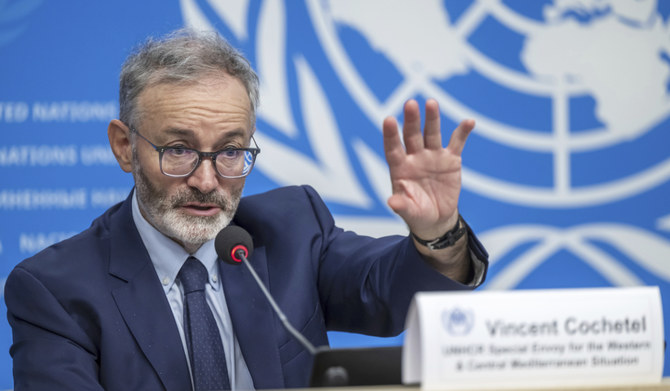
Vincent Cochetel, UNHCR special envoy for the Western and Central Mediterranean Situation, addresses a press conference in Geneva, Switzerland. (AP)
2 / 2
In this undated still image taken from video, the Louise Michel, a migrants search and rescue ship operating in the Mediterranean and financed by British street artist Banksy, is seen at sea. (MV Louise Michel/REUTERS)
Short Url
Updated 05 July 2024
Follow

Migrants face ‘unimaginable horrors crossing Africa’

  • Migrants face expulsion, organ trafficking risks, climate change, conflict, and racism
  • “Every one that has crossed to Sahara can tell you of people they know who died in the desert,” UNHCR special envoy says

GENEVA: Refugees and migrants face extreme violence, abuse, and exploitation on land routes crossing Africa to get to the Mediterranean, with far more believed to be dying there than at sea, a UN-backed report said.

Nearly 30,000 migrants have been declared dead or missing, attempting to cross the Mediterranean to Europe in the past decade.
However, it could be even worse for those traveling through Africa to the coast, according to a report from UN agencies for refugees and migrants and the monitoring group Mixed Migration Center.
Based on more than 31,000 interviews with refugees and migrants, the report found that 1,180 people were known to have died while crossing the Sahara Desert between January 2020 and May 2024.
Five deaths a day are being recorded on the desert routes — taking the total to at least 870 so far this year — Laurence Hart of the UN’s International Organization for Migration told reporters in Geneva. But these numbers are believed to be a vast underestimate.

BACKGROUND

Nearly 30,000 migrants have been declared dead or missing, attempting to cross the Mediterranean to Europe in the past decade.

While data is lacking, the bodies behind the report say there are thousands of deaths each year.
“Deaths of refugees and migrants in the desert (are) presumed to be double those happening at sea,” they said in a statement.
“For everyone crossing the Sahara, you get the testimony of bodies being seen, being dropped,” said Vincent Cochetel, UNHCR’s special envoy for the central and western Mediterranean.
“Everyone that has crossed the Sahara can tell you of people they know who died in the desert,” he told reporters.
Those on the move face torture, kidnapping for ransom, people trafficking, sexual violence, robbery, arbitrary detention, and collective expulsions, the report said.
Migrants crossing the desert often find themselves abandoned there by people smugglers, while those who get sick are sometimes tossed off pickup trucks.
With no adequate aid structures or proper search and rescue systems along the way, they are pretty much destined to die.
Despite the “unimaginable horrors people face in some countries along the route,” the report highlighted an increase in the number of people attempting the perilous land crossings.
This was in part due to deteriorating situations in their homelands, the report said, pointing to the eruption of conflicts across the Sahel region and in Sudan and new and long-running violence in the Horn of Africa and the east of the continent.
There was also the devastating impact of climate change and disasters, as well as xenophobia and racism spurring refugees and migrants to leave.
While no clear statistics exist for overall migration flows through Africa, UNHCR data shows a tripling of arrivals in Tunisia between 2020 and 2023.
The organizations stressed the urgent need for protection along the routes.
“This is not to facilitate the movement of people,” Cochetel insisted.
“It is to find protection solutions to address the abuse and the violations they suffer.”
He said most people on the move globally were not going to Europe.
The pollsters conducting the survey used for Friday’s report found nearly four out of 10 migrants had run the risk of physical violence during their journey.
Eighteen percent spoke of the danger of kidnappings, while 15 percent said there was a clear risk of sexual violence, and 14 percent said they risked death.
Cochetel also estimated that “hundreds” of people had fallen victim to organ traffickers in some countries.
People sometimes sell an organ out of desperation.
“But most of the time, people are drugged, and the organ is removed without their consent,” he said.
“They wake up and one kidney is missing.”


India rolls out strictest anti-pollution curbs as toxic smog engulfs Delhi

Demonstrator wearing an oxygen mask and holding oxygen tanks takes part in protest.
Updated 5 sec ago
Follow

India rolls out strictest anti-pollution curbs as toxic smog engulfs Delhi

  • Private monitors in several parts of northern Delhi recorded AQI spikes between 550 and 700s
  • Authorities invoked stage four of the capital region’s emergency pollution-control framework

NEW DELHI: India’s capital choked under a thick blanket of smog on Sunday, with the government imposing anti-pollution curbs after monitoring stations in some areas recorded extremely hazardous air quality.

Home to 30 million people, Delhi has not recorded a single “clean air” day in 2025, with Air Quality Index readings hitting high above the 50 score throughout the year.

On the AQI scale from 0 to 500, good air quality is represented by levels below 50, while levels above 300 are dangerous.

Worsening since late October, official records over the weekend were in the severe to severe-plus range of 400–500, but as 24-hour averages, they did not capture the peaks. Private monitors in several parts of North and North West Delhi recorded AQI spikes above 550 and even into the 700s in real-time.

On Saturday evening, the Ministry of Environment’s Commission for Air Quality Management invoked stage four — the highest level — of the Graded Response Action Plan for Delhi and surrounding areas.

To “prevent further deterioration of air quality in the region,” the commission suspended all non-essential construction, shut stone crushers and mining operations, stopped entry of trucks into the capital region, and ordered schools to shift to hybrid classes or online, where possible.

While authorities blamed the pollution on “adverse meteorological conditions,” residents have been demanding more government action.

“The situation is so bad in Delhi that we don’t have any option but to force kids to do online classes. The government has failed us; it has not done anything to address the issue,” said Nabanita Nayak, who decided for her teenage children to attend school online only, despite concerns over their screen addiction.

“If the kids are too much in front of laptops, that’s also an issue. As a mother, I am worried.” 

Delhi’s pollution has been worsening since Diwali in late October, when the average AQI has been above 370, or “very poor.” Since mid-November, it has been over 400, which means “severe” air quality, with certain areas recording 500 and above, which is classified as a “hazardous” level.

“I don’t feel proud living in Delhi. It’s the capital city of the country … We talk about being a developed nation by 2047 — we have deadlines,” said Jagriti Arora, who is keeping her 7-year-old daughter at home to prevent allergy flare-ups caused by air pollution.

“The government has to do something … China had a big problem with pollution, but now they’ve managed to bring it down.”

Delhi’s air quality deteriorates in winter due to local emissions and seasonal weather conditions. Cold temperatures and low wind speeds result in a temperature inversion, which traps pollutants close to the ground instead of letting them disperse. This allows emissions from millions of vehicles, ongoing construction, and nearby industrial activity to accumulate in the air. Urban waste burning and dust from construction sites further add to it.

“This is not a new thing. This has been happening now for over 10 years,” Arora said. “You can see it. You don’t need to actually look at an AQI meter to see how bad the pollution is these days.”