WASHINGTON: President Joe Biden on Thursday opened a critical stretch in his effort to salvage his imperiled reelection campaign, facing a growing sense that he may have just days to make a persuasive case that he is fit for office before Democratic support for him completely evaporates.
In the aftermath of Biden’s disastrous debate performance last week against Republican Donald Trump, some financial backers were holding off or canceling upcoming fundraisers, according to a person familiar with the plans who spoke to The Associated Press on condition of anonymity to talk about private discussions.
Biden himself, in a Wednesday night meeting with Democratic governors, acknowledged that he needs to get more sleep and limit evening events so he can turn in earlier to be rested for the job, according to three people familiar with the meeting, who also spoke on condition of anonymity. One person said the president joked that his health was fine, it was his brain that had challenges.
California Gov. Gavin Newsom, who was in the meeting, was asked about the idea that Biden wants to limit events after 8 p.m. and responded: “He did that with a smile on his face. It was more of a rhetorical framework of just being fit and rested.”
Newsom, who was campaigning for Biden in western Michigan, added, “I like when a president acknowledges they’re human.”
In an interview with a Wisconsin radio station that aired Thursday, Biden argued that much more than his own political future was in jeopardy, saying: “The stakes are really high. I know you know this. For democracy, for freedom ... our economy, they’re all on the line.”
The interview on the Earl Ingram Show on the Civic Media Radio Network, taped Wednesday, was the part of a media and public events blitz that the Democratic president and his staff have acknowledged as a make-or-break moment.
After hosting a July Fourth evening barbecue at the White House for military families, Biden is scheduled to campaign in Wisconsin on Friday and sit for an interview with ABC’s George Stephanopoulos that will air as a prime-time special that night.
He plans to be in Philadelphia on Sunday and hold a full news conference during the NATO summit in Washington next week.
It is not a given that his campaign will survive even that long if he does not deliver a strong showing on ABC. Discussions that were once a whisper around who should step into his place should he bow out are growing louder.
For now, Biden is not ready to walk away and he has communicated that in conversations with Democratic governors, close allies and staffers from his campaign.
But time is short for a possible change. The Democratic National Committee announced weeks ago that it would hold a virtual roll call for a formal nomination before the party’s national convention, which begins Aug. 19.
“I’m proud to be running for reelection as a president who’s made his promises and I’ve kept them,” Biden said in the radio interview.
“I had a bad night. A bad night. I screwed up,” he said of the debate, where he gave halting and convoluted answers.
“But 90 minutes on stage does not erase what I’ve done for 3 1/2 years,” he said in a different interview, with Philadelphia-area WURD Radio.
In his private conversations, Biden has focused on how to reverse the trajectory from his rocky debate and has emphasized the critical nature of this year’s presidential election.
During one call, when asked what would happen if his efforts to course correct do not work, Biden stressed that he understood how important the race is and that he would put the country first, according to a person who spoke directly with the president. The person was granted anonymity to discuss private conversations.
Biden’s meeting Wednesday night with the Democratic governors lasted for more than hour and drew more than 20 of them, some in person and some participating virtually. Afterward they described the conversation as “candid” and said they were standing behind Biden despite being concerned about a Trump victory in November. Details about Biden’s comments on getting more sleep were first reported by The New York Times.
During that meeting, Biden told leaders he had been checked out by his doctor following his debate performance, according to two people familiar with the talks who spoke on condition of anonymity because they were not authorized to discuss the private conversation. A few hours earlier, White House press secretary Karine Jean-Pierre had said Biden had not been examined by the doctor.
The White House has blamed Biden’s debate performance, where he appeared pale and his raspy voice trailed off at times, on a cold. Biden also said he had jet lag following back-to-back foreign trips that ended 12 days earlier.
Biden’s staff has resisted repeated calls to release more robust medical records for the 81-year-old president. After his last full physical in February, his doctor declared him fit for duty.
Two Democratic lawmakers have publicly called for Biden to drop out of the race. Most Democratic lawmakers, though, are taking a wait-and-see approach, holding out for a better idea of how the situation plays out through new polling and the TV interview. That’s according to Democratic lawmakers who requested anonymity to speak bluntly about the president.
Some have suggested Vice President Kamala Harris is emerging as the favorite to replace Biden if he were to withdraw. Those involved in private discussions acknowledge that California’s Newsom and Gov. Gretchen Whitmer of Michigan remain viable alternatives. But for some insiders, Harris is viewed as the best prospect to quickly unify the party and avoid a messy and divisive convention fight.
Newsom was asked directly whether, if Biden dropped out, he would he support Harris. He said, “I don’t even like playing in the hypotheticals.”
Trump was seen on video declaring that Harris would be his new rival, saying, “she’s so pathetic.” It was unclear when he made the comments, which were posted on his social media account.
Even as other Democratic allies have remained quiet since the debate, there is a growing private frustration about the Biden campaign’s response at a crucial moment in the campaign — particularly in Biden waiting several days to do direct damage control with senior members of his own party.


![]()

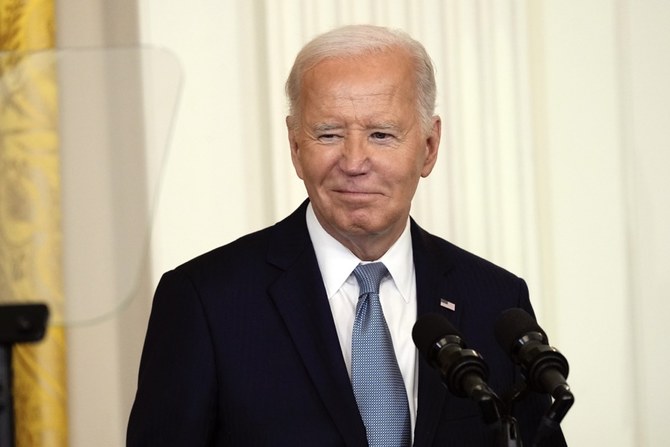
Biden heads into a make-or-break stretch for his imperiled presidential campaign
Short Url
https://arab.news/w7xjq
Biden heads into a make-or-break stretch for his imperiled presidential campaign
Latest updates







© 2026 SAUDI RESEARCH & PUBLISHING COMPANY, All Rights Reserved And subject to Terms of Use Agreement.