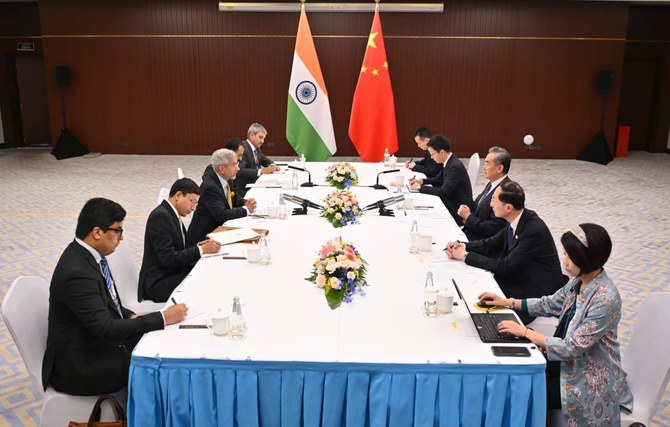

New Delhi: India seeks to increase efforts to resolve border issues with China, its top diplomat said on Thursday, as he met his Chinese counterpart on the sidelines of the Shanghai Cooperation Organization’s summit in Kazakhstan.
The 10-member transregional economic and security body established by China and Russia, and comprising also Central Asian republics, India, Pakistan, Iran and Belarus, held a two-day meeting of its heads of state in the Kazakh capital Astana on July 3-4.
All countries were represented by their leaders and top diplomats, except for India, as Prime Minister Narendra Modi skipped the summit. The Indian delegation was led by Foreign Minister S. Jaishankar.
Jaishankar and Chinese FM Wang Yi held talks on Thursday aiming to address the tensions that broke out between New Delhi and Beijing in 2020, following deadly clashes on their de facto Himalayan border known as the Line of Actual Control.
Both have since deployed thousands of troops to the area and downscaled engagements. Multiple talks aiming to resolve the standoff have not succeeded in normalizing the ties.
“Discussed early resolution of remaining issues in border areas. Agreed to redouble efforts through diplomatic and military channels to that end,” Jaishankar said in an X post after the meeting with Wang.
“The three mutuals — mutual respect, mutual sensitivity and mutual interest — will guide our bilateral ties.”
The spokesperson of China’s Ministry of Foreign Affairs said in a statement that the ministers “agreed to work toward stability in the border area and hold a new round of consultations on the border issue as soon as possible.”
She quoted Wang as saying that both countries, as representatives of the Global South, should work together to “safeguard the common interests of developing countries, and make due contributions to regional and world peace, stability and development.”
India and China have been unable to agree on their 3,500-km border since they fought a war in 1962.
Jaishankar and Wang’s meeting was the first high-level engagement between the countries since India’s election and the start of Modi’s third term last month.
“In that context, it is important to note that primarily the discussion seems to have revolved around addressing the standoff,” said Manoj Kewalramani, China studies fellow and chairperson of the Indo-Pacific studies program at the Takshashila Institution in Bangalore.
“It is useful that the two foreign ministers met at the sidelines of the SCO summit. Maintaining channels of dialogue between the two sides is important. To that extent, it is good that this meeting took place.”
Kewalramani told Arab News that the presence of Chinese troops in the Ladakh area on the border was, however, posing a main obstacle to normalization.
“It does seem like Delhi will be unwilling to restore normalcy unless additional disengagement takes place. It would be strategically imprudent and politically difficult to do so,” he said.
“Unless there is a meaningful change in Chinese policies, it is very difficult for the Indian government to pursue normalization.”