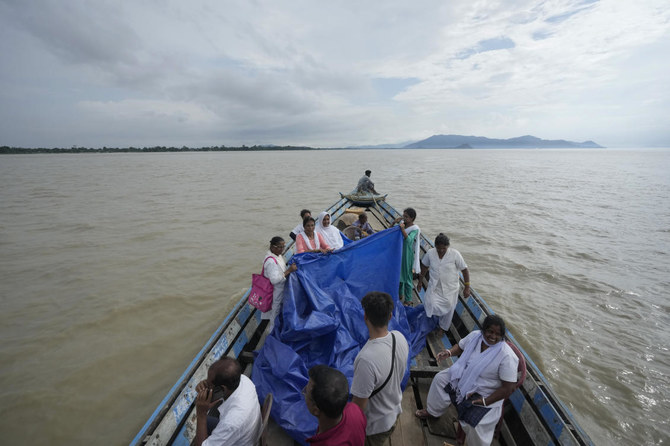
MORIGAON, India: A blue tarp covered a mother and her newborn daughter from the incessant rain on their boat journey. Jahanara Khatoon, 25, had just given birth on the boat on their way to a health care center, surrounded by the raging floodwaters of the Brahmaputra River.
“I am very happy,” said her husband, Kamaluddin, who was also on the boat. “My wife wanted a boy, but Allah has given me a girl and I’m very satisfied. I don’t want to have any more children.”
The couple had left their home on Phuliamari Char, one of the islands in the river, after it was inundated by floodwaters, taking shelter on a nearby island known as Chars.
Increased rainfall in the region blamed on climate change has made the Brahmaputra River — already known for its powerful, unpredictable flow — even more dangerous for those who live near it or on the more than 2,000 islands in it.
India, and Assam state in particular, is seen as one of the world’s most vulnerable regions to climate change because of increasingly intense rain and floods, according to a 2021 report by the Council on Energy, Environment and Water, a New Delhi-based climate think tank.
Khatoon and Kamaluddin earn their living as farmers on their island in Assam state’s Morigaon district.
A medical team was visiting flooded Chars to aid those who needed medical help, especially pregnant women. The team convinced Khatoon to travel with them to the nearest medical facility across the river.
The baby couldn’t wait for Khatoon to get to the health care center. As her labor progressed, the team on the boat quickly got to work, holding up a tarp to protect from the rain as they helped with the delivery.
Within 10 minutes the baby emerged to shouts of celebration.
Diluwara Begum, an auxiliary nurse and midwife, lifted the newborn and whispered prayers into her ears.
“This was my first time helping deliver a baby on a boat. It was a very different feeling. It feels good.” she said.
The family has named the baby Karima, which means “Giving.”


Indian mother delivers baby on boat as her river island is inundated by floodwaters
https://arab.news/wxyac
Indian mother delivers baby on boat as her river island is inundated by floodwaters

- “I am very happy,” said her husband, Kamaluddin, who was also on the boat
- The couple had left their home on Phuliamari Char, one of the islands in the river, after it was inundated by floodwaters, taking shelter on a nearby island known as Chars


Pope names veteran Vatican diplomat as ambassador to the US to manage relations with Trump
- Italian Archbishop Gabriele Caccia, 68, is currently the Holy See’s ambassador to the UN
- He replaces French-born Cardinal Christophe Pierre
ROME: Pope Leo XIV on Saturday named a veteran Vatican diplomat as his new ambassador to the United States to manage one of the Holy See’s most important bilateral relationships at a crucial time, with ties strained over the Trump administration’s war in Iran and immigration crackdown.
Italian Archbishop Gabriele Caccia, 68, is currently the Holy See’s ambassador to the United Nations in New York. He replaces French-born Cardinal Christophe Pierre, who at age 80 is retiring as apostolic nuncio in Washington.
Caccia served as the Holy See’s ambassador to Lebanon and the Philippines before being posted to the UN in 2019. Ordained a priest in Milan in 1983, Caccia later served as “assessor” in the Vatican secretariat of state, a key administrative post in the Holy See’s most important office.
He inherits a complicated and consequential dossier on both the US church and state fronts at a time of global turmoil.
Pierre’s tenure as ambassador was notable for clear signs of friction between the leadership of the US Conference of Catholic Bishops, which tends to skew conservative, and the more progressive priorities of Pope Francis’ pontificate.
The relationship with the US and its church is crucial for the Holy See, not least because US Catholics are the most generous donors to the Holy See’s coffers.
Leo, history’s first US-born pope, is well aware of the dynamic, having served as Francis’ point man on bishop nominations for two years before his 2025 election. Leo has emphasized a message of pacification and unity in the church.
The first Trump administration clashed with Francis especially on migration, and that tension has continued in Leo’s pontificate and the second Trump term. Leo has repeatedly insisted that the Trump administration respect the human dignity of migrants, while acknowledging its right to its borders.
More recently, Leo has expressed “profound concern” about the US-Israeli war in Iran and urged both sides to “stop the spiral of violence before it becomes an irreparable abyss.”
In comments last Sunday, Leo called for the resumption of diplomacy. Weapons, he said, only sow “destruction, pain and death.”
In a major foreign policy speech earlier this year, Leo also made clear he opposed the US aggressive use of military power, in an apparent reference to Washington’s incursion in Venezuela and threats to take Greenland. He denounced how nations were using force to assert their dominion worldwide and “completely undermine” peace and the post-World War II international legal order.
Caccia said in a statement Saturday he was humbled by Leo’s appointment and faith in naming him ambassador to his native country.
“I receive this mission with both joy and a sense of trepidation,” according to a statement reported by Vatican News. He said his was a mission “at the service of communion and peace,” recalling that this year marks the 250th anniversary of the US independence.
The current president of the US conference, Archbishop Paul S. Coakley, welcomed Caccia’s appointment and offered the US hierarchy’s “warmest welcome and our prayerful support.”
The Holy See has a tradition of diplomatic neutrality, though Leo has spoken out strongly against the humanitarian toll of Israel’s military action in Gaza and Russia’s invasion of Ukraine.