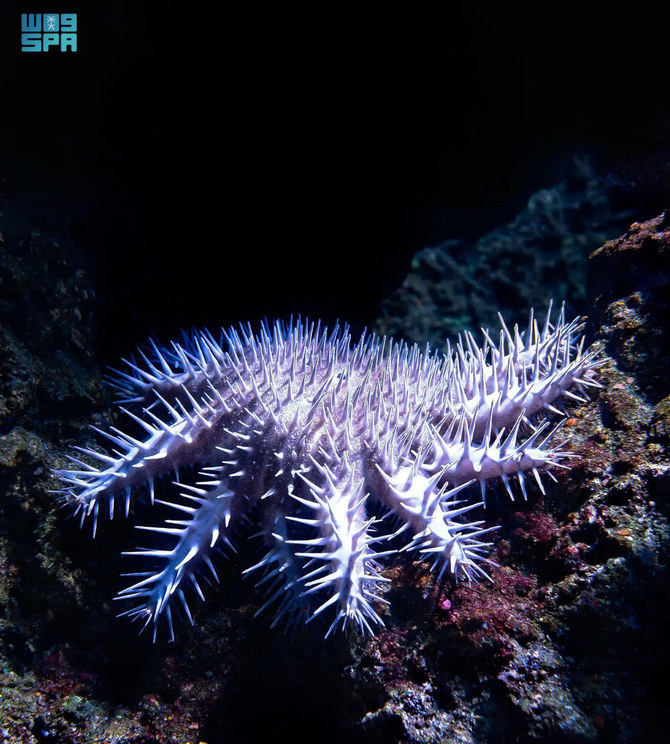

RIYADH: Saudi Arabia’s National Center for Wildlife Development has launched a survey of the Red Sea’s crown-of-thorns starfish to better understand and manage future outbreaks of the coral-eating species.
The action plan is the result of a workshop held by the NCWD in late 2022, during which the threat of outbreaks was discussed, the Saudi Press Agency reported on Wednesday.
The wildlife center, in collaboration with experts around the world, aims to develop protocols to detect outbreaks, and identify the best way to control damage to coral reefs.
“The crown-of-thorns starfish is a marine organism that feeds on algae and bacteria that grow on coral reefs, but it poses a major threat to coral reef ecosystems when it becomes widespread,” the report said, citing discussions during the workshop.
“The spread of the crown-of-thorns starfish has been linked to significant damage to coral reefs in the Red Sea, especially during the breeding season, which is observed in the last two weeks of July until the first two weeks of August,” it added.

Left unchecked, the outbreak of crown-of-thorns starfish could be dangerous to coral reef health. (SPA photo)
Marine scientists and other experts who participated in the workshop have attributed outbreaks to the disruption of the food chain and overfishing of the species that feed on it.
The most important species that need protection is the humphead wrasse (Cheilinus undulatus), also known as the Napoleon fish, or locally as tarpani.
“They eat crown-of-thorn starfish and therefore keep populations of this damaging coral reef predator in check,” said a recent report of the World Wildlife Fund.

It is said that the humphead wrasse were also called Napoleon fish because of the hump on their forehead that resembles the hat of the French emperor Napoleon Bonaparte. (Photo Courtesy of WWF)
In Malaysia, the WWF helped to stop the export of the humphead wrasse and is working with other countries to do the same.
“We work with partners to repopulate protected coral reefs with wrasses that were formerly intended for sale through a buyback program with local fishermen. Since 2010, over 860 humphead wrasse have been released back into the wild,” the WWF said.
The fish is considered vulnerable to overfishing because it takes them about five to seven years to reach sexual maturity and reproduce.