CANBERRA: Pro Palestine protesters climbed the roof of Australia’s Parliament House in Canberra on Thursday and unfurled banners, one saying Palestine will be free, and accused Israel of war crimes, TV footage showed.
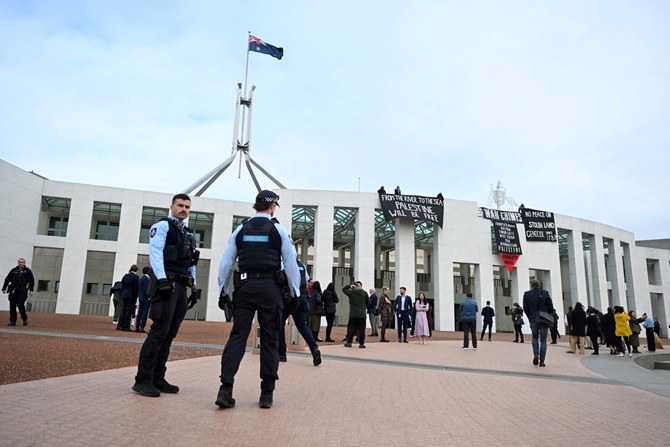
Footage showed four people dressed in dark clothes on the roof of the building, unfurling black banners including one reading “from the river to the sea, Palestine will be free,” a common refrain of Pro Palestine protesters.
One of the protesters began a speech using a megaphone accusing the Israeli government of war crimes, an accusation it rejects.
“We will not forget, we will not forgive and we will continue to resist,” the protester said.
A handful of police and security advised people not to walk directly under the protest at the main entrance to the building, but there appeared to be no immediate attempt to remove the protesters, a Reuters witness said.
“This is a serious breach of the Parliament’s security,” opposition Home Affairs spokesperson James Paterson said in a post on social media platform X.
“The building was modified at great expense to prevent incursions like this. An investigation is required.”
The war in Gaza began when Hamas gunmen burst into southern Israel on Oct. 7, killed 1,200 people and took around 250 hostages back into Gaza, Israel says.
The offensive launched by Israel in retaliation has killed nearly 38,000 people, according to the Gaza health ministry, and has left the heavily built-up coastal enclave in ruins.
Both Israel and Hamas committed war crimes in the early stages of the Gaza war, a UN inquiry found last month, saying that Israel’s actions also constituted crimes against humanity because of the immense civilian losses.

Pro Palestine protesters scale roof of Australia’s Parliament
Short Url
https://arab.news/zw3n7
Pro Palestine protesters scale roof of Australia’s Parliament
Philippine president announces new gas find in waters facing the disputed South China Sea
MANILA: Philippine President Ferdinand Marcos Jr. announced the discovery of a new natural gas deposit near an existing gas field in waters facing the disputed South China Sea, which could shield his country from a potential power crisis.
The discovery of the gas reservoir northwest off Palawan province was “significant” and could eventually supply power to more than 5.7 million households annually, Marcos said Monday.
The undersea reservoir is estimated to contain about 98 billion cubic feet (2.7 billion cubic meters) of gas. Initial tests showed 60 million cubic feet (1.6 million cubic meters) of gas could be extracted each day from the well, Marcos said without providing other details including when commercial production could start.
“This helps Malampaya’s contribution and strengthens our domestic gas supply for many years to come,” Marcos said. “Aside from the natural gas, the discovery also includes condensate, which is a high-value liquid fuel.”
The new gas deposit, called Malampaya East 1, was discovered by a Philippine consortium about 5 kilometers (3.1 miles) east of the main Malampaya gas field, where commercial gas production started more than two decades ago and was projected to considerably decline in a few years.
The Malampaya gas to power facility has generated more than 20 percent of the electricity to Luzon, the most populous northern Philippine island region. In 2023, Marcos extended an exploration contract in Malampaya by 15 years.
Experts have predicted Malampaya could run out of gas in a few years, which has sparked fears of a potential power crisis in Luzon, where the bustling capital and main financial and business district is located.
The offshore gas field lies within the country’s Exclusive Economic Zone of the Philippines, a 200-nautical-mile (370-kilometer) stretch of water from a country’s coastline where it has exclusive rights to explore and harness resources under the 1982 United Nations Convention on the Law of the Sea.
Philippine efforts to explore for oil and gas in another offshore region, the Reed Bank, has been stalled for years because of opposition from Beijing, which claims sovereignty over the area along with most of the South China Sea. The Reed Bank also lies in the fringes of the South China Sea west of the Philippine island province of Palawan.
Vietnam’s oil and gas exploration in the disputed region also has been opposed by China. Beijing claims virtually the entire South China Sea and has reinforced its presence including coast guard and naval patrols in the disputed waterway in recent years.
Malaysia, Brunei and Taiwan also have been involved in the region’s long-simmering territorial standoffs.
The discovery of the gas reservoir northwest off Palawan province was “significant” and could eventually supply power to more than 5.7 million households annually, Marcos said Monday.
The undersea reservoir is estimated to contain about 98 billion cubic feet (2.7 billion cubic meters) of gas. Initial tests showed 60 million cubic feet (1.6 million cubic meters) of gas could be extracted each day from the well, Marcos said without providing other details including when commercial production could start.
“This helps Malampaya’s contribution and strengthens our domestic gas supply for many years to come,” Marcos said. “Aside from the natural gas, the discovery also includes condensate, which is a high-value liquid fuel.”
The new gas deposit, called Malampaya East 1, was discovered by a Philippine consortium about 5 kilometers (3.1 miles) east of the main Malampaya gas field, where commercial gas production started more than two decades ago and was projected to considerably decline in a few years.
The Malampaya gas to power facility has generated more than 20 percent of the electricity to Luzon, the most populous northern Philippine island region. In 2023, Marcos extended an exploration contract in Malampaya by 15 years.
Experts have predicted Malampaya could run out of gas in a few years, which has sparked fears of a potential power crisis in Luzon, where the bustling capital and main financial and business district is located.
The offshore gas field lies within the country’s Exclusive Economic Zone of the Philippines, a 200-nautical-mile (370-kilometer) stretch of water from a country’s coastline where it has exclusive rights to explore and harness resources under the 1982 United Nations Convention on the Law of the Sea.
Philippine efforts to explore for oil and gas in another offshore region, the Reed Bank, has been stalled for years because of opposition from Beijing, which claims sovereignty over the area along with most of the South China Sea. The Reed Bank also lies in the fringes of the South China Sea west of the Philippine island province of Palawan.
Vietnam’s oil and gas exploration in the disputed region also has been opposed by China. Beijing claims virtually the entire South China Sea and has reinforced its presence including coast guard and naval patrols in the disputed waterway in recent years.
Malaysia, Brunei and Taiwan also have been involved in the region’s long-simmering territorial standoffs.
© 2026 SAUDI RESEARCH & PUBLISHING COMPANY, All Rights Reserved And subject to Terms of Use Agreement.


