LONDON: Britain’s political leaders made a final frantic push for votes Wednesday on the last day of an election campaign expected to return a Labour government after 14 years of Conservative rule.
Prime Minister Rishi Sunak insisted he was still “fighting hard” despite one of his closest allies conceding that the Tories were heading for an “extraordinary landslide” defeat on Thursday.
The Conservatives suffered a further blow at the 11th hour when The Sun tabloid, famous for backing election winners, endorsed Keir Starmer’s Labour.
Polls overwhelmingly predict that Labour will win its first general election since 2005 — making Starmer the party’s first prime minister since Gordon Brown left office in 2010.
That outcome would see Britain swing leftwards back to the center ground after almost a decade and a half of right-wing Conservative governments, dominated first by austerity, then Brexit and a cost-of-living crisis.
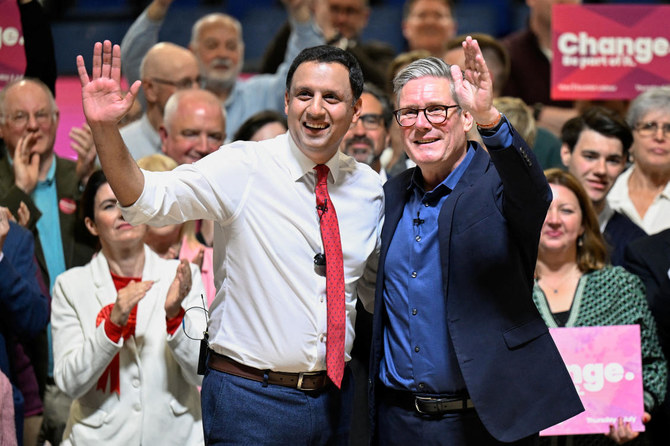
Starmer, 61, criss-crossed the UK in a bid to shore up Labour support and warn against complacency in the campaign’s final hours.
“If you want change, you have to vote for it,” he told reporters at an event in Carmarthenshire, south Wales, where supporters handed out cakes with red ribbons, the color associated with the party.
“I’m not taking anything for granted,” he added, before flying to Scotland on the same plane that took the England football team to the European Championships in Germany.
Sunak, 44, sought to hammer home his oft-repeated warnings that a Labour government would mean tax rises and weaker national security — jibes that Labour has branded a desperate attempt to cling to power.
The Tories also stepped up their warnings to voters to stop the prospect of Labour winning a “supermajority,” which Labour fears is intended to hit turnout.
Sunak ally Mel Stride, the work and pensions secretary, said Wednesday the electorate would “regret” handing Labour “untrammelled” power without an effective Tory opposition.
“If you look at the polls, it is pretty clear that Labour at this stage are heading for an extraordinary landslide on a scale that has probably never, ever been seen in this country before,” he told right-wing broadcaster GB News.
But ex-PM Boris Johnson — ousted by his own colleagues, including Sunak, in 2022 — staged his first major intervention of the campaign Tuesday, urging supporters not to see the result as a “foregone conclusion.”
Labour has enjoyed a consistent 20-point lead in the polls over the past two years with many voters dissatisfied at the Conservatives’ handling of a range of issues including public services, immigration and the economy.
Several surveys predict that Labour will win more than the record 418 seats it won when Tony Blair ended 18 years of Conservative rule in 1997.
Labour requires at least 326 seats to secure a majority in the 650-seat parliament.
Voters head to the polls from 7:00 am (0600 GMT), with results expected to start dropping from about 2230 GMT late Thursday into Friday morning.
The vote is Britain’s first July election since 1945, when Labour under Clement Attlee defeated the Conservatives of World War II leader Winston Churchill, ushering in a period of transformational social change.
Attlee’s government created the modern welfare state, including the state-run National Health Service (NHS), Britain’s most cherished institution after the royal family.
Starmer’s “change” agenda is not so radical this time around and promises cautious management of the economy, as part of a long-term growth plan that includes nursing battered public services back to health.
A Labour government would face a formidable to-do list, ranging from spurring anaemic growth to ending NHS strikes and improving post-Brexit ties with Europe.
Some voters simply eye a respite from politics after a chaotic period of five prime ministers, a succession of scandals and Tory infighting between centrists and right-wingers that shows no sign of abating.
The Sun called the Conservatives a “divided rabble, more interested in fighting themselves than running the country,” adding: “It is time for a change.”
Starmer — the working-class son of a tool maker and a nurse — has none of the political charisma or popularity of former leader Blair, who presided over that last Labour victory in 2005.
But the former human rights lawyer and chief public prosecutor stands to gain from a country fed up with the Tories, and a feeling of national decline.
Arch-Euroskeptic Nigel Farage hopes the discontent will see him elected an MP at the eighth time of trying, while the Liberal Democrats are expected to gain dozens of seats.


![]()

Labour predicted to oust Tories in UK election
Short Url
https://arab.news/n2fne
Labour predicted to oust Tories in UK election
- Polls overwhelmingly predict that Labour will win its first general election since 2005
- Prime Minister Rishi Sunak insisted he was still “fighting hard”


Latest updates


© 2026 SAUDI RESEARCH & PUBLISHING COMPANY, All Rights Reserved And subject to Terms of Use Agreement.