DEIR EL-BALAH, Palestinian Territories: Wafaa Elwan’s five-year-old son cannot sleep in the Gaza tent city where she and her seven children shelter, but it is not the guns of war that cause his daily nightmare.
“My son can’t sleep through the night because he can’t stop scratching his body,” the anxious mother said.
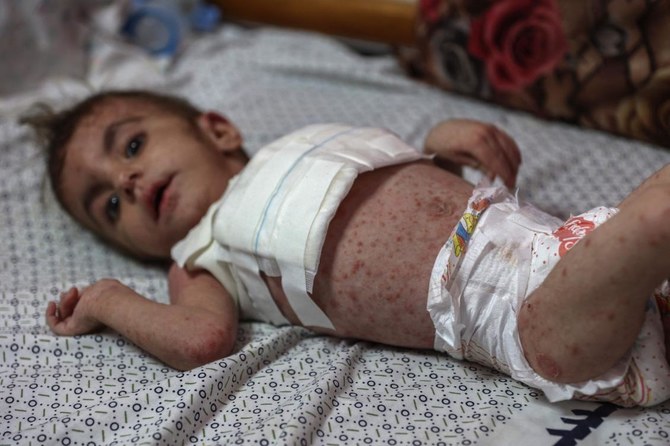
The boy has white and red blotches over his feet and legs, and more under his T-shirt. He is one of many Gazans suffering from skin infections ranging from scabies to chicken pox, lice, impetigo and other debilitating rashes.
More than 150,000 people in the Palestinian territory have contracted skin diseases in the squalid conditions into which displaced Gazans have been forced since the Israel-Hamas war erupted on October 7, according to the World Health Organization.
“We sleep on the ground, on sand where worms come out underneath us,” said Elwan. Her family is one of thousands living on a sandy patch near the sea close to the central Gaza city of Deir Al-Balah.
Elwan believes infections are inevitable. “We cannot bathe our children as before. There are no hygiene and sanitary products for us to wash and clean the place. There’s nothing.”
Parents used to tell their children to wash in the Mediterranean. But pollution that has built up as war has devastated basic facilities has accentuated the risk of disease.
“The sea is all sewage. They even throw garbage and baby napkins into the sea,” she said.
The WHO has reported 96,417 cases of scabies and lice since the start of the war in Gaza, 9,274 cases of chickenpox, 60,130 cases of skin rashes and 10,038 impetigo cases.
Scabies and chickenpox are particularly widespread in the coastal Palestinian territory, according to Sami Hamid, a pharmacist who runs a makeshift clinic in the Deir Al-Balah camp.
Two boys in the clinic showed dozens of the distinctive chickenpox-induced blisters and scabs spread over their hands, feet, backs and stomachs.
Lacking medicines, Hamid, 43, himself displaced, rubbed a calamine lotion on the boys’ skin to soothe the itching.
Children’s skin suffers from “the hot weather and the lack of clean water,” he said.
Mohammed Abu Mughaiseeb, the medical coordinator in Gaza for Doctors Without Borders (MSF), said that children are vulnerable because “they are children — they play outside, they’ll touch anything, eat anything without washing it.”
Abu Mughaiseeb said hot weather increases the sweat and accumulation of dirt that causes rashes and allergies, which if scratched lead to infections.
“People are not living in houses anymore, there is no proper hygiene,” he said.
MSF doctors fear the appearance of other skin conditions such as leishmaniasis, which can be fatal in its most virulent form.
Gaza’s children are already highly vulnerable to disease, he said, because their immune systems are compromised by malnutrition.
Hamid, the pharmacist, said his team visited a makeshift school recently, where 24 out of 150 students had scabies.
“Some of them have developed skin infections, and unfortunately these infections are spreading among them,” Ola Al-Qula, a teacher at one makeshift tent school, said.
Other diseases have also rampaged through camps for the displaced, feeding on the poor hygiene, the WHO warned.
“The toilets here are primitive, draining into channels among tents, which ultimately contributes to the spread of epidemics,” said Hamid.
WHO said 485,000 cases of diarrhea have been reported.
The United Nations said Tuesday there are now 1.9 million people displaced in Gaza out of a population of some 2.4 million.
The war began with Hamas’s October 7 attack on southern Israel, which resulted in the deaths of 1,195 people, mostly civilians, according to an AFP tally based on Israeli figures.
Israel’s retaliatory offensive has killed at least 37,925 people, also mostly civilians, according to data from the health ministry in Hamas-run Gaza.


![]()

Dangerous skin diseases spreading among Gaza children
Short Url
https://arab.news/mfk56
Dangerous skin diseases spreading among Gaza children
- More than 150,000 people in the Palestinian territory have contracted skin diseases in the squalid conditions into which displaced Gazans have been forced since since the Israel-Hamas war


Latest updates


Recommended


© 2026 SAUDI RESEARCH & PUBLISHING COMPANY, All Rights Reserved And subject to Terms of Use Agreement.