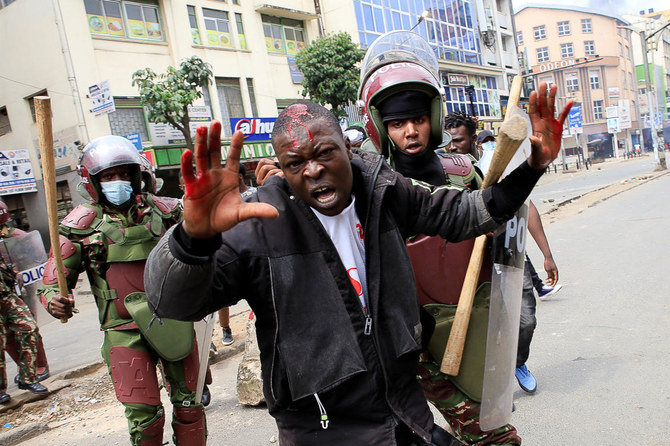
NAIROBI: Kenyan police said they have arrested more than 270 people masquerading as protesters who are suspected of going on a criminal rampage during anti-government rallies on Tuesday.
Widespread looting and property damage was reported during the youth-led demonstrations in various cities across the country, which some protesters said had been infiltrated by “goons.”
“Security forces across the country singled out suspects found engaging in criminal activities in the guise of protesting, and took them to custody,” the Directorate of Criminal Investigations said in a statement posted on X, formerly Twitter, late Tuesday.
It said a total of 204 suspects were arrested in the capital Nairobi and another 68 in various other areas of the country.
“The DCI has further deployed scrupulous investigators across the affected regions to pursue suspects captured on CCTV cameras and mobile phone recordings violently robbing, stealing and destroying properties and businesses of innocent citizens,” the statement added.
Tuesday’s demonstrations began in an atmosphere of calm but later degenerated into violence, with police firing tear gas at rock-throwing crowds in Nairobi and scenes of looting and property damage in the capital and other cities.
“Goons have infiltrated,” prominent Gen-Z protester Hanifa Adan posted on X on Tuesday.
Young Gen-Z Kenyans launched protests last month against a deeply unpopular finance bill that contained a raft of new taxes, adding to the hardship of people already suffering a cost of living crisis.
The Kenya National Commission on Human Rights (KNCHR) said on Monday that 39 people had been killed and 361 injured during two weeks of rallies — with the worst violence occurring in Nairobi on Tuesday last week — and condemned the use of force against demonstrators as “excessive and disproportionate.”
Although President William Ruto later abandoned the finance bill, the protesters are now calling for him to resign in a wider campaign against his rule under the hashtag “RutoMustGo.”
More demonstrations have been called for Thursday and Sunday.
It is the most serious crisis to confront Ruto since he took office in September 2022 in a nation often considered a beacon of stability in a turbulent region.
On Tuesday, Interior Minister Kithure Kindiki denounced what he described as an “orgy of violence,” warning that the government would take action against anyone engaging in “anarchic chaos and cruel plunder.”
“This reign of terror against the people of Kenya and the impunity of dangerous criminal gangs must end at whatever cost,” he said.
In a television interview on Sunday, Ruto denied he had “blood on my hands” after the protester deaths but his calls for dialogue with Kenyan youth about their grievances have not appeased the demonstrators.
Ruto also warned that following the scrapping of the finance bill, the cash-strapped government would now have to borrow more.
The government had said previously that the tax increases were necessary to fill its coffers and service a huge public debt of some 10 trillion shillings ($78 billion), or about 70 percent of GDP.

Kenya police say over 270 arrested for criminal acts during Tuesday protests
Short Url
https://arab.news/4a6p8
Kenya police say over 270 arrested for criminal acts during Tuesday protests
- Widespread looting and property damage was reported during the youth-led demonstrations in various cities across the country
- Demonstrations began in an atmosphere of calm but later degenerated into violence, with police firing tear gas at rock-throwing crowds in Nairobi
US, Japan defense chiefs say China harming regional peace
- Japan’s top envoy: China ‘disseminating information that is completely contrary to the facts’ about the radar incident
TOKYO: Beijing’s actions are “not conducive to regional peace,” Japan’s defense minister and US counterpart Pete Hegseth agreed during a call after Chinese aircraft locked radar on Japanese jets near Taiwan, Tokyo said Friday.
The December 6 radar incident came after comments by Prime Minister Sanae Takaichi on Taiwan that infuriated China.
It was followed this week by Chinese-Russian air patrols around Japan.
Hegseth and Shinjiro Koizumi “exchanged candid views on the increasingly severe security situation in the Indo-Pacific region, including the radar incident,” the Japanese defense ministry said after the call.
They “expressed serious concern over any actions to increase regional tensions, as China’s actions are not conducive to regional peace and stability,” the statement added.
Koizumi said on X that he told Hegseth that China was “disseminating information that is completely contrary to the facts” about the radar incident.
“However, Japan has made clear that it does not seek escalation and that we are responding calmly while making necessary rebuttals, and we are keeping the door open for dialogue,” Koizumi added.
Hegseth’s office said that they “discussed... China’s military activities” among other issues including “Japan’s efforts to increase its defense spending and strengthen its capabilities.”
“Secretary Hegseth and Defense Minister Koizumi reaffirmed the importance of the US-Japan Alliance and underscored their commitment to deterring aggression in the Asia-Pacific,” the US statement added.
‘Tactical exercises’
Takaichi had suggested on November 7 that Japan would intervene with military force in any Chinese attack on Taiwan, which Beijing claims as its own and has not ruled out seizing by force.
Last week, J-15 jets from China’s Liaoning aircraft carrier twice locked radar on Japanese aircraft that had scrambled in international waters near Okinawa, according to Japan.
Fighter jets use their radar for fire control to identify targets as well as for search and rescue operations.
But China’s foreign ministry on Wednesday accused Japan of sending the jets “to intrude into the Chinese training area without authorization, conduct close-range reconnaissance and harassment, create tense situations, and... maliciously hype up the situation.”
On Tuesday two Russian Tu-95 nuclear-capable bombers flew from the Sea of Japan to rendezvous with two Chinese H-6 bombers in the East China Sea, then conducted a joint flight around the country, Japan said.
Japan said that it scrambled fighter jets in response.
A day later, Japan and the United States air forces conducted their own joint air drills, Tokyo said.
The “tactical exercises” over the Sea of Japan involved two US B52 bombers, three Japanese F-35 fighter jets and three Japanese F-15s, Tokyo said.
South Korea said Tuesday that Russian and Chinese warplanes also entered its air defense zone, with Seoul also deploying fighter jets that same day.
Beijing confirmed on Tuesday that it had organized drills with Russia’s military according to “annual cooperation plans.”
Moscow also described it as a routine exercise, saying it lasted eight hours and that some foreign fighter jets followed the Russian and Chinese aircraft.
The December 6 radar incident came after comments by Prime Minister Sanae Takaichi on Taiwan that infuriated China.
It was followed this week by Chinese-Russian air patrols around Japan.
Hegseth and Shinjiro Koizumi “exchanged candid views on the increasingly severe security situation in the Indo-Pacific region, including the radar incident,” the Japanese defense ministry said after the call.
They “expressed serious concern over any actions to increase regional tensions, as China’s actions are not conducive to regional peace and stability,” the statement added.
Koizumi said on X that he told Hegseth that China was “disseminating information that is completely contrary to the facts” about the radar incident.
“However, Japan has made clear that it does not seek escalation and that we are responding calmly while making necessary rebuttals, and we are keeping the door open for dialogue,” Koizumi added.
Hegseth’s office said that they “discussed... China’s military activities” among other issues including “Japan’s efforts to increase its defense spending and strengthen its capabilities.”
“Secretary Hegseth and Defense Minister Koizumi reaffirmed the importance of the US-Japan Alliance and underscored their commitment to deterring aggression in the Asia-Pacific,” the US statement added.
‘Tactical exercises’
Takaichi had suggested on November 7 that Japan would intervene with military force in any Chinese attack on Taiwan, which Beijing claims as its own and has not ruled out seizing by force.
Last week, J-15 jets from China’s Liaoning aircraft carrier twice locked radar on Japanese aircraft that had scrambled in international waters near Okinawa, according to Japan.
Fighter jets use their radar for fire control to identify targets as well as for search and rescue operations.
But China’s foreign ministry on Wednesday accused Japan of sending the jets “to intrude into the Chinese training area without authorization, conduct close-range reconnaissance and harassment, create tense situations, and... maliciously hype up the situation.”
On Tuesday two Russian Tu-95 nuclear-capable bombers flew from the Sea of Japan to rendezvous with two Chinese H-6 bombers in the East China Sea, then conducted a joint flight around the country, Japan said.
Japan said that it scrambled fighter jets in response.
A day later, Japan and the United States air forces conducted their own joint air drills, Tokyo said.
The “tactical exercises” over the Sea of Japan involved two US B52 bombers, three Japanese F-35 fighter jets and three Japanese F-15s, Tokyo said.
South Korea said Tuesday that Russian and Chinese warplanes also entered its air defense zone, with Seoul also deploying fighter jets that same day.
Beijing confirmed on Tuesday that it had organized drills with Russia’s military according to “annual cooperation plans.”
Moscow also described it as a routine exercise, saying it lasted eight hours and that some foreign fighter jets followed the Russian and Chinese aircraft.
© 2025 SAUDI RESEARCH & PUBLISHING COMPANY, All Rights Reserved And subject to Terms of Use Agreement.