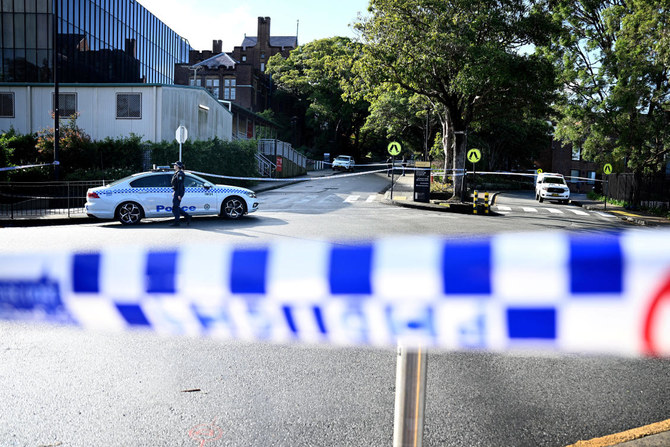
MELBOURNE: A state government minister said on Wednesday a 14-year-old boy accused of stabbing a student at the University of Sydney has faced charges that were dismissed by a court, while newspapers reported he was accused of threatening to shoot fellow students.
The boy remained at a Sydney hospital for a mental health assessment the day after the early Tuesday attack, New South Wales Police Minister Yasmin Catley said.
“We have to make sure that we wrap services and support around these kids who are being radicalized online and their families,” Catley told Australian Broadcasting Corp.
Police say the boy took a bus from the site of the stabbing to the hospital seeking treatment for a cut on his hand. He was arrested at the hospital.
The 22-year-old student who was stabbed once in the neck was discharged from the same hospital overnight, Catley said.
The boy wore miltary clothing and used a kitchen knife in the attack, police allege.
Catley said the suspect was charged by police last year and a court dismissed the charges. She added that he had been attending a Department of Communities and Justice program, which news media have described as a deradicalization program.
Sydney’s The Daily Telegraph newspaper reported, citing unnamed sources, that the suspect was charged last year with threatening to shoot fellow students at his Sydney school and with threatening to engage in self-harm, but a magistrate dismissed the charges in February on mental health grounds.
Police have yet to determine a motive or file charges.

Boy accused of stabbing student at Sydney university has faced previous charges, officials say
https://arab.news/rdkj4
Boy accused of stabbing student at Sydney university has faced previous charges, officials say
- Suspect remains at a Sydney hospital for a mental health assessment the day after the early Tuesday attack
- He was charged last year with threatening to shoot fellow students and with threatening to engage in self-harm
Fossils of ‘Java Man,’ first known Homo erectus, return to Indonesia
- Netherlands to repatriate more than 28,000 items in Dubois collection in 2026
- Fossils excavated in Indonesia were ‘removed against will of people’
JAKARTA: Prehistoric bones belonging to “Java Man” — the first known fossil evidence of Homo erectus — went on display at Indonesia’s National Museum on Thursday, more than 130 years after they were taken to the Netherlands during Dutch colonial rule.
The parts of the skeleton — a skull fragment, molar and thigh bone — were uncovered along the Bengawan Solo River on Java island in the late 19th century by Dutch anatomist and geologist Eugene Dubois.
The three items, and a related shell that was scratched by early Homo erectus, are the first in the planned repatriation of more than 28,000 fossils and natural history objects originating in Java and Sumatra that Dubois had removed.
“Repatriation is a national priority,” Indonesian Culture Minister Fadli Zon said during an official handover ceremony in Jakarta.
“We bear the responsibility to protect cultural heritage, restore historical narratives and ensure public access to the cultural and scientific heritage that belongs to Indonesia.”
Fossils of the Java Man, which was hand-carried in a GPS-tracked, climate-controlled suitcase with a diplomatic seal, were some of the first pieces of evidence showing links between apes and humans.
The fossils are part of the larger Dubois collection that was managed by Naturalis Biodiversity Center, a 200-year-old scientific institution in Leiden.
The rest of the collection will be transferred to Indonesia in 2026, the Dutch Embassy in Jakarta said in a statement, adding that Indonesia’s National Research and Innovation Agency will take a lead role in preserving and managing the items.
“This handover marks the beginning of the next phase. We intend to repatriate thousands of items excavated in Indonesia over 130 years ago,” said Marcel Beukeboom, general director of Naturalis Biodiversity Center.
“This fossil bears witness to an important link in human evolution, while also representing part of Indonesian history and cultural heritage,” he said.
Jakarta started to campaign for the Dutch government to return stolen Indonesian artifacts after declaring independence in 1945, but the Netherlands started to return stolen items only in small numbers in the 1970s.
Recent efforts by the Indonesian Repatriation Committee have brought back home hundreds of artifacts since 2023, bringing the number to more than 2,000 items so far.
The repatriation of the Dubois collection was first announced in September, following recommendation by the Netherlands’ Colonial Collections Committee.
“The Colonial Collections Committee has concluded … that the Dutch state never owned the Dubois collection,” the Dutch government said in a news release issued at the time.
“The committee believes that the circumstances under which the fossils were obtained means it is likely they were removed against the will of the people, resulting in an act of injustice against them.
“Fossils held spiritual and economic value for local people, who were coerced into revealing fossil sites.”
The returned fossils are now a centerpiece of “Early History,” a new permanent exhibit at the National Museum in Jakarta that opened to the public on Thursday.
It explores the history of human civilization throughout Indonesia, with displays including a replica of one of the world’s oldest cave paintings from South Sulawesi and inscriptions from the 4th-century Hindu Kutai Martadipura Kingdom in East Kalimantan.


