

Iran’s presidential candidates discuss economic sanctions and nuclear deal ahead of July 5 runoff

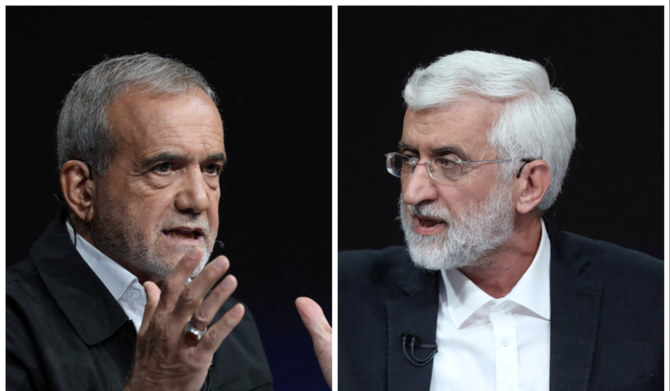
Masoud Pezeshkian (L) and Saeed Jalili attend an election debate at a television studio in Tehran, Iran July 2, 2024. (REUTERS)
Short Url
Updated 03 July 2024
Follow

Iran’s presidential candidates discuss economic sanctions and nuclear deal ahead of July 5 runoff

  • Pezeshkian’s hard-line competitor Jalili, who strongly opposed the 2015 deal, said during Tuesday’s debate that the US must honor its commitments on par “with the commitments we fulfilled”

TEHRAN, Iran: Iranian presidential candidates on Tuesday discussed the impact of economic sanctions imposed on their country by the United States and other Western nations and presented their proposals for reviving a nuclear deal with world powers.
It was the second — and last — live debate on state television pitting little-known reformist Masoud Pezeshkian and Saeed Jalili, a hard-line former nuclear negotiator, ahead of Friday’s runoff election in which voters will choose a successor for the late President Ebrahim Raisi, who died last month in a helicopter crash.
Pezeshkian, a cardiac surgeon, said that sanctions imposed by the West have badly hurt Iran’s economy. He cited a 40 percent inflation over the past four years and the increasing poverty rates. “We live in a society in which many are begging on the streets,” he said, adding that his administration would “immediately” work to try to get sanctions lifted and vowed to “repair” the economy.
As he did the day before, Pezeshkian said he would find a solution to revive a nuclear deal with world powers by discussing the plan with the country’s parliament and finding possible alternatives. “No government in history has been able to flourish inside a cage,” he said, referring to the impact of sanctions on Iran’s spiraling economy.
Former President Hassan Rouhani, a relative moderate, in 2015 struck a nuclear deal with world powers that capped Iran’s uranium enrichment in return to lifting sanctions but later, in 2018, President Trump pulled the US out from the landmark deal abruptly restoring harsh sanctions on Iran.
Pezeshkian’s hard-line competitor Jalili, who strongly opposed the 2015 deal, said during Tuesday’s debate that the US must honor its commitments on par “with the commitments we fulfilled.” He condemned his opponent for not having any plans for getting sanctions lifted and said he would resume talks about a nuclear deal.
Jalili, who is known as the “Living Martyr” after losing a leg in the 1980s Iran-Iraq war and is famous among Western diplomats for his haranguing lectures and hard-line stances, also pledged to support the country’s stock exchange market by providing insurance to stocks as well as financial support to local industries.
Both candidates pledged to revive the economy, provide energy subsidies to poor people and facilitate importing cars while supporting the domestic auto industry. They did not elaborate on the source of funds they will need to fulfill their promises.
Iran will hold a runoff presidential election Friday, only its second since the 1979 Islamic Revolution, after only 39.9 percent of its voting public cast a ballot the previous week. Of over 24.5 million votes, more than 1 million ballots were later rejected — typically a sign of people feeling obligated to head to the polls but wanting to reject all the candidates.


US military launches strikes in Syria against Daesh fighters after American deaths

Updated 20 December 2025
Follow

US military launches strikes in Syria against Daesh fighters after American deaths

  • “This is not the beginning of a war — it is a declaration of vengeance,” Defense Secretary Pete Hegseth says
  • President Trump earlier pledged “very serious retaliation” but stressed that Syria was fighting alongside US troops

WASHINGTON: The Trump administration launched military strikes Friday in Syria to “eliminate” Daesh group fighters and weapons sites in retaliation for an ambush attack that killed two US troops and an American interpreter almost a week ago.
A US official described it as “a large-scale” strike that hit 70 targets in areas across central Syria that had Daesh (also known as Islamic State or IS) infrastructure and weapons. Another US official, who also spoke on condition of anonymity to discuss sensitive operations, said more strikes should be expected.
The attack was conducted using F-15 Eagle jets, A-10 Thunderbolt ground attack aircraft and AH-64 Apache helicopters, the officials said. F-16 fighter jets from Jordan and HIMARS rocket artillery also were used, one official said.
“This is not the beginning of a war — it is a declaration of vengeance. The United States of America, under President Trump’s leadership, will never hesitate and never relent to defend our people,” Defense Secretary Pete Hegseth said on social media.


President Donald Trump had pledged “very serious retaliation” after the shooting in the Syrian desert, for which he blamed Daesh. The troops were among hundreds of US troops deployed in eastern Syria as part of a coalition fighting the terrorist group.
Trump in a social media post said the strikes were targeting Daesh “strongholds.” He reiterated his support for Syrian President Ahmad Al-Sharaa, who he said was “fully in support” of the US effort to target the militant group.
Trump also offered an all-caps threat, warning the group against attacking US personnel again.
“All terrorists who are evil enough to attack Americans are hereby warned — YOU WILL BE HIT HARDER THAN YOU HAVE EVER BEEN HIT BEFORE IF YOU, IN ANY WAY, ATTACK OR THREATEN THE USA.,” the president added.
The attack was a major test for the warming ties between the United States and Syria since the ouster of autocratic leader Bashar Assad a year ago. Trump has stressed that Syria was fighting alongside US troops and said Al-Sharaa was “extremely angry and disturbed by this attack,” which came as the US military is expanding its cooperation with Syrian security forces.
Syria’s foreign ministry in a statement on X following the launch of US strikes said that last week’s attack “underscores the urgent necessity of strengthening international cooperation to combat terrorism in all its forms” and that Syria is committed “to fighting Daesh and ensuring that it has no safe havens on Syrian territory and will continue to intensify military operations against it wherever it poses a threat.”


Daesh has not claimed responsibility for the attack on the US service members, but the group has claimed responsibility for two attacks on Syrian security forces since, one of which killed four Syrian soldiers in Idlib province. The group in its statements described Al-Sharaa’s government and army as “apostates.” While Al-Sharaa once led a group affiliated with Al-Qaeda, he has had a long-running enmity with Daesh.
Syrian state television reported that the US strikes hit targets in rural areas of Deir ez-Zor and Raqqa provinces and in the Jabal Al-Amour area near Palmyra. It said they targeted “weapons storage sites and headquarters used by Daesh as launching points for its operations in the region.”

Trump this week met privately with the families of the slain Americans at Dover Air Force Base in Delaware before he joined top military officials and other dignitaries on the tarmac for the dignified transfer, a solemn and largely silent ritual honoring US service members killed in action.

President Donald Trump, from left, Defense Secretary Pete Hegseth and Chairman of the Joint Chiefs Air Force Gen. Dan Caine attend a casualty return ceremony at Dover Air Force Base, Delaware, on Dec. 17, 2025,of soldiers who were killed in an attack in Syria last week. (AP)

The guardsmen killed in Syria last Saturday were Sgt. Edgar Brian Torres-Tovar, 25, of Des Moines, and Sgt. William Nathaniel Howard, 29, of Marshalltown, according to the US Army. Ayad Mansoor Sakat, of Macomb, Michigan, a US civilian working as an interpreter, was also killed.
The shooting nearly a week ago near the historic city of Palmyra also wounded three other US troops as well as members of Syria’s security forces, and the gunman was killed. The assailant had joined Syria’s internal security forces as a base security guard two months ago and recently was reassigned because of suspicions that he might be affiliated with Daesh, Interior Ministry spokesperson Nour Al-Din Al-Baba has said.
The man stormed a meeting between US and Syrian security officials who were having lunch together and opened fire after clashing with Syrian guards.
When asked for further information, the Pentagon referred AP to Hegseth’s social media post.