Tunisia sets elections for October. President Kais Saied hasn’t said he will run

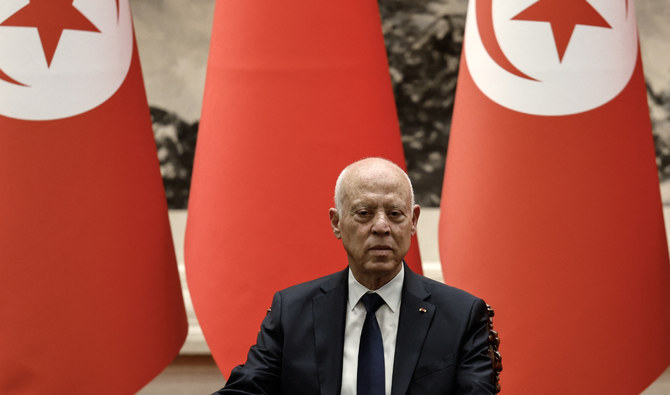
Tunisia’s President Kais Saied. (AFP)
Short Url
Updated 04 July 2024
Follow

Tunisia sets elections for October. President Kais Saied hasn’t said he will run

TUNIS: Tunisia’s increasingly authoritarian leader has scheduled the next presidential election for October without saying whether he will seek a second term after five tumultuous years at the head of the North African nation once seen as a model of democracy for the Arab world.
President Kais Saied set Oct. 6 for the election in a decree issued late Tuesday, according to a statement from the presidency. Saied’s first term ends on Oct. 23.
The election will be voters’ first chance to evaluate Saied’s tenure amid an economic crisis and the drift into authoritarianism.
Saied ran in 2019 on a populist, anti-corruption platform that energized Tunisians disillusioned with party politics and economic stagnation following the Arab Spring pro-democracy protests that in 2011 toppled the country’s longtime dictator.
However, Saied reversed some of Tunisia’s democratic gains, rewriting the constitution to consolidate his power and jailing critics, including from the largest political parties. Analysts expect he will run for a second, five-year term given that the new constitution grants him full powers.
He also dissolved the parliament two years ago after lawmakers of the Ennahda opposition Islamist party held a virtual session seeking to annul his actions in 2021 to assume sweeping powers.
Saied argued at the time that the country was facing “imminent peril” because of protests and economic vows. He has governed the country by decree ever since.
More than 40 of Saied’s critics and political opponents have been jailed in the past year on various charges of conspiring against the country’s security, including the leader of Ennahda, the largest opposition party.
Earlier this year, its leader, Rached Ghannouchi, was sentenced to three years in prison on allegations that his party relied on foreign financing to bankroll its political campaigns in 2019. The sentence was added to Ghannouchi’s 15-month prison term that a different court handed down last year after he was found guilty of supporting terrorism and inciting hatred.
Tunisia’s main opposition coalition has said it won’t take part in the presidential election unless Saied’s political opponents are freed and judicial independence is restored. The National Salvation Front, a coalition of the main opposition parties that includes Ennahdha, has expressed concern that the election wouldn’t be fair
Several other political leaders have announced their candidacy, including the leader of the right-wing Free Destourian Party, Abir Moussi, who is in custody on suspicion of disturbing public order. Lotfi Mraïhi of the Republican Popular Union party, who unsuccessfully ran for the presidency in 2019, is also running, although authorities have issued a warrant against for alleged money laundering.



Syria nears anniversary of Assad’s fall amid renewed ‘deeply troubling’ abuses, UN warns

Updated 05 December 2025
Follow

Syria nears anniversary of Assad’s fall amid renewed ‘deeply troubling’ abuses, UN warns

  • Early steps by interim leadership ‘encouraging but only the beginning’ of long process of accountability, human rights chief says
  • Concern that rising hate speech, both online and on the streets, has intensified violence against Alawite, Druze, Christian, Bedouin communities 

NEW YORK: Syria is days away from marking the first anniversary of the fall of President Bashar Assad’s regime, but the country’s interim authorities face mounting criticism over continuing abuses and a fragile security environment, the UN human rights chief said. 

In a statement on Friday, UN High Commissioner for Human Rights Volker Turk said early steps by the interim leadership, including the creation of national commissions for transitional justice and missing persons, and investigative bodies examining violence in coastal areas and in Suweida, were “encouraging but only the beginning” of a long process of accountability. 

Trials for suspects linked to last year’s coastal violence have begun, and a draft law on transitional justice has been announced. But Turk said the human rights situation remains deeply troubling. 

According to the UN, hundreds of people have been killed over the past year in summary executions, arbitrary killings, and abductions. Victims include members of minority communities and individuals accused of ties to the former government. Deaths were attributed to gunfire, stabbings, blunt-force attacks, shelling, hand grenades and explosive remnants of war. 

The UN said perpetrators include security forces under the interim authorities, armed groups aligned with them, remnants of the former government’s forces, local militias, and unidentified armed actors. 

Investigators also documented reports of sexual violence, arbitrary detention, looting, destruction of homes, forced evictions, and property confiscations, along with restrictions on free expression and peaceful assembly. 

Turk warned that rising hate speech, both online and on the streets, had intensified violence against Alawite, Druze, Christian, and Bedouin communities. 

The past year has also seen repeated Israeli military operations inside Syrian territory, including incursions and the occupation of additional areas. The UN said it had received reports of civilian casualties in a recent Israeli strike near Damascus, along with arrests and home searches carried out during military actions. 

Turk expressed concern that former armed groups have been integrated into new security forces without adequate human rights checks, raising the risk of repeat violations. 

“Proper vetting and comprehensive security sector reform are essential to prevent individuals responsible for serious abuses from entering the security forces,” he said. 

He urged Syria’s interim authorities to ensure independent and transparent investigations into all violations, past and present, and to hold those responsible to account. 

“Accountability, justice, peace, and the security of all Syrians are absolute prerequisites for a successful transition,” Turk said, adding that victims must have access to remedies and reparation. 

The UN Human Rights Office said its Damascus program is supporting efforts to advance inclusive transitional justice and strengthen the rule of law as Syria navigates a post-Assad transition.