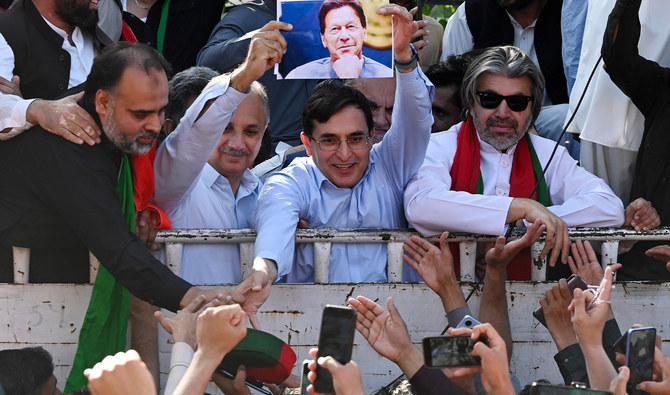

ISLAMABAD: A disgruntled lawmaker from the former Prime Minister Imran Khan-backed opposition has said frustrations with how the Pakistan Tehreek-e-Insaf (PTI) was being run had reached a “breaking point” amid widespread reports at least two dozen lawmakers from the party were considering forming a forward bloc.
Speculations about a forward bloc within the PTI have been widely reported by Pakistani media in recent weeks, with reports suggesting up to 24 lawmakers could break off and form a forward bloc due to the party leaders’ failure to secure Khan’s release from jail and their blocking of access to the imprisoned former cricket star.
Last week, Omar Ayub Khan, the leader of the opposition in the national assembly and a close Khan aide, announced his resignation as PTI’s secretary general in a post on X, intensifying speculation about an internal rift within the party. PTI lawmaker Sher Afzal Marwat has recently demanded the resignation of PTI Senator Shibli Faraz, accusing him of preventing access to Khan. Lawmaker Junaid Akbar also resigned from the party’s core committee last week.
Khan has been in jail since August last year and faces a string of legal cases. At least four court convictions against him ruled the 71-year-old out of the February general elections as convicted felons cannot run for public office under Pakistani law. Arguably Pakistan’s most popular politician, Khan says all cases against him are motivated to keep him out of politics.
“Despite being members of the party’s core committee, we were unable to meet Imran Khan [in jail] and a few individuals repeatedly meet with him and come out narrating Khan’s decisions which always suit them but not the party or its supporters,” Junaid, who resigned from the PTI core committee last month, told Arab News in an interview this week.
He said party leaders were “under a lot of pressure” from supporters and their “frustration” with the situation had reached a “breaking point.”
“Many of us share these reservations, but we are not forming a forward bloc,” Junaid said. “However, we will not bear public criticism for decisions made by a certain group of individuals.”
He lamented that party members except a select few were not allowed to visit Khan in jail, and decisions were “imposed” on them in the name of the party founder.
Most meetings with Khan are held by PTI Chairman Gohar Khan, who is also his lawyer, and a few others in the party.
Junaid said many others in the PTI were also ready to resign like him over lack of access to Khan and not being involved in party decision-making, without naming the members.
“Party is being run like a public limited company. Our question is: why are these people favored? Do they have more contribution to the party than us?” Junaid said.
“The people who are favored and given high posts in the party haven’t done anything for Khan’s release.”
To ascertain the party’s stance, Arab News reached out to several party leaders including Gohar Khan, Omar Ayub Khan, close Khan aide Asad Qaiser, and Secretary Information Raoof Hassan. Hassan declined to comment while the others did not respond to Arab News queries.
“ONLY KHAN”
A former member of Khan’s cabinet who left the party last year, Fawad Chaudhry, said although rifts within the party were evident, the forward bloc would have little impact as the PTI’s support base was tied to Imran Khan.
He said the current leadership led by Gohar Khan lacked “political stature” and had been unable to maintain party unity.
“Their insecurities have led them to restrict access to Khan, resulting in limited meetings and controlled information flow,” told Arab News.
“These issues [within the party] have surfaced because of their inability to manage the party effectively,” Chaudhry added. “Only Khan has the capacity to control and unify the party.”
Ahmed Bilal Mahboob, president of the Islamabad-based political think tank, the Pakistan Institute of Legislative Development and Transparency, endorsed Chaudhry’s view, saying the popularity of the PTI and its elected representatives “solely” depended on Khan.
“A forward block is not legally sustainable in our system and I doubt if deserters of the party will have any future,” he told Arab News.
“It is quite normal to have differences within a large political party especially when its prime unifying force, its leader, has been imprisoned for about a year, its officeholders are under pressure from police and intelligence agencies and there is a likelihood that agents of intelligence agencies are subverting the party from within.”
Mehboob advised the PTI to develop a “robust policy-making mechanism” and demonstrate that the leadership was “strongly backed” by Khan to ensure discipline in the party.
Following his removal from office in a parliamentary vote of no-trust, Khan and his PTI have been facing a state crackdown which intensified after May 2023 when the former prime minister was briefly arrested in a land graft case, leading his supporters to pour out on the streets in protests, rampaging government and military properties.
Though Khan was released in less than 48 hours, thousands of party supporters and leaders were arrested, with more than 100 being tried in military courts.