

Pakistan sets up National Emergencies Operation Center as monsoon begins

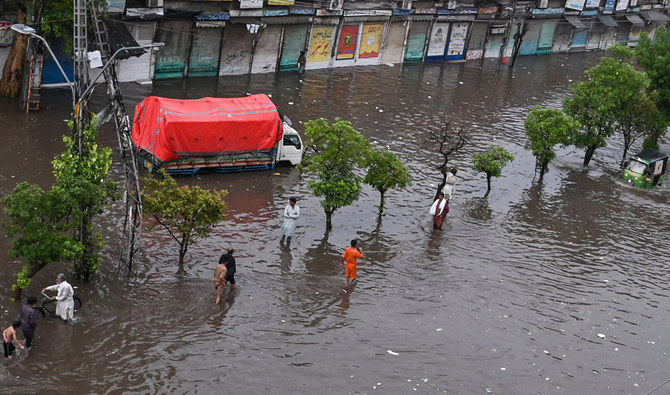
ommuters make their way through a flooded street after a heavy rainfall near row of shops in Lahore on July 1, 2024. (AFP)
Short Url
Updated 01 July 2024
Follow

Pakistan sets up National Emergencies Operation Center as monsoon begins

  • Public advised to download “Pak NDMA Disaster Alert” mobile app for timely alerts
  • Disaster authority issues precautionary measures against urban flooding in cities

ISLAMABAD: Pakistan’s top disaster management authority has established a National Emergencies Operation Center (NEOC) in anticipation of intense cloud bursts and moderate to heavy rainfall expected to start tomorrow, Tuesday, as the country enters the monsoon season.

A statement from the PM office said on Monday the NEOC would use latest tools and technologies, including real-time satellite feeds, to anticipate disasters up to three months in advance and was run by a multidisciplinary team of experts employing the power of geographic information systems (GIS), remote sensing, climatology, meteorology, seismology, hydrology, and data sciences to monitor and analyze global and local hazards.

“NEOC has been reported a significant activity from the eastern Indian side, indicating intense cloud bursts that may hit Pakistani areas,” the PM Office said on Monday.

“Repeated early warnings have been shared with all provinces, and rainfall is likely to start over the upper catchments of all major rivers particularly Sutlej, Ravi and Chenab from July 2, 2024.”

The disaster management authority had also issued an alert regarding lightning expected in different cities of Punjab and the federal capital, Islamabad, during July 5-7, which could lead to rapid rises in water levels, flash flooding events, and urban flooding in metropolitan areas, the statement said. 

” NDMA warns that the anticipated rainfall poses a significant risk of low to medium level flooding in River Sutlej, with water levels expected to reach low flood levels (approximately 50,000 cusecs) by July 5 and high flood levels (approximately 120,000 cusecs) by July 10,” the PM Office added.

The disaster management authority has been working closely with the federal and provincial departments to ensure preparedness and response to any potential emergency, the statement said, advising the public to remain vigilant and follow instructions from local authorities as well as download the “Pak NDMA Disaster Alert” for timely alerts, weather reports and flood updates.

“Protect yourself from floodwater, avoid contact with it, which may be contaminated or contain debris or electrical wires,” it added. “Develop an evacuation plan with your family, identify a safe location, and create an emergency kit with essential supplies.”

The disaster management authority also advised travelers to avoid unnecessary travel in case of heavy rainfalls and likely floods.

Pakistan is consistently ranked among the world’s worst-affected countries from climate change. Unprecedented rainfall and melting of glaciers in June 2022 triggered massive floods across the country that killed nearly 1,700 people and inflicted damages worth $3 billion. Scientists and experts attributed the floods to the adverse effects of climate change. 

Pakistan also went through a severe heat wave in May and June, which saw temperatures in some regions rise to above 50 degrees Celsius.


Pakistan mulls 'Super App' for public services, document verification in major technology push

Updated 15 February 2026
Follow

Pakistan mulls 'Super App' for public services, document verification in major technology push

  • Pakistan has been urging technology adoption in public, private sectors as it seeks to become a key tech player globally
  • The country this month launched the Indus AI Week to harness technology for productivity, skills development and innovation

KARACHI: Pakistan is planning to launch a “Super App” to deliver public services and enable digital document verification, the country's information technology (IT) minister said on Sunday, amid a major push for technology adoption in public and private sectors.

Pakistan, a country of 240 million people, seeks to become a key participant in the global tech economy, amid growing interest from governments in the Global South to harness advanced technologies for productivity, skills development and innovation.

The country's information and communications technology (ICT) exports hit a record $437 million in Dec. last year, according to IT Minister Shaza Fatima Khawaja. This constituted a 23% increase month on month and a 26% increase year on year.

Pakistan's technology sector is also advancing in artificial intelligence (AI) and cloud computing, marked by the launch of Pakistan’s first sovereign AI cloud in November, designed to keep sensitive data domestic and support growth in the broader digital ecosystem.

“In developed countries, citizens can access all government services from a mobile phone,” Fatima said, announcing plans for the Super App at an event in Karachi where more than 7,000 students had gathered for an AI training entrance test as part of the ‘Indus AI Week.’

“We will strive to provide similar facilities in the coming years.”

Khawaja said the app will reduce the need for in-person visits to government offices such as the National Database and Registration Authority (NADRA) and the Higher Education Commission (HEC).

The Indus AI Week initiative, which ran from Feb. 9 till Feb. 15. was aimed at positioning Pakistan as a key future participant in the global AI revolution, according to the IT minister.

At the opening of the weeklong initiative, Prime Minister Shehbaz Sharif announced that Pakistan would invest $1 billion in AI by 2030 to modernize the South Asian nation’s digital economy.

“These initiatives aim to strengthen national AI infrastructure and make the best use of our human resource,” Khawaja said, urging young Pakistanis to become creators, inventors and innovators rather than just being the consumers of technology.