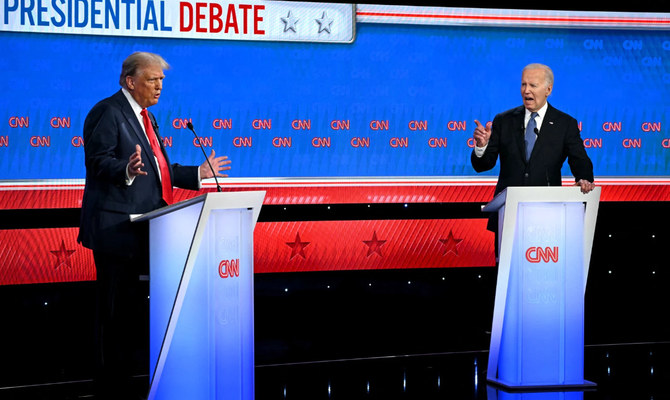

President Joe Biden’s train-wreck debate with Republican opponent Donald Trump followed a series of decisions by his most senior advisers that critics now point to as wrong-headed, interviews with Democratic allies, donors and former and current aides show.
Trump, 78, repeated a series of well-worn, glaring falsehoods during the 90-minute debate on Thursday, including claims that he actually won the 2020 election.
Biden, 81, failed to refute them and his fumbling, halting performance has sparked calls from Democrats for him to end his quest for a second term and for “soul-searching” or resignations among top aides.
“My only request was make sure he’s rested before the debate, but he was exhausted. He was unwell,” said one person who said they appealed to Biden’s top aides in the days before, to no avail. “What a bad decision to send him out looking sick and exhausted.”
Others were even more pointed.
“It is my belief that he was over-coached, over-practiced. And I believe [senior aide] Anita Dunn... put him in a venue that was conducive for Trump and not for him,” said John Morgan, a Florida-based attorney and major Biden fundraiser.
Morgan suggested Dunn and other aides “be fired forever and never let back anywhere near the campaign.”
Biden’s debate strategy was signed off on by campaign chair Jen O’Malley Dillon, who helped him win in 2020 and was appointed in January to boost an uneven reelection campaign. Dunn, a longtime Biden aide and former Barack Obama campaign strategist, backed that strategy.
Confidence going into the event was high. Trump was convicted of falsifying documents by a jury in New York on May 31, while Biden held back-to-back visits in Europe.
To the surprise of some Biden aides, his stubbornly low poll numbers began to inch up nationally in the weeks that followed.
Advisers set up a rigorous debate prep calendar, with Biden sequestered at Camp David for six days.
An inner circle, some close to Biden for decades, were involved: Ron Klain, his first White House chief of staff, Dunn, former White House counsel and Dunn’s husband Bob Bauer and long-time adviser Mike Donilon, as well as about a dozen other policy and political experts.
Biden’s campaign said on Friday that no staff shake-up was under consideration. A spokesman for Dunn said multiple aides were involved in the preparation, and noted that Morgan was not there.
In an email to supporters Saturday, O’Malley Dillon said internal polls and focus groups showed no change in voters’ opinions in battleground states after the debate. She warned “overblown media narratives” may drive “temporary dips in the polls,” but said she was confident Biden would win in November.
FACTS AND ZINGERS
Biden’s trips abroad, especially to France earlier this month, generated Republican social media clips poking fun at his age but, his team believed, it also showed him as a strong leader on an international stage.
White House aides who traveled with the president were in a good mood as he headed to Camp David on June 21. They believed Biden was going into the debate with the most precious political asset: momentum, the wind at his back.
Biden had flown to France, back to the United States, to Italy, and to the West Coast, among other travels, over a 14-day period before taking just a few days to rest at his vacation home in Rehoboth Beach, Delaware.
He was dragging, according to several people who observed him during this period.
As Biden and his aides settled in at Camp David six days before the debate, aides figured he had a lot to accomplish, more than his opponent. Trump could just complain about the present administration — and Biden would need the facts and some zingers at his fingertips.
They expected Trump would be far more disciplined and prepared than he had been in 2020 and believed that they would need to counter a string of rapid-fire lies.
In lengthy prep sessions, they peppered Biden with details, then followed them up with mock debates.
Critics say now that the preparation should have focused on the bigger vision he needs to sell to the country, and that Biden had insufficient rest headed into the debate.
Run down, Biden would also catch a small cold, White House aides said, as he has regularly during his term after long stretches of time zone-bending work.
The result, critics say, was candidate Biden at his worst: He appeared on stage with his face wan, his hair straggly at his collar and his voice hoarse. He was frequently incoherent.
“I’ve never seen him perform that way before,” said Michael LaRosa, former special assistant to President Biden and press secretary for first lady Jill Biden.
“He can run circles around most people on matters of complex policy,” LaRosa said. “This was always going to be a matter of presentation and cosmetics, and superficial judgments that were going to be made about his performance. And he wasn’t able to clear the bar.”
NEW DEBATE FORUM
Earlier this year, some Biden aides discussed whether he should debate Trump at all, arguing that it could give Trump a broad public platform that would disadvantage Biden.
Then Biden himself, in an April interview with shock jock Howard Stern, delivered a decision on debating Trump that was a surprise to some advisers. “I am, somewhere,” he said.
The triumphant memory of his State of the Union address in March fresh in their minds, Biden’s team geared up to debate but took radical steps to control the terms.
They decided to reject three long-scheduled presidential debates in September and October organized by the Commission on Presidential Debates, still smarting over the group’s handling of the 2020 debates.
Trump repeatedly violated the rules of what would be a chaotic first debate in 2020, showing up despite having tested positive for COVID-19, and talking over Biden relentlessly.
His team tried to set the contest on their own terms, with what they saw as a more pliant host in CNN. No audience cheering Trump’s invective. Networks and moderators inclined to challenge Trump. No Robert F. Kennedy Jr. A mute button.
The day after the debate, Biden bounced back with a forceful speech in North Carolina, and a pledge to keep going. Many donors and Democrats are rallying around him.
But the damage has been done.
Asked on Sunday whether the Democratic Party was discussing a new 2024 candidate, Maryland Congressman Jamie Raskin told MSNBC: “There are very honest and serious and rigorous conversations taking place at every level of our party, because it is a political party and we have differences in point of view.”
Raskin added: “Whether he’s the candidate or someone else is the candidate, he’s going to be the keynote speaker at our convention.”