


WASHINGTON: Top Democrats on Sunday ruled out the possibility of replacing President Joe Biden as the Democratic nominee after a feeble debate performance and called on party members to focus instead on the consequences of a second Donald Trump presidency.
After days of hand-wringing about Biden’s poor night on stage debating Trump, Democratic leaders firmly rejected calls for their party to choose a younger presidential candidate for the Nov. 5 election.
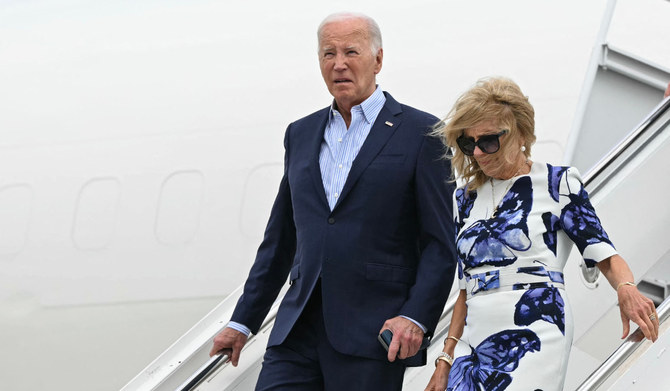
Biden, 81, meanwhile, was huddling with family members at the Camp David presidential retreat on Sunday.
The New York Times cited people close to the situation as saying that Biden’s family were urging him to stay in the race and keep fighting. The paper said some members of his clan privately expressed exasperation at how his staff prepared him for Thursday night’s event.
A drumbeat of calls for Biden to step aside has continued since Thursday and a post-debate CBS poll showed a 10-point jump in the number of Democrats who believe Biden should not be running for president, to 46 percent from 36 percent in February.
“The unfortunate truth is that Biden should withdraw from the race, for the good of the nation he has served so admirably for half a century,” the Atlanta Journal-Constitution said in an editorial on Sunday. “The shade of retirement is now necessary for President Biden.”
Democratic leaders rejected this.
“Absolutely not,” responded Georgia Democratic Senator Raphael Warnock, one of several Democrats seen as a possible replacement for Biden.
“Bad debates happen,” he told NBC’s Meet the Press program. “The question is, ‘Who has Donald Trump ever shown up for other than himself and people like himself?’ I’m with Joe Biden, and it’s our assignment to make sure that he gets over the finish line come November.”
House of Representatives Democratic leader Hakeem Jeffries, who could become speaker next year if his party can take control of the House in November, acknowledged that Biden had suffered a setback, but this was “nothing more than a setup for a comeback.”
“So the moment that we’re in right now is a comeback moment,” he told MSNBC.
Senator Chris Coons of Delaware, a leading Biden surrogate, told ABC’s This Week program Biden needed to stay in the race to ensure Trump’s defeat.
“I think he’s the only Democrat who can beat Donald Trump,” Coons said.
RASKIN SOUNDS LESS CERTAIN
With Democratic leaders rallying around him, it will be up to Biden to decide whether he wants to end his re-election bid.
But other Democrats held open the possibility of choosing a different presidential candidate.
Representative Jamie Raskin, a prominent Democrat in Congress, told MSNBC that “very honest and serious and rigorous conversations” were taking place within the party.
“Whether he’s the candidate or someone else is the candidate, he’s going to be the keynote speaker at our convention. He will be the figure that we rally around to move forward,” Raskin said.
During the debate, a hoarse-sounding Biden delivered a shaky, halting performance in which he stumbled over his words on several occasions. Some Democrats later said privately that the showing could prove to be a disqualifying factor.
For his part in the debate, Trump made a series of well-worn falsehoods, including claims that migrants have carried out a crime wave, that Democrats support infanticide and that he actually won the 2020 election.
Trump’s daughter-in-law Lara, co-chair of the Republican National Committee, told Fox News that Trump was feeling “great” after “probably the best debate of his political career.”
Biden headed to Camp David after a frenzied run of seven campaign events across four states following the debate.
While the Camp David trip had been planned for months, the timing and circumstances of Biden being surrounded by family members who have weighed heavily in his past decisions to run for the presidency have added to the scrutiny around the visit.
Two people familiar with the scheduling said the gathering would include a family photo shoot. The attendees include his wife Jill, as well as the Biden children and grandchildren.
The New York Times said one of the strongest voices imploring Biden to resist pressure to drop out was his son Hunter, who on June 11 became the first child of a sitting president to be convicted of a felony after a jury found him guilty of lying about illegal drug use when he purchased a handgun in 2018.
DNC Chairman Jaime Harrison and Biden campaign manager Julie Chavez Rodriguez held a Saturday afternoon call with dozens of committee members across the country, a group of some of the most influential members of the party.
The call was part pep talk, part planning meeting for the upcoming national convention, according to two people who were on the call who requested anonymity to discuss private discussions.


