US justice department wants Boeing to plead guilty to fraud over fatal crashes, lawyers say

1 / 2
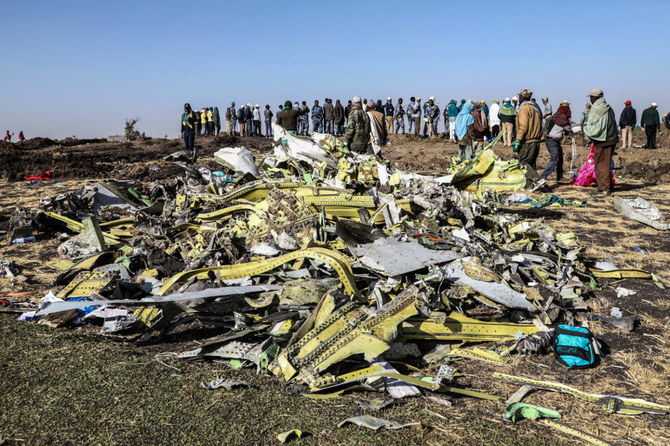
People stand near collected debris at the crash site of Ethiopia Airlines near Bishoftu, a town some 60 kilometes southeast of Addis Ababa, Ethiopia, on March 11, 2019. (AFP/File)
2 / 2
The US Justice Department reportedly plans to propose that Boeing plead guilty to fraud in connection with two deadly plane crashes involving its 737 Max jetliners. (AP)
Short Url
Updated 01 July 2024
Follow

US justice department wants Boeing to plead guilty to fraud over fatal crashes, lawyers say

  • Boeing will have until the end of the coming week to accept or reject the offer
  • Families of the 346 people who died in the 2018 and 2019 crashes want Boeing to face a criminal trial and to pay a $24.8 billion fine

The US Justice Department is pushing Boeing to plead guilty to criminal fraud in connection with two deadly plane crashes involving its 737 Max jetliners, according to several people who heard federal prosecutors detail a proposed offer Sunday.
Boeing will have until the end of the coming week to accept or reject the offer, which includes the giant aerospace company agreeing to an independent monitor who would oversee its compliance with anti-fraud laws, they said.
The case stems from the department’s determination that Boeing violated an agreement that was intended to resolve a 2021 charge of conspiracy to defraud the US government. Prosecutors alleged at the time that Boeing misled regulators who approved the 737 Max and set pilot-training requirements to fly the plane. The company blamed two relatively low-level employees for the fraud.
The Justice Department told relatives of some of the 346 people who died in the 2018 and 2019 crashes about the plea offer during a video meeting. The family members, who want Boeing to face a criminal trial and to pay a $24.8 billion fine, reacted angrily. One said prosecutors were gaslighting the families; another shouted at them for several minutes when given a chance to speak.
“We are upset. They should just prosecute,” said Massachusetts resident Nadia Milleron, whose 24-year-old daughter, Samya Stumo, died in the second of two 737 Max crashes. “This is just a reworking of letting Boeing off the hook.”

Prosecutors told the families that if Boeing rejects the plea offer, the Justice Department would seek a trial in the matter, meeting participants said. Justice Department officials presented the offer to Boeing during a meeting later Sunday, according to a person familiar with the situation.
Boeing and the Justice Department declined to comment.
The plea deal would take away the ability of US District Judge Reed O’Connor to increase Boeing’s sentence for a conviction, and some of the families plan to ask the Texas judge to reject the deal if Boeing agrees to it.
“The underlying outrageous piece of this deal is that it doesn’t acknowledge that Boeing’s crime killed 346 people,” said Paul Cassell, one of the lawyers for victims’ families. “Boeing is not going to be held accountable for that, and they are not going to admit that that happened.”
Sanjiv Singh, a lawyer for 16 families who lost relatives in the October 2018 Lion Air crash off Indonesia, called the plea offer “extremely disappointing.” The terms, he said, “read to me like a sweetheart deal.”
Another lawyer representing families who are suing Boeing, Mark Lindquist, said he asked the head of the Justice Department’s fraud section, Glenn Leon, whether the department would add additional charges if Boeing turns down the plea deal. “He wouldn’t commit one way or another,” Lindquist said.

The meeting with crash victims’ families came weeks after prosecutors told O’Connor that the American aerospace giant breached the January 2021 deal that had protected Boeing from criminal prosecution in connection with the crashes. The second one took place in Ethiopia less than five months after the one in Indonesia.
A conviction could jeopardize Boeing’s status as a federal contractor, according to some legal experts. The company has large contracts with the Pentagon and NASA.
However, federal agencies can give waivers to companies that are convicted of felonies to keep them eligible for government contracts. Lawyers for the crash victims’ families expect that would be done for Boeing.
Boeing paid a $244 million fine as part of the 2021 settlement of the original fraud charge. The Justice Department is likely to seek another, similar penalty as part of the new plea offer, said a person familiar with the matter who spoke on condition of anonymity to discuss an ongoing to discuss an ongoing case.
The deal would include a monitor to oversee Boeing — but the company would put forward three nominees and have the Justice Department pick one, or ask Boeing for additional names. That provision was particularly hated by the family members on the call, participants said.
The Justice Department also gave no indication of moving to prosecute any current or former Boeing executives, another long-sought demand of the families.
Lindquist, a former prosecutor, said officials made clear during an earlier meeting that individuals – even CEOs – can be more sympathetic defendants than corporations. The officials pointed to the 2022 acquittal on fraud charges of Boeing’s chief technical pilot for the Max as an example.
It is unclear what impact a plea deal might have on other investigations into Boeing, including those following the blowout of a panel called a door plug from the side of a Boeing Max 9 during an Alaska Airlines flight in January.


Mystery of CIA’s lost nuclear device haunts Himalayan villagers 60 years on

Updated 56 min 44 sec ago
Follow

Mystery of CIA’s lost nuclear device haunts Himalayan villagers 60 years on

  • Plutonium-fueled spy system was meant to monitor China’s nuclear activity after 1964 atomic tests
  • Porter who took part in Nanda Devi mission warned family of ‘danger buried in snow’

NEW DELHI: Porters who helped American intelligence officers carry a nuclear spy system up the precarious slopes of Nanda Devi, India’s second-highest peak, returned home with stories that sent shockwaves through nearby villages, leaving many in fear that still holds six decades later.

A CIA team, working with India’s Intelligence Bureau, planned to install the device in the remote part of the Himalayas to monitor China, but a blizzard forced them to abandon the system before reaching the summit.

When they returned, the device was gone.

The spy system contained a large quantity of highly radioactive plutonium-238 — roughly a third of the amount used in the atomic bomb dropped by the US on the Japanese city of Nagasaki in the closing stages of the Second World War.

“The workers and porters who went with the CIA team in 1965 would tell the story of the nuclear device, and the villagers have been living in fear ever since,” said Narendra Rana from the Lata village near Nanda Devi’s peak.

His father, Dhan Singh Rana, was one of the porters who carried the device during the CIA’s mission in 1965.

“He told me there was a danger buried in the snow,” Rana said. “The villagers fear that as long as the device is buried in the snow, they are safe, but if it bursts, it will contaminate the air and water, and no one will be safe after that.”

During the Sino-Indian tensions in the 1960s, India cooperated with the US in surveillance after China conducted its first nuclear tests in 1964. The Nanda Devi mission was part of this cooperation and was classified for years. It only came under public scrutiny in 1978, when the story was broken by Outsider magazine.

The article caused an uproar in India, with lawmakers demanding the location of the nuclear device be revealed and calling for political accountability. The same year, then Prime Minister Morarji Desai set up a committee to assess whether nuclear material in the area near Nanda Devi could pollute the Ganges River, which originates there.

The Ganges is one of the world’s most crucial freshwater sources, with about 655 million people in India, Nepal, and Bangladesh depending on it for their essential needs.

The committee, chaired by prominent scientists, submitted its report a few months later, dismissing any cause for concerns, and establishing that even in the worst-case scenario of the device’s rupture, the river’s water would not be contaminated.

But for the villagers, the fear that the shell containing radioactive plutonium could break apart never goes away, and peace may only come once it is found.

Many believe the device, trapped within the glacier’s shifting ice, may have moved downhill over time.

Rana’s father told him that the device felt hot when it was carried, and he believed it might have melted its way into the glacier, remaining buried deep inside.

An imposing mass of rock and ice, Nanda Devi at 7,816 m is the second-highest mountain in India after Kangchenjunga. 

When a glacier near the mountain burst in 2021, claiming over 200 lives, scientists explained that the disaster was due to global warming, but in nearby villages the incident was initially blamed on a nuclear explosion.

“They feared the device had burst. Those rescuing people were afraid they might die from radiation,” Rana said. “If any noise is heard, if any smoke appears in the sky, we start fearing a leak from the nuclear device.”

The latent fear surfaces whenever natural disasters strike or media coverage puts the missing device back in the spotlight. Most recently, a New York Times article on the CIA mission’s 60th anniversary reignited the unease.

“The apprehensions are genuine. After 1965, Americans came twice to search for the device. The villagers accompanied them, but it could not be found, which remains a concern for the local community,” said Atul Soti, an environmentalist in Joshimath, Uttarakhand, about 50 km from Nanda Devi.

“People are worried. They have repeatedly sought answers from the government, but no clear response has been provided so far. Periodically, the villagers voice their concerns, and they need a definitive government statement on this issue.”

Despite repeated queries whenever media attention arises, Indian officials have not released detailed updates since the Desai-appointed committee submitted its findings.

“The government should issue a white paper to address people’s concerns. The white paper will make it clear about the status of the device, and whether leakage from the device could pollute the Ganges River,” Soti told Arab News.

“The government should be clear. If the government is not reacting, then it further reinforces the fear.”