

Iran election shows declining voter support amid calls for change

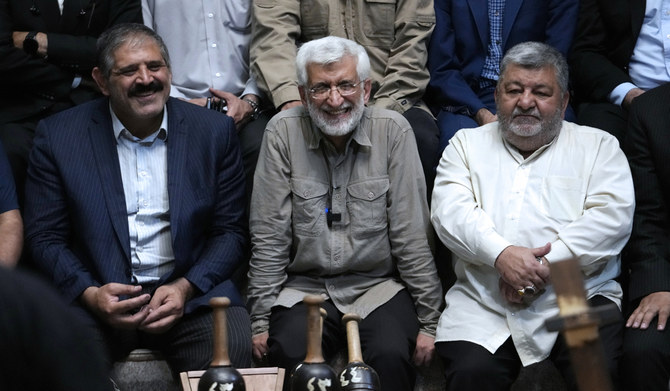
Presidential candidate Saeed Jalili attends a meeting in Tehran. (AP)
Short Url
Updated 30 June 2024
Follow

Iran election shows declining voter support amid calls for change

  • Of the 61 million eligible voters, only about 40 percent cast ballots, marking a record-low turnout in the country where some people have lost faith in the process. More than 1 million ballots were spoiled

TEHRAN: The first round of Iran’s presidential election revealed shrinking support for reformists and conservatives even though some voters are pushing for change by backing the sole reformist candidate, analysts say.
Masoud Pezeshkian, the reformist contender and ultraconservative Saeed Jalili, led the polls held on Friday to replace the late President Ebrahim Raisi, who died in a helicopter crash last month.
Friday’s vote, marked by a historically low turnout, “clearly shows that both reformists’ and conservatives’ bases have considerably shrunk,” said Ali Vaez of the International Crisis Group think tank.
In the lead-up to the election, Iran’s main reformist coalition supported Pezeshkian, with endorsements by former presidents Mohammed Khatami and Hassan Rouhani, a moderate.

FASTFACT

The combined votes of Saeed Jalili and Mohammed Baqer Qalibaf totaled 12.8 million.

“The reformists brought out the big guns and tried their best to mobilize their base,” Vaez said on social media platform X, but “it was simply insufficient.”
Likewise, the conservatives failed to garner sufficient votes “despite the tremendous resources they deployed,” he added.
Vaez pointed out that the combined votes of Jalili and conservative parliamentary speaker Mohammed Baqer Qalibaf, who came in third, totaled 12.8 million.
That figure was well below Raisi’s nearly 18 million votes in the 2021 election.
Of the 61 million eligible voters, only about 40 percent cast ballots, marking a record-low turnout in the country where some people have lost faith in the process. More than 1 million ballots were spoiled.
For Vaez, the decline in turnout, from around 49 percent in 2021, was “a real embarrassment for the leadership” in Iran, where ultimate political power lies with the supreme leader, Ayatollah Ali Khamenei.
Political commentator Mohammed Reza Manafi said Pezeshkian’s lead reflected a push for “fundamental changes” regarding the economy and relations with the rest of the world.
However, those favoring Pezeshkian “do not expect a miracle or a quick solution but hope he can gradually prevent conditions from worsening,” Manafi added.
Iran has been reeling from the economic impact of international sanctions, contributing to soaring inflation, high unemployment, and a record low for the Iranian rial against the US dollar.
The vote also came amid heightened regional tensions over the Gaza war between Israel and Hamas and diplomatic tensions over Iran’s nuclear program.
Pezeshkian, an outspoken heart surgeon who has represented the northwestern city of Tabriz in parliament since 2008, came out on top thanks to his “clean record without any accusations of financial corruption,” said Manafi.
Official figures showed Pezeshkian had 42.4 percent of the vote, against 38.6 percent for Jalili.
The reformists have urged “constructive relations” with Washington and European capitals to “get Iran out of its isolation.”
In contrast, Jalili is widely recognized for his uncompromising anti-West stance.
He is a former nuclear negotiator and a representative of Khamenei on the Supreme National Security Council, Iran’s highest security body.
During his campaign, he rallied a substantial base of hard-line supporters under the slogan “no compromise, no surrender” to the West.
He staunchly opposed the 2015 nuclear deal with the US and other world powers, which imposed curbs on Iran’s nuclear activity in return for sanctions relief.
At the time, Jalili argued that the pact violated Iran’s “red lines” by accepting inspections of nuclear sites.
The deal collapsed in 2018.
In a Sunday column in the ultraconservative Javan daily, political expert Ali Alavi hailed Jalili’s “honesty and truthfulness, unlike the others.”
The candidate also received support from Ghalibaf, who, after Saturday’s result, urged his support base to back Jalili in next Friday’s runoff.
Two ultraconservatives who dropped out a day before the election have also endorsed Jalili.
But on Sunday, the reformist newspaper Etemad quoted former vice president Isa Kalantari as warning against a continued conservative grip on the government.
“The country will be in peril and face numerous problems and challenges,” he said.
Vaez said the “Jalili fear factor can’t be overlooked.”
“Many who didn’t vote in this round might vote in the next one: not because they hope for better, but because they fear the worst.”
Political analyst Mohammad Marandi, however, said Jalili may not be “the sort of radical that is depicted by his opponents.”
Marandi believes that under either of the two candidates, Iran will “continue to pursue strong ties with the Global South” countries.
He added that they “will still attempt to see what can be done with the nuclear deal,” though Jalili “will just approach it with more skepticism.”


NGOs fear ‘catastrophic impact’ of new Israel registration rules

Updated 3 sec ago
Follow

NGOs fear ‘catastrophic impact’ of new Israel registration rules

  • NGOs working in Israel and occupied Palestinian territories have until December 31 to register under the new framework
  • Save the Children is among the charities already barred under the new rules
PARIS: New rules in Israel for registering non-governmental organizations, under which more than a dozen groups have already been rejected, could have a catastrophic impact on aid work in Gaza and the West Bank, relief workers warn.
The NGOs have until December 31 to register under the new framework, which Israel says aims not to impede aid distribution but to prevent “hostile actors or supporters of terrorism” operating in the Palestinian territories.
The controversy comes with Gaza, which lacks running water and electricity, still battling a humanitarian crisis even after the US-brokered October ceasefire in the war between Israel and Hamas, sparked by the Palestinian militant group’s October 7, 2023 attack on Israel.
Israel’s Ministry of Diaspora Affairs and Combating Antisemitism told AFP that, as of November 2025, approximately 100 registration requests had been submitted and “only 14 organization requests have been rejected... The remainder have been approved or are currently under review.”
Requests are rejected for “organizations involved in terrorism, antisemitism, delegitimization of Israel, Holocaust denial, denial of the crimes of October 7,” it said.

‘Very problematic’

The amount of aid entering Gaza remains inadequate. While the October 10 ceasefire agreement stipulated the entry of 600 trucks per day, only 100 to 300 are carrying humanitarian aid, according to NGOs and the United Nations.
The NGOs barred under the new rules include Save the Children, one of the best known and oldest in Gaza, where it helps 120,000 children, and the American Friends Service Committee (AFSC).
They are being given 60 days to withdraw all their international staff from the Gaza Strip, the occupied West Bank and Israel, and will no longer be able to send humanitarian supplies across the border to Gaza.
In Gaza, Save the Children’s local staff and partners “remain committed to providing crucial services for children,” such as psychosocial support and education, a spokeswoman told AFP.
The forum that brings together UN agencies and NGOs working in the area on Thursday issued a statement urging Israel to “lift all impediments,” including the new registration process, that “risk the collapse of the humanitarian response.”
The Humanitarian Country Team of the Occupied Palestinian Territory (HCT) warned that dozens of NGOs face deregistration and that, while some had been registered, “these NGOs represent only a fraction of the response in Gaza and are nowhere near the number required just to meet immediate and basic needs.”
“The deregistration of NGOs in Gaza will have a catastrophic impact on access to essential and basic services,” it said.
NGOs contacted by AFP, several of whom declined to be quoted on the record due to the sensitivity of the issue, say they complied with most of Israel’s requirements to provide a complete dossier.
Some, however, refused to cross what they described as a “red line” of providing information about their Palestinian staff.
“After speaking about genocide, denouncing the conditions under which the war was being waged and the restrictions imposed on the entry of aid, we tick all the boxes” to fail the registration, predicted the head of one NGO.
“Once again, bureaucratic pressure is being used for political control, with catastrophic consequences,” said the relief worker.
Rights groups and NGOs including Amnesty International and Human Rights Watch have accused Israel of carrying out a genocide against Palestinians in Gaza, a term vehemently rejected by the Israeli government.
“If NGOs are considered to be harmful for passing on testimonies from populations, carrying out operational work and saying what is happening and this leads to a ban on working, then this is very problematic,” said Jean-Francois Corty, president of French NGO Medecins du Monde.

- ‘Every little criticism’ -

The most contentious requirement for the NGOs is to prove they do not work for the “delegitimization” of Israel, a term that appears related to calling into question Israel’s right to exist but which aid workers say is dangerously vague.
“Israel sees every little criticism as a reason to deny their registration... We don’t even know what delegitimization actually means,” said Yotam Ben-Hillel, an Israeli lawyer who is assisting several NGOs with the process and has filed legal appeals.
He said the applications of some NGOs had already been turned down on these grounds.
“So every organization that operates in Gaza and the West Bank and sees what happens and reports on that could be declared as illegal now, because they just report on what they see,” he told AFP.
With the December 31 deadline looming, concerns focus on what will happen in early 2026 if the NGOs that are selected lack the capacity and expertise of organizations with a long-standing presence.
Several humanitarian actors told AFP they had “never heard of” some of the accredited NGOs, which currently have no presence in Gaza but were reportedly included in Trump’s plan for Gaza.
“The United States is starting from scratch, and with the new registration procedure, some NGOs will leave,” said a European diplomatic source in the region, asking not to be named. “They might wake up on January 1 and realize there is no-one to replace them.”