

How Saudi Arabia is creating a buzz around beekeeping and the honey making industry

1 / 3
Honey has long held a special place in Saudi culture, cultivated by beekeepers across the Kingdom for its medicinal and culinary uses. (AN file photos)
2 / 3
The Honey and Agricultural Products Festival in Saudi Arabia's northwestern province of Tabuk puts the focus firmly on the role of beekeepers. (X: @MEWA_KSA)
3 / 3
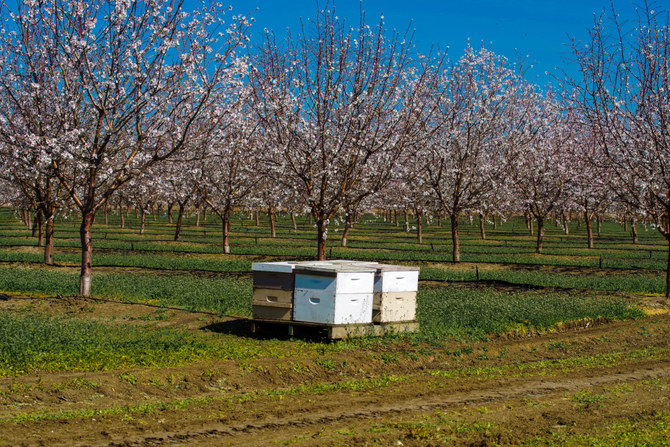
Portable white beehive boxes placed on wooden pallet in blossoming almond orchard to help increase pollination of the trees to increase crop yield. (Shutterstock)
Short Url
Updated 29 June 2024
Follow

How Saudi Arabia is creating a buzz around beekeeping and the honey making industry

  • To promote the ancient craft of beekeeping, the Kingdom is helping a new generation earn qualifications and practical skills in honey making
  • Besides its profitability, honey production is one of the most beneficial activities for supporting local plant species and agricultural crops

RIYADH: Honey has long held a special place in Saudi culture, cultivated by beekeepers across the region for its medicinal and culinary uses. Now, with added government support, its true economic potential and environmental benefits are being realized.

Last year, more than 100 licenses were granted to beekeepers to produce this liquid gold on land administered by the Imam Abdulaziz bin Mohammed Royal Reserve Development Authority, predominantly in the Rawdat Khuraim oasis.

Here, beekeepers have been producing the finest types of natural honey, such as Najdi acacia honey, spring flower honey, wild sidr, salam honey, and shafalah — boosting the local economy with sales of highly prized products.
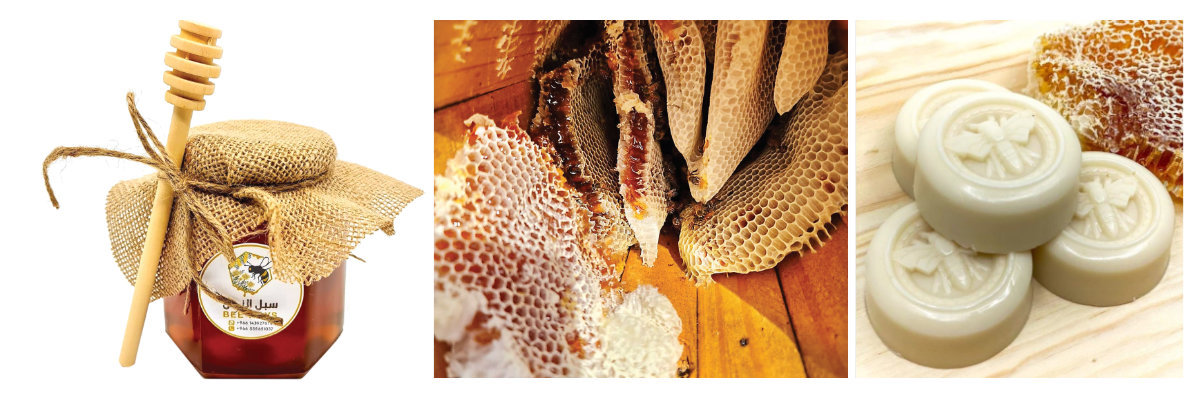


Aside from honey, the other products of bees are beeswax and natural substances that have several uses, such as making sealants, lubricants, construction material and medications. (Supplied)

“Natural honey is a product that is in high demand in the Kingdom,” a spokesperson for the authority told Arab News. “At the reserve, we have natural pastures characterized by honey plants, ensuring that the breeder obtains sufficient nectar to produce honey.”

Saudi Arabia is immensely proud of its honeymaking heritage, attested by events like the Jazan Honey Festival and the Honey and Agricultural Products Festival in the Tabuk region, and weekly auctions in Taif to sell honey and other bee products.

To promote the ancient craft of beekeeping, the reserve recently hosted an integrated “bee basics” training program, offering a new generation the opportunity to earn qualifications and practical experience in honey making.
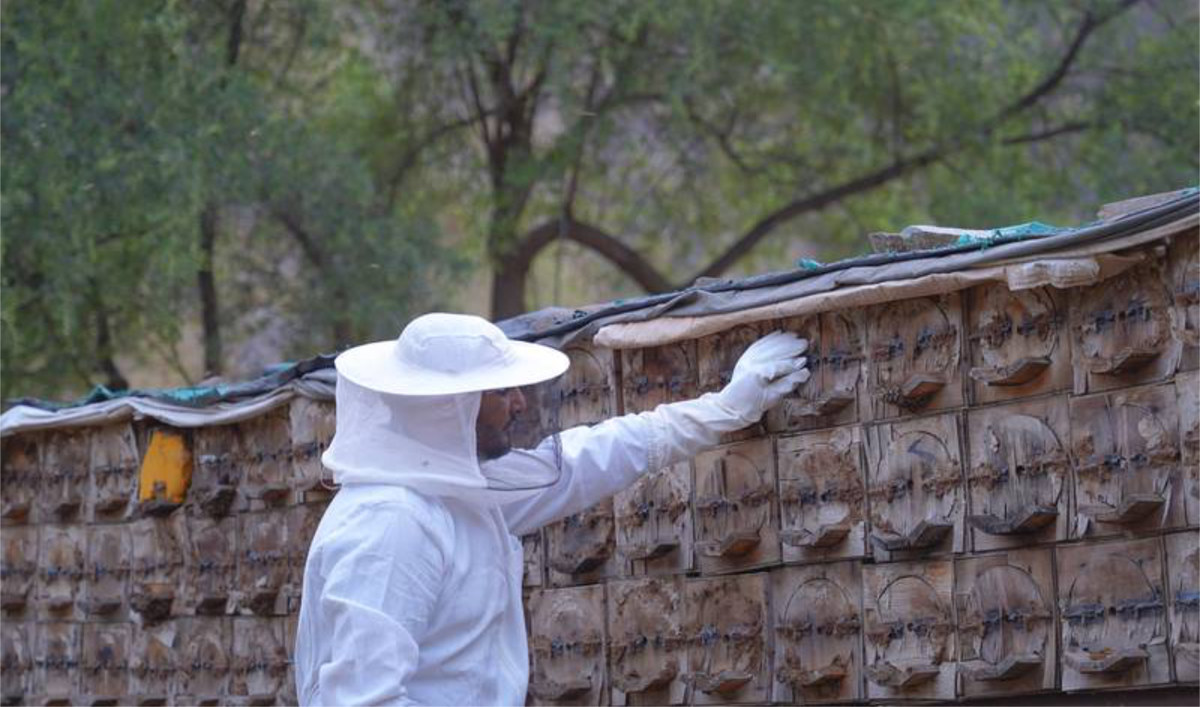


Honeybees in the higher reaches of Saudi Arabia are drawing crowds and making the native juniper-covered Soudah mountains one of the most interesting models for sustainable tourism in the Middle East. (Supplied) 

“Now, the trainees have finished the program and the next honey harvest season will allow us to see the fruits of the program’s labor,” the spokesperson added.

Honey production is one of the most beneficial activities for supporting local plant species and agricultural crops. Bees are pollinating insects. As they visit plants seeking nectar, pollen catches on their bodies and passes between plants, thereby fertilizing them.

DID YOUKNOW?

• Bees play a crucial role in pollinating date palms, a popular and profitable agricultural crop in the region.

• Beekeepers often move their hives to date palm orchards when in bloom to enhance pollination and increase fruit yield.

• Saudi Arabia is known for producing unique and high-quality honey varieties like sidr, sourced from the nectar of the sidr tree.

The authority has a specialized team devoted to issuing licenses for apiaries within the confines of the reserve, providing sufficient space between each apiary to ensure the bees avoid mingling with other hives, keeping the resulting honey pure.

“Environmental control teams carry out monitoring tours as part of their work, to ensure the health of the environment surrounding the apiaries, which is reflected in the proper nutrition of the bees,” the authority spokesperson said.

Various government entities have launched programs designed to boost economic development and promote local products, while empowering young people and other underrepresented groups through training and job creation.
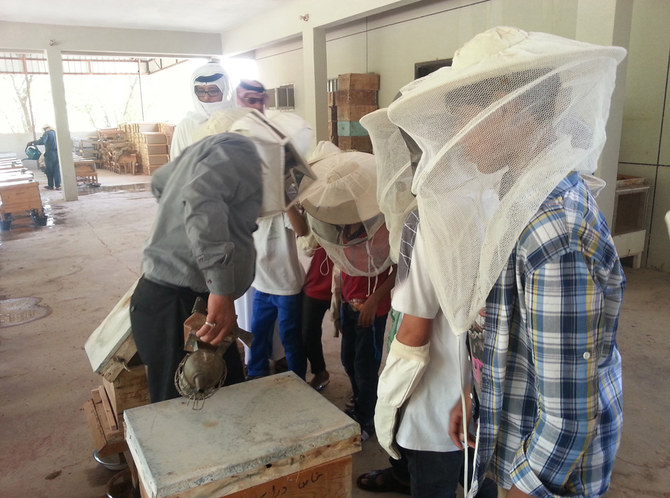


Saudis participate in a summer beekeeping training in Al-Baha province. (SPA file photo)

Through the Sustainable Rural Agricultural Development Program, chartered by the UN Food and Agriculture Organization and the Kingdom’s Ministry of Environment, Water and Agriculture, more than 100 local beekeepers were recently trained on honeybee queen-rearing techniques, prompted by the declining number of honeybee colonies.

Just five years ago, Norah Shawi Al-Shimmari was the only woman known to be working in the beekeeping industry in Saudi Arabia. Now, thanks to training schemes like these, many more women are taking up the craft and prospering as a result.

It has not been without its obstacles, however. “My biggest challenge is getting from one place to another and needing someone to drive me to faraway places,” Al-Shimmari told Arab News.

“I need a guardian and a car and someone to carry things with me as well. My work the past period has been without help. I myself am lifting, housing the bees and sorting the honey, which is very difficult.”

At first, Al-Shimmari would only produce honey under the brand name Al-Shawi Apiaries, named after her late father. After some training to utilize beeswax for beauty, nutritional and medicinal items, she soon expanded her line of projects and made the brand her own.

This led her to suggest ways to work with other beekeepers to create a sustainable economic ecosystem for honey products, like collecting leftover wax and using it to create other products instead of leaving it to waste.

Through perseverance, self-taught Al-Shimmari became the first female beekeeper in the north of the Kingdom and the only woman among 33 beekeepers who took part in the 2021 Hail Honey Festival in early November, where she was dubbed the “Beekeeper of the North.”
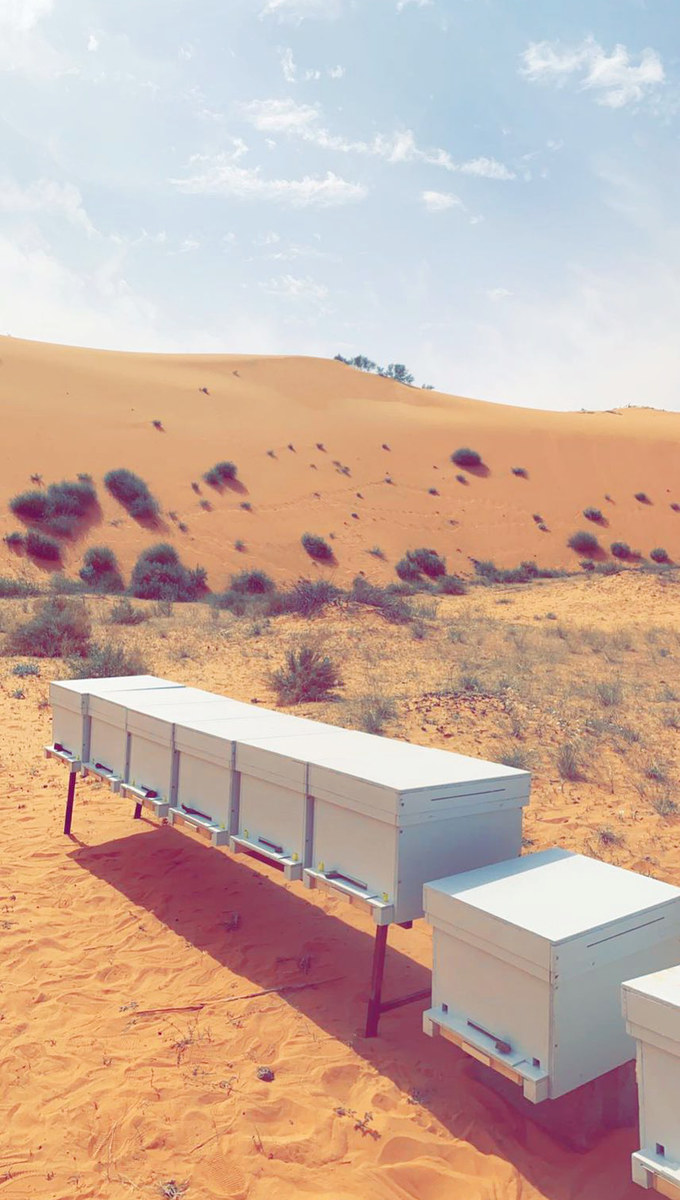


Since launching her beekeeping career four years ago, Norah Shawi Al-Shimmari has found sweet success and been dubbed the “Beekeeper of the North.” (Supplied)

Seeing her work, the emir of Hail Region arranged for a training workshop to take place. More than 40 women have since graduated from this program to become beekeepers themselves. “Now, the Hail region hosts 43 female beekeepers,” said Al-Shimmari.

“Some of them left the field, and some faced impediments or situations that wouldn’t allow them to continue, but some of them are still persevering … my advice for any woman who sees themselves in the field is to pursue the profession.”

There are similar stories across the Kingdom. Hailing from Jeddah, Saudi couple Ahmed Badghaish and Nada Khaled Malaika began their beekeeping journey two decades ago with nothing more than a passion for nature and an innate curiosity about the world of bees.
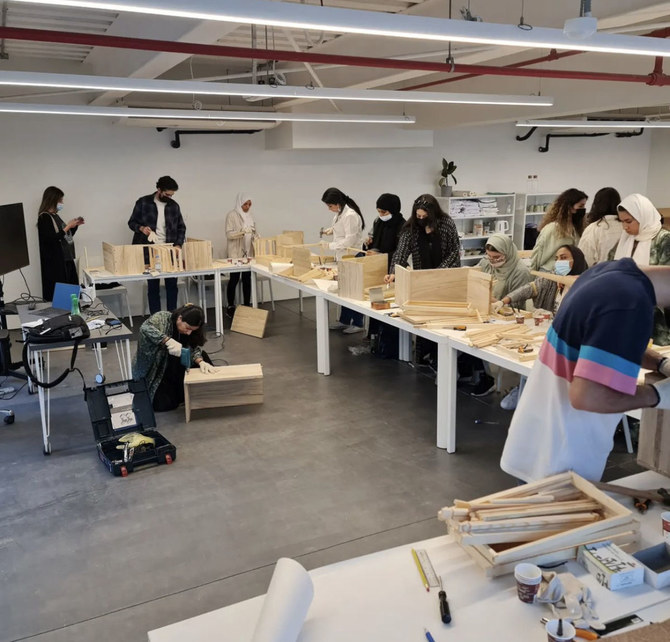


A group of beekeeping enthusiasts learn to make hive boxes during a workshop in Jeddah, conducted by honey entrepreneur Ahmed Badgahish. (Instagram @beewaysaudi)

Over the years, they have transformed a modest business into a thriving apiary named Bee Ways that houses 1,200 beehives, and their products have won multiple international awards.

For small, local producers like Al-Shimmari, however, the profession is a true labor of love.

Opinion

This section contains relevant reference points, placed in (Opinion field)

“After a long seasonal journey, production and transportation, the big achievement after sorting the honey and seeing the product is such a pleasure. This is what drives me to continue improving and thriving in this field,” she said.

“My biggest supporter, after God and my family, was the Ministry of Environment, Water and Agriculture. They stood behind me and opened up opportunities in festivals. I’m always the first to get their invitations.”


ALSO READ: 

Saudi mother-of-six finds sweet success with her ‘kingdom of bees’

Run by a Saudi couple, Bee Ways travels all over the Kingdom in search of greenest pastures

Beehives of Saudi Arabia’s Maysan believed to be over 1,000 years old


Despite the challenges, the honey and beekeeping industry is on a steady rise with continuous support from government entities.

Since 2020, about SR140 million ($37.3 million) in funding has been distributed to 10,584 beneficiaries through the Sustainable Agricultural Rural Development Program — Saudi Reef — according to the Saudi Press Agency.
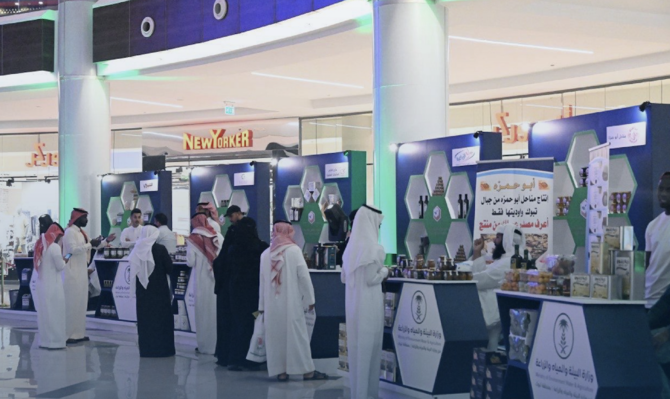


The Honey and Agricultural Products Festival in Saudi Arabia's northwestern province of Tabuk puts the focus firmly on the role of beekeepers. (X: @MEWA_KSA)

On World Bee Day, marked each year on May 20, the Ministry of Environment, Water and Agriculture announced that honey production had reached 5,000 tons annually. It aims to increase this to 7,500 tons by 2026 and achieve self-sufficiency.

There are now more than 20,000 ministry-registered beekeepers across the Kingdom.


How AI is powering Saudi Arabia’s video games industry

Updated 13 March 2026
Follow

How AI is powering Saudi Arabia’s video games industry

  • Technology is boosting efficiency and supporting local content development

RIYADH: Artificial intelligence is becoming a central force in Saudi Arabia’s rapidly expanding gaming and esports sector, shaping everything from game development and publishing to player analytics and competitive tournaments.

As the Kingdom accelerates its ambitions under Vision 2030, AI is increasingly being deployed not only as a technical tool but also as a strategic driver for industry growth and global competitiveness.

Saudi Arabia is integrating AI across studios, publishing platforms and esports operations to improve efficiency, expand local content creation, attract international investment and streamline tournament management. The broader goal is to position the Kingdom not only as one of the world’s largest gaming markets but also as a global hub for game development and esports infrastructure.

For Saudi studios seeking international audiences, understanding how AI systems generate results is also critical to maintaining cultural accuracy and relevance in game content. (Unsplash.com photo)

According to Saudi Arabia’s National Gaming and Esports Strategy, the Kingdom is home to more than 23.5 million gamers — around 67 percent of the population. Market revenues are projected to reach $1.36 billion by 2026. By 2030, the sector aims to contribute more than SR50 billion to the national GDP and create about 39,000 jobs.

Women represent 42 percent of gamers and 18 percent of esports players, among the highest participation rates in the region.

The Public Investment Fund, through its gaming arm Savvy Games Group, has invested billions of dollars in game studios, publishers and esports platforms worldwide. The investments are designed to strengthen local content creation while attracting global developers and investors to Saudi Arabia.

INNUMBERS

23.5 million Number of gamers in Saudi Arabia, representing about 67% of the population

$1.36 billion Revenue the Kingdom’s gaming market is expected to reach by 2026

SR50 billion Amount the gaming and esports sector aims to add to GDP to create 39,000 jobs by 2030

A spokesperson for Savvy Games Group told Arab News that AI is already integrated across its portfolio, particularly within ESL FACEIT Group.

“AI is used across our businesses. At ESL FACEIT Group, AI is already embedded in operations, particularly around data analytics and fair play,” the spokesperson told Arab News. “For example, EFG uses Minerva, an AI-powered moderation system that identifies and reduces toxic or abusive behavior by analyzing player communications and behavior patterns at scale. This enables faster and more consistent decisions and helps create healthier competitive environments for players.”

However, the spokesperson said AI itself does not automatically create a competitive advantage.

“AI tools are increasingly accessible to studios everywhere, which means they are not a competitive advantage on their own,” the spokesperson told Arab News. “The advantage comes from how clearly studios define their use cases and how effectively they apply AI to support their goals.”

For Saudi studios seeking international audiences, understanding how AI systems generate results is also critical to maintaining cultural accuracy and relevance in game content.

Within development studios, AI is helping accelerate production while lowering costs. AI-powered tools assist with concept art, 3D modeling, animation and world design, while automated testing systems can simulate thousands of gameplay scenarios to identify bugs and balance issues before release.

Steer Studios, for example, is applying AI in asset production and testing workflows. Automating repetitive tasks allows creative teams to devote more time to storytelling, gameplay design and world-building — key elements that distinguish successful games.

AI is also playing an important role in localizing content for Arabic-speaking audiences. Studios including Fahy Studios, Starvania Studio and Lobah Game Studio use AI for dialogue generation, translation and other localization tasks, helping Saudi-developed games reach global markets more quickly without losing cultural context.

For live-service and mobile games, maintaining player engagement is crucial to long-term revenue. AI systems track player behavior in real time, adjust difficulty levels, refine matchmaking systems and personalize in-game experiences.

Publishing platforms such as Nine66 and Sandsoft also rely on AI-driven analytics to support developers. These tools help predict player lifetime value, optimize marketing campaigns and manage online gaming communities.

“Our approach aligns closely with KSA’s focus on digital transformation, innovation and long-term capability building under Vision 2030,” the Savvy Games Group spokesperson told Arab News. “We see AI as an enabler of productivity, operational efficiency and ecosystem sustainability.”

The spokesperson added that partnerships, including collaboration with Humain, allow Saudi companies to explore scalable and responsible applications of AI across studios.

Opinion

This section contains relevant reference points, placed in (Opinion field)

“We take a pragmatic approach,” the spokesperson told Arab News. “We focus on technologies that provide real benefits. Any AI solution we use must improve efficiency and make day-to-day work easier.”

Artificial intelligence is also transforming the esports ecosystem.

Esports Infra — a platform created by Singapore-based Samarium in partnership with Saudi AI firm Wakeb — is designed to streamline the management of players, teams and content creators.

“Esports suffers from fragmentation,” Jonas Moaz, Esports Infra founder, told Arab News. “Talented players often don’t have a clear path to professionalism. Organizations struggle to find players, and content creators lack tools to connect with audiences.”

The platform uses machine learning to classify player skill levels, computer vision to analyze gameplay and predictive analytics to forecast development potential.

“We expect to improve the efficiency of building esports organizations — particularly in talent discovery and time management — by up to 50 percent,” Moaz told Arab News.

In addition to player analytics, the platform assists with scheduling, contract management and sponsorship evaluation, giving teams and brands clearer insights into performance and commercial value.

Saudi Arabia’s gaming sector is steadily evolving from a consumer-driven market into a center for game creation and esports infrastructure. (Unsplash.com photo)

Despite AI’s growing role, its use in esports competition itself remains tightly regulated. Organizations such as the International Esports Federation prohibit AI from influencing live matches.

“We fully respect those regulations,” Moaz told Arab News. “Our tools support analysis but do not play on behalf of players. AI operates outside match time or as a statistical layer.”

Protecting player data and ensuring fairness remain key priorities for developers and platform providers.

“This is a top priority for us,” Moaz told Arab News. “Player data is encrypted and used only to improve the experience. To ensure fairness, we regularly audit our algorithms to prevent bias.”

Saudi Arabia’s gaming sector is steadily evolving from a consumer-driven market into a center for game creation and esports infrastructure. AI is embedded throughout this transformation — from accelerating game development and localization to analyzing player behavior and professionalizing competitive gaming.

If the targets outlined in Vision 2030 are achieved, AI will play a defining role not only in improving industry operations but also in helping Saudi Arabia compete globally in a sector increasingly driven by data, efficiency and advanced technology.
