

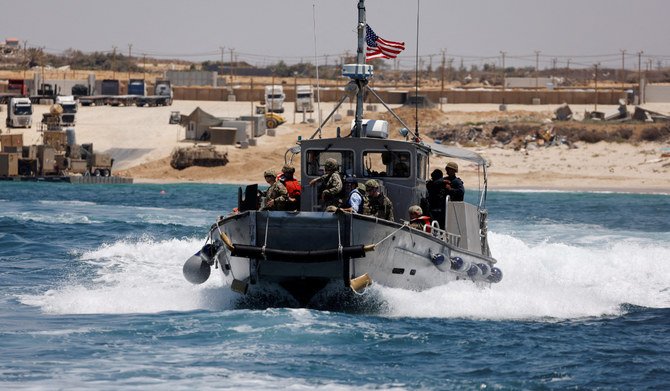


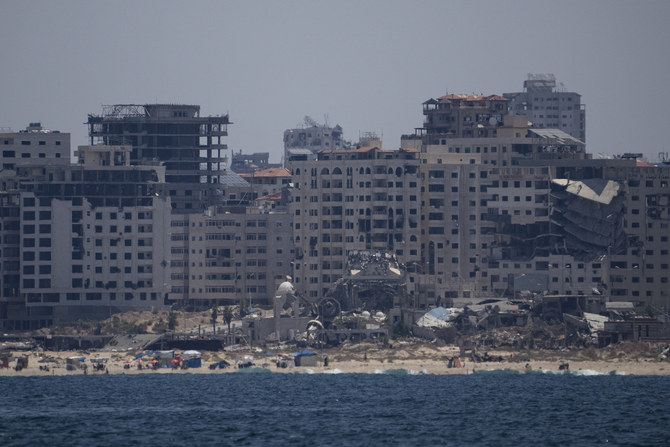


GAZA CITY: With US soldiers within shouting distance of Gaza’s bombed-out coast, the American military is taking another stab at delivering aid to hungry Palestinians by sea.
After several fits and starts, a $230 million pier is up and running again. The US military invited reporters for a tour of it on Tuesday, marking the first time international media has witnessed its operations firsthand.
International journalists have not been allowed to enter Gaza independently since the Israel-Hamas war began Oct. 7.
The project, which first launched in mid-May, resumed operations last week after a recent pause due to rough seas.
As journalists looked on Tuesday, US soldiers with machine guns directed the pier’s operations. US vessels carrying trucks loaded with humanitarian aid docked at the pier.
Israeli and Cypriot drivers drove the trucks off the vessels and headed down the 400-meter (437-yard) causeway to the beach, where they unloaded pallets of aid.
The trucks then returned to the vessels to be ferried to large cargo ships and reloaded. The cargo ships travel across the Mediterranean Sea from Cyprus.
Col. Samuel Miller, the commander of a joint task force, US Army 7th Transportation Brigade, said the vessels can ferry aid to the pier at least five times a day.
“Our mission out here is to receive those humanitarian assistance pallets offshore from a larger vessel onto that floating pier,” he said, shouting over waves crashing against the pier. “Over time, we are learning organization and we’ve gotten better.”
The floating pier was anchored back on Gaza’s shoreline on June 19 after heavy seas and high winds led the military to disconnect it from the beach. In May, similar conditions forced a two-week pause in operations after the pier broke apart and four US Army vessels ran aground, injuring three service members, one critically.
Since coming back online, the pier has been delivering hundreds of pallets of aid a day to the shore, Miller said.
From the pier, Associated Press journalists could see aid piling up against a backdrop of near-total destruction. Israeli army vehicles slowly moved between blown-out buildings along the coast. Tents stood on beaches in the distance.
The US military said about 6,200 metric tons (6,800 tons) of aid have so far been delivered from the project to Gaza’s shore.
While aid from the pier is reaching the beach, it’s still difficult to get it to Palestinians in Gaza. The UN World Food Program has suspended aid delivery from the pier due to security concerns after the Israeli military appeared to use the area in a June 8 hostage rescue. Lawlessness around the pier, with hungry Palestinians seizing aid off trucks headed to delivery zones, also is a major concern.
The US launched the project to bring relief to Gaza, where Israel’s military offensive against Hamas has displaced over 80 percent of the territory’s 2.3 million people and unleashed a humanitarian disaster. International officials say hundreds of thousands of people are on the brink of famine.
UN and other international aid officials have voiced skepticism over the pier, saying its effectiveness is limited and it is no substitute for Israeli-controlled land crossings into the territory.
UN officials told the AP on Tuesday that they are considering suspending all aid operations across Gaza unless steps are taken to better protect humanitarian workers. That would plunge Gaza into an even deeper humanitarian catastrophe.
Palestinians in Gaza are heavily reliant on UN aid, which has only trickled into the territory since Israel’s incursion in early May into Rafah, Gaza’s southernmost city, shut down a major land crossing and slowed deliveries from another major crossing.
Still, the soldiers operating the pier Tuesday were hopeful.
“I talk to my sailors on a daily basis,” said US Navy Capt. Joel Stewart. “They understand that our aid is necessary for the people of Gaza that are suffering under the conditions of war.”


