

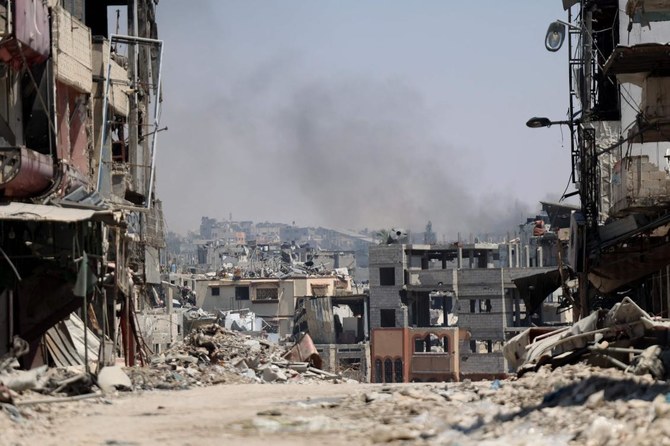

GAZA: Israel’s military on Friday said it was conducting raids backed by air strikes in northern Gaza, killing “dozens” of militants in an area where it had declared the command structure of Hamas dismantled months ago.
The operation in Shujaiya, on the edge of Gaza City, caused numerous casualties, witnesses and medics said on Thursday when it began.
Renewed fighting in Gaza’s north followed comments on Sunday by Israeli Prime Minister Benjamin Netanyahu in which he said the “intense phase” of the war was winding down after almost nine months.
Experts say they foresee a potentially prolonged next phase.
Omer Dostri, a military expert at the Jerusalem Institute for Strategy and Security, said he expects the army to reduce its ground presence and to increasingly use drones and fighter jets “to further dismantle Hamas.”
On Friday in the Shujaiya area, an AFP correspondent witnessed an air strike and saw smoke rising. Artillery fire boomed.
In a statement, Israel’s military said that, overnight Thursday, troops “started to conduct targeted raids” in the Shujaiya area as part of an operation that began earlier in the day.
Intelligence had indicated “the presence of terrorists and terrorist infrastructure in the area of Shujaiya,” the military said, in its first details of the operation.
As troops went in, warplanes struck dozens of Hamas targets, it said, following other “significant” strikes that killed “dozens” of militants in the north.
The Al-Quds Brigades, the armed wing of the Palestinian militant group Islamic Jihad, said on Friday it was fighting in the northern Gaza neighborhood of Shujaiya and had targeted Israeli troops with mortar shells.
Meanwhile, Gaza’s civil defense agency said Israeli forces had targeted the agency’s headquarters while advancing in western Rafah.
Multiple agency staff were wounded, while two fire engines, an ambulance and an excavator used for rescuing people from under rubble were damaged, one of the agency’s officials Mohammad Al-Mughair told AFP.
On Thursday, a military spokesman told residents and displaced Gazans in a social media message to leave “for your safety.”
They were asked to head south, to a declared “humanitarian zone” about 25 kilometers (15 miles) away.
An AFP photographer saw many Palestinians leaving on foot, carrying their belongings through rubble-strewn streets.
Hamas said Israeli forces were “starting a ground incursion,” reporting “several” dead as “thousands flee under relentless bombing.”
The war started with Hamas’s October 7 attack on southern Israel, which resulted in the deaths of 1,195 people, mostly civilians, according to an AFP tally based on Israeli figures.
The militants also seized hostages, 116 of whom remain in Gaza although the army says 42 are dead.
Israel’s retaliatory offensive has killed at least 37,765 people, also mostly civilians, according to data from the health ministry in Hamas-run Gaza.
On Friday the military announced the death of another soldier, aged 19, during combat in southern Gaza. This brings to 314 the number killed since ground operations began in the territory.
Elsewhere in the coastal strip, paramedics on Friday reported three people killed in Deir Al-Balah, central Gaza.
AFP images showed the municipal building had been destroyed.
Colleagues prayed over the bodies of four civil defense volunteers killed during bombardment of the nearby Nuseirat refugee camp, other AFP images showed.
Orange work vests lay on top of their white-shrouded bodies.
Witnesses on Friday reported artillery fire in Nuseirat.
Fighting in Gaza comes alongside growing fears of a wider regional conflagration involving Israel and Lebanon’s Hezbollah movement. The two sides have engaged in near-daily exchanges of fire since the war in Gaza began.
Such exchanges have escalated this month.
US officials have voiced hope a Gaza ceasefire could also lead to a reduction in hostilities on Israel’s northern border, but months of on-off mediation, also involving Egypt and Qatar, have not brought a deal.
On Thursday, Hezbollah said it fired “dozens” of rockets at a military base in northern Israel in retaliation for Israeli strikes on Lebanon.
Hezbollah said four of its fighters had been killed. Israel’s military said air strikes killed three Hezbollah operatives.
In Gaza, most of the population has been uprooted and much of the territory’s infrastructure has been destroyed, leaving residents struggling to survive.
A UN-backed assessment this week said almost half a million people in Gaza are still experiencing “catastrophic” hunger.
An Israeli government spokesman dismissed the report, partly because “it’s based upon data from Hamas’s own health institutions.”
But the Integrated Food Security Phase Classification, on its website, says it was created “precisely to supersede potential political interferences through technical neutrality,” and that its parameters are based on international standards.
Netanyahu’s announcement that intense fighting is winding down comes with his right-wing coalition under a range of pressures.
Thousands of protesters again gathered in front of his Jerusalem residence on Thursday to call for a hostage release deal, an AFP reporter said.
In the Tel Aviv area, mounted police dispersed ultra-Orthodox men protesting a Supreme Court ruling that they must be drafted for military service.


