

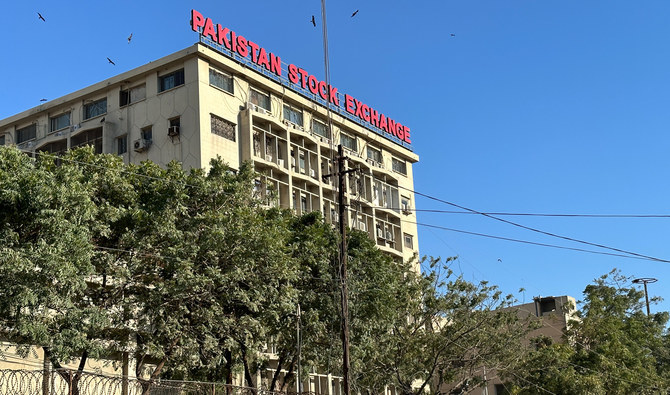

KARACHI: Pakistan’s stock market ended fiscal year 2024 on a high, with its key stock index recording 78,444 points on Friday, the highest level reached on the last day of a fiscal year amid renewed optimism among investors that Islamabad would secure a fresh loan from the International Monetary Fund (IMF).
Pakistan’s National Assembly on Friday passed the government’s tax-laden finance bill for the next fiscal year starting July 1, 2024. Finance Minister Muhammad Aurangzeb presented the budget on June 12 which featured a challenging tax revenue target of Rs13 trillion ($46.55 billion), up by about 40 percent from the target set in the current fiscal year.
The new budget has further burdened Pakistan’s salary class by imposing more direct tax on their income. Meanwhile, tax has also been increased to 18 percent on textile and leather products and mobile phones. However, analysts noted that the tax-heavy budget is in line with the IMF’s conditions for Pakistan to secure another financial bailout package.
Pakistan’s stock market rebounded last year after the South Asian country secured a last-gasp $3 billion short-term loan from the global lender that proved instrumental in the country avoiding a sovereign default.
“The KSE-100 index witnessed an increase of 36,992 points or 89.2 percent on an annual basis during FY24 to close at 78,445 points,” Tahir Abbas, head of research at Arif Habib Limited, told Arab News. He noted that this was the highest increase in percentage terms since FY03.
However, the market closed the last trading day of the outgoing fiscal year on a bearish note, with the index losing 83 points.
“Stocks closed lower amid pressure at the fiscal year-end close and on concerns of an expected higher CPI inflation for June 2024, and $918 million profit repatriations causing massive foreign outflows in May 2024,” Ahsan Mehanti, a senior stock analyst, explained.
Pakistan’s currency also stabilized during the outgoing fiscal year, as the Pakistani rupee appreciated by 2.8 percent on an annual basis against the US dollar. The local currency’s performance was a welcome sight, considering it had underperformed over the past three years.
The currency appreciated primarily due to the decrease in the current account deficit, an improvement in Pakistan’s foreign inflows, a reduction in the gap between the open and interbank rates, and other administrative measures by the government.
Inflation, which surged to a record high of 38 percent in May 2023, has also declined considerably to 11.8 percent in May 2024 as per official data.
However, the inflation outlook for June 2024 has increased slightly compared to the previous month but remains well below the June 2023 level. This rise can be attributed primarily to higher prices of perishable items, driven by the Eid Al-Adha event, according to a monthly report issued by the finance ministry.
“FY2024 is going to end with an economic stabilization path accompanied by improved macroeconomic indicators,” the finance ministry’s report for June 2024 said.
The report added that subsiding inflationary pressures, stability in external accounts and exchange rate, fiscal consolidation and gradual recovery in industrial activities are restoring confidence among economic agents.




