BRIDGETOWN, Barbados: Unbeaten throughout almost a month of cricket across the USA and the Caribbean, India and South Africa will face off at the Kensington Oval on Saturday in the T20 World Cup final both looking to end long waits for glory.
A tournament which has been a mixed bag in terms of quality, entertainment and attendances, has certainly succeeded in setting up a final between the two best teams in the shortest format.
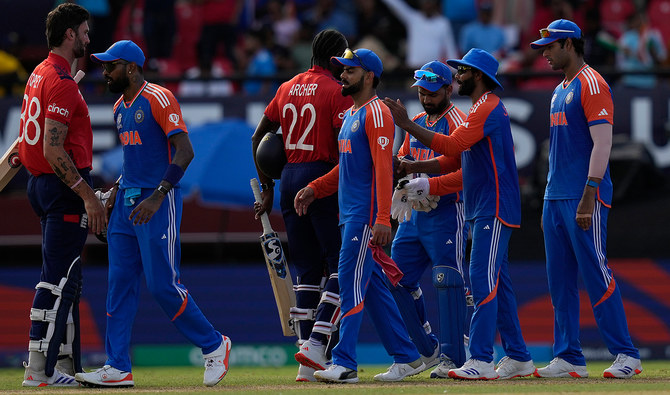
India crushed defending champions England by 68 runs in Guyana on Thursday, the day after South Africa thrashed Afghanistan by nine wickets in Trinidad to end a long and agonizing wait for a title game.
This will be South Africa’s first senior men’s final since the inaugural Champions Trophy in Bangladesh in 1998 when the Proteas beat the West Indies in the title match.
Over the years they have been labelled ‘chokers’ by their critics and had many question how a nation that has produced so many talented players, hasn’t been able to make a final for 26 years.
Skipper Aiden Markram was part of the team which were beaten by Australia in the ODI World Cup last year but says the players haven’t reflected much on the years of near-misses and disappointments.
“We haven’t spoken about it to be honest. I think it’s a personal and individual motivation that you get to a final; to earn the opportunity to hopefully lift the trophy,” he said after the win over the Afghans.
“So you reflect back to five months ago we couldn’t get over the line in that semifinal and you look at (here) a few things went our way. We managed to win the game and we found ourselves in the final.”
Certainly there has been no hint that South Africa have lacked belief in this tournament — they topped group D with a 100 percent record including wins over Sri Lanka and Bangladesh.
Then in the Super Eights, they won all three games with victories over England and co-hosts West Indies and the USA.
“This team’s been together for a long time now as a white ball group, both formats. We feel and we believe that we can compete with the best in the world and we can win trophies. And it’s nice for us to now have that opportunity,” Markram said.
“You do get belief though from winning close games and potentially winning games that you thought you weren’t going to win. It does a lot for your changing room and the vibe in the changing room. So, we’ll take a little bit of confidence from that and see if we can put it to any use in the final,” he added.
India have the chance to banish the memory of their loss to Australia in the final of the 50-over World Cup on home soil last year.
Despite India being the epicenter of the T20 game, through the hugely successful Indian Premier League competition, their only triumph in this competition came 17 years ago.
India’s last trophy of any kind was the Champions Trophy in 2013.
But the team have taken care of their business with little drama, beating arch-rivals Pakistan in New York and going on to win their group before a key win over Australia in the Super Eights.
“We’ve been very calm,” said captain Rohit Sharma.
“We understand the occasion of the final. It’s important we stay composed, because that helps you make good decisions. We have been very steady, calm, and that has been the key for us,” he added.
It was India’s spinners who were the heroes against England with left-armers Kuldeep Yadav and Axar Patel taking three wickets each.
But they also possess one of the most effective quick bowlers in the format in Jasprit Bumrah.
Rohit, 37, and fellow opener Virat Kohli, 35, came into this tournament looking for glory in what could well be their final tournament.
While Rohit has made more runs, 248, than any player in the final, Kohli has disappointed with just 75 runs in seven innings but has the perfect stage on which to make that form irrelevant.
The historic home of West Indies cricket, should produce the right atmosphere with a large contingent of Indian supporters, as always, expected at the game.


![]()

Unbeaten India and South Africa ready to end glory waits in T20 World Cup final
Short Url
https://arab.news/rx7cd
Unbeaten India and South Africa ready to end glory waits in T20 World Cup final
- India crushed defending champions England by 68 runs a day after South Africa thrashed Afghanistan by nine wickets
- This will be South Africa’s first senior men’s final since the inaugural Champions Trophy played in Bangladesh in 1998
Latest updates


© 2026 SAUDI RESEARCH & PUBLISHING COMPANY, All Rights Reserved And subject to Terms of Use Agreement.