

Pakistan’s Punjab to toughen laws against kite flying— state media 

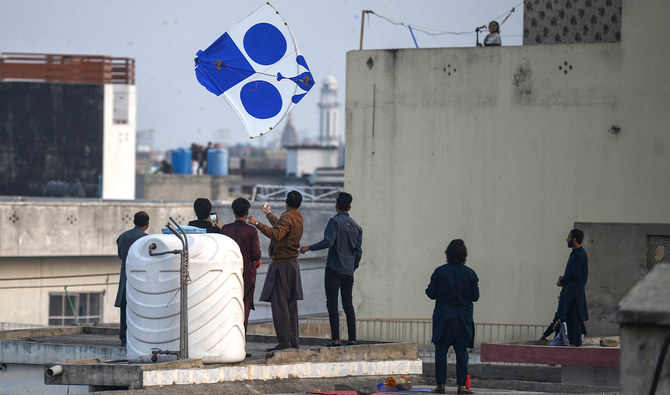
Youths fly kites on a rooftop during the Basant Kite Festival despite a ban imposed by authorities in 2007 following a spate of accidents, in Rawalpindi on February 18, 2022. (AFP/File)
Short Url
Updated 27 June 2024
Follow

Pakistan’s Punjab to toughen laws against kite flying— state media 

  • Punjab to set six months to three years, fine of Rs500,000 ($1795) for kite makers
  • Razor-sharp wires used to fly kites have caused numerous injuries, deaths in Punjab

ISLAMABAD: The government in Pakistan’s most populous Punjab province has decided to amend the Kite Flying Prohibition Ordinance 2001 to deter people from taking part in the activity, the state-run Associated Press of Pakistan (APP) reported on Thursday. 

Kite flying has long been a passion in South Asia and for decades, the Basant— a kite flying celebration— would transform Pakistan’s skies into a glittery kaleidoscope of hundreds of thousands of kites to commemorate the advent of spring. 

But in 2005, the Supreme Court banned the celebration after 19 people died from decapitation by stray strings. Thick strings or razor-sharp wires reinforced with glass and chemicals so they can better attack opponents’ kites and slice their strings, have been known to knock out power lines and, in some cases, tangle around a human neck or limb, causing serious injury or death.

“To prevent kite flying in Punjab, the government has decided to amend the Kite Flying Prohibition Ordinance 2001,” APP said, adding that the Punjab Law Department has sent a draft of the amendments to the Chief Minister’s Office in consultation with the Standing Committee on Law.

Quoting sources, the state media said that the amended ordinance suggests an imprisonment term for kite makers from six months to three years and a fine of up to Rs500,000 ($1795). 

The ordinance in its present form has set an imprisonment term of three years and a fine of Rs100,000 ($359) for those who make kites and fly them. 

“Also in the ordinance, there will be a fine for the children while the parents of the children have also been recommended to be punished,” APP said. 

The ban on kite flying has been lifted several times over the years for the period of Basant, but the sport still caused deaths as kite fliers continued to use wire or modified strings.


Pakistan’s capital police look to military expertise to build elite SWAT force

Updated 8 sec ago
Follow

Pakistan’s capital police look to military expertise to build elite SWAT force

  • A SWAT force is an elite, specially trained police unit that is deployed in high-risk and complex security situations
  • Islamabad police have requested attachment of two army majors, 16 SSG commandos for training of personnel

ISLAMABAD: Islamabad police have sought the assistance of Pakistan Army to help establish a Special Weapons and Tactics (SWAT) unit, an official said on Friday, as the capital police department undertakes multifaceted duties.

The development comes amid a surge in militancy in Pakistan and follows a suicide blast that killed 12 people and injured 36 others outside a district court’s complex in Islamabad’s G-11 sector in Nov. last year, prompting heightened security measures by authorities.

A SWAT force is an elite, specially trained police unit that is deployed in high-risk and complex situations that regular police are not equipped to handle. Various countries train their SWAT personnel in close-quarters combat, tactical movement and breaching, explosives handling and crisis response.

In a letter written to the Islamabad chief commissioner, Inspector General Ali Nasir Rizvi noted the capital police were performing multifaceted duties, including maintenance of law and order, crime prevention as well as security and route assignments, requesting the attachment of army personnel.

“We are establishing a SWAT [unit] and we have asked for officers from them to impart training and the National Police Academy has requested too,” he said.

The Islamabad police have inducted 200 personnel in the SWAT force that is likely to operate under the command and supervision of a senior superintendent of police, according to local media reports.

The capital police department seeks services of two army majors and 16 commandos from the military’s elite Special Services Group (SSG), according to the letter seen by Arab News. Of the 16 commandos, 10 are to be deputed at the National Police Academy.

Late last year, the Islamabad Capital Territory (ICT) administration also introduced an electronic tagging system as part of a broader effort to enhance surveillance, regulate traffic and improve record-keeping in a city that hosts the country’s main government institutions, foreign missions and diplomatic enclaves.

Under the system, vehicles are fitted with electronic tags that can be read automatically by scanners installed at checkpoints across the capital, allowing authorities to identify unregistered vehicles without manual inspections.