ISLAMABAD: A senior State Department official said on Wednesday the United States had consistently urged Pakistan to respect its citizens’ rights and legal obligations, following a resolution by US lawmakers demanding an impartial investigation into election manipulation allegations after the February 8 national polls.
The US House of Representatives overwhelmingly voted for a resolution to support democracy in Pakistan a day earlier, condemning “attempts to suppress the people of Pakistan’s participation in their democracy” and asking the government to respect due process of law, freedom of press and free speech in Pakistan.
While Pakistan’s Defense Minister Khawaja Asif dismissed the resolution as having “no value” and described it as political posturing in a US election year, experts pointed out that 85 percent of House members had voted on it, with 98 percent endorsing it.
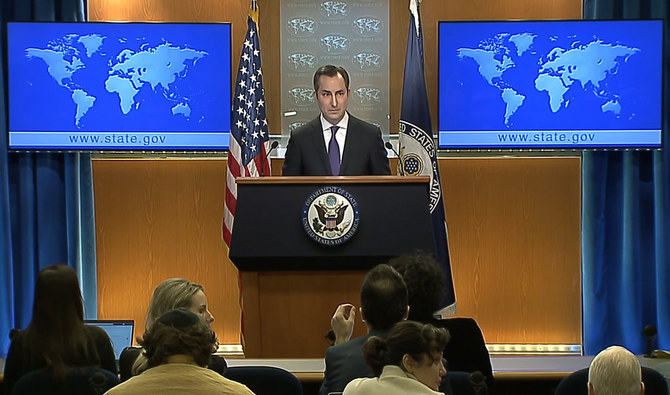
Asked about the resolution, which also prodded President Joe Biden’s administration to collaborate with Pakistan in upholding democracy, human rights and rule of law, State Department Spokesperson Matthew Miller said Washington was already committed to these principles.
“I’m not going to comment on that resolution specifically, but speaking generally, our most senior officials – including Secretary [Antony] Blinken and Ambassador [Donald] Blome – have consistently both privately and publicly urged Pakistan to respect the rights of its people and live with its constitutional and international obligations,” he said.
“We continuously urge the Government of Pakistan to respect human rights and fundamental freedoms, including the freedoms of expression, association, peaceful assembly, and religion, as well as the rights of marginalized populations such as women and religious minorities,” he added.
Pakistan’s foreign office released a statement after the US House had voted, saying the resolution “stems from an incomplete understanding of the political situation and electoral process in Pakistan.”
However, the country’s defense minister was more curt in his response, saying the US had “no right to interfere in our internal affairs or give any sort of verdict on the matter.”
Washington’s support will be crucial for Islamabad in coming weeks as it looks to secure a fresh bailout from the International Monetary Fund to stave off an economic crisis.
The resolution will not have much impact on Washington’s policy toward Pakistan, Michael Kugelman, director of the Wilson Center’s South Asia Institute, said in a post on social media platform X.
But, he added, it raised questions about whether Pakistan legislation could follow, noting bipartisan support for the resolution.
- With inputs from Reuters


![]()

US says efforts already underway to strengthen Pakistan’s democracy after Congress seeks election probe
Short Url
https://arab.news/5t8kb
US says efforts already underway to strengthen Pakistan’s democracy after Congress seeks election probe
- US House resolution prodded Biden administration to collaborate with Pakistan in upholding democracy, human rights
- Pakistan’s defense minister Khawaja Asif says the United States has ‘no right to interfere in our internal affairs’
Latest updates







© 2026 SAUDI RESEARCH & PUBLISHING COMPANY, All Rights Reserved And subject to Terms of Use Agreement.