Seoul: North Korea successfully tested its multiple-warhead missile capability, state media said Thursday, as dozens more trash-laden balloons from Pyongyang landed in the South.
Relations between the two Koreas are at one of their lowest points in years, with Pyongyang ramping up weapons testing while bombarding the South with balloons full of trash it says are in retaliation to similar missives sent northwards by activists in the South.
The balloons briefly forced Seoul’s major hub Incheon Airport to close on Wednesday, and in response to the successive launches, South has fully suspended a tension-reducing military treaty and re-started propaganda loudspeaker broadcasts and live-fire drills near the border.
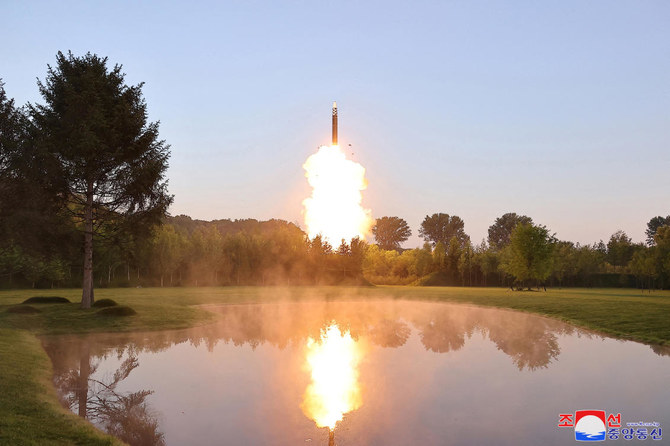
North Korea claimed it had “successfully conducted the separation and guidance control test of individual mobile warheads,” the state-run Korean Central News Agency (KCNA) said Thursday.
The “separated mobile warheads were guided correctly to the three coordinate targets” during the test, carried out the day before, it said.
“The test is aimed at securing the MIRV capability,” KCNA added, referring to multiple independently targetable reentry vehicle technology — or the ability to fire multiple warheads on a single ballistic missile.
South Korea’s military had previously said the North’s test on Wednesday appeared to be of a hypersonic missile, but that the launch ended in a mid-air explosion.
More smoke than usual appeared to emanate from the missile, raising the possibility of combustion issues, the official said, adding it may have been powered by solid propellants.
According to KCNA, the test “was carried out by use of the first-stage engine of an intermediate-range solid-fuel ballistic missile within a 170-200 kilometer (105 to 124-mile) radius.”
“The effectiveness of a decoy separated from the missile was also verified by anti-air radar,” it said.
Acquiring multiple-warhead missile technology is an ultimate goal for nations seeking ICBM-level missiles to carry nuclear warheads, said Hong Min, a senior research fellow at the Korea Institute for National Unification.
It appears the North is “testing such technology step by step over the long haul,” he told AFP.
“They appear to be making technological advancements in the early development stages of multiple-warhead missiles.”
For three consecutive days, North Korea has floated hundreds of trash-carrying balloons southward in a tit-for-tat propaganda campaign.
Seoul’s military said around 70 balloons had landed by Thursday morning, mainly in northern Gyeonggi province and the Seoul area, with the contents found to not be hazardous.
“The payload is about 10 kilograms (22 pounds), so there is a risk if the balloons descend rapidly,” it said, adding the military was ready to respond.
The response to the latest balloons “will be flexible depending on the strategic and operational situation. This depends on North Korea’s actions,” it added.
South Korea’s Marine Corps resumed live-fire exercises on islands near the western inter-Korean border on Wednesday, marking the first such exercises since the 2018 tension-reducing military deal with the North was fully suspended this month.
South Korea and the United States also staged joint air drills Wednesday involving around 30 aircraft, including Washington’s advanced stealth fighter jet, F-22 Raptor.
President Yoon Suk Yeol visited a US aircraft carrier on Tuesday that arrived in South Korea for joint trilateral military drills this week aimed at countering North Korean threats.
The drills, which run from Thursday to Saturday, involve Washington’s nuclear-powered aircraft carrier the USS Theodore Roosevelt, Tokyo’s guided missile destroyer JS Atago, and Seoul’s fighter jet KF-16s, among other assets.
Pyongyang has routinely criticized such exercises as rehearsals for an invasion.


![]()

North Korea says successfully tested multiple-warhead missile
Short Url
https://arab.news/8q2j2
North Korea says successfully tested multiple-warhead missile
- South Korea’s military had previously said the North’s test on Wednesday appeared to be of a hypersonic missile
- Acquiring multiple-warhead missile technology is an ultimate goal for nations seeking ICBM-level missiles to carry nuclear warheads


Latest updates


© 2026 SAUDI RESEARCH & PUBLISHING COMPANY, All Rights Reserved And subject to Terms of Use Agreement.