

Pakistan Navy warship Babur returns after joint exercises with Saudi Arabia, Turkiye

This handout photograph, taken and released by Pakistan Navy, shows Pakistan Navy’s warship Babur sit in the dock at the Karachi Naval Dockyard in Karachi on June 26, 2024. (Photo courtesy: Pakistan Navy)
Short Url
Updated 27 June 2024
Follow

Pakistan Navy warship Babur returns after joint exercises with Saudi Arabia, Turkiye

  • PNS Babur warship conducted joint exercise with Saudi Arabia’s Al-Riyadh frigate in Jeddah last Wednesday
  • Pakistan and Turkiye launched warship last year, which is part of a four-vessel deal between the two countries

ISLAMABAD: Pakistan Navy’s warship PNS Babur returned to Karachi on Wednesday after holding separate joint exercises with Turkiye and Saudi Arabia this month, the navy said in a statement. 
Last Wednesday, the Pakistani ship visited the Jeddah port where it conducted a joint exercise with Saudi Arabia’s Al-Riyadh frigate to strengthen mutual cooperation between the two countries. 
On June 15, PNS Babur participated in bilateral exercise TURGUTREIS-IX at the Aksaz naval base in Turkiye. Their activities encompassed harbor and sea exercises, where the two navies rehearsed various maritime operations and enhanced interoperability.
The navy organized a ceremony at the dockyard in Karachi to welcome PNS Babur upon its arrival on Wednesday, the Pakistan Navy said in a statement. Commander Pakistan Fleet Vice Admiral Muhammad Faisal Abbasi was the chief guest. 
“While addressing the ceremony, Commander Pakistan Fleet highlighted that PN MILGEM class corvettes will significantly enhance Pakistan Navy’s capability of safeguarding maritime frontiers,” the navy said.
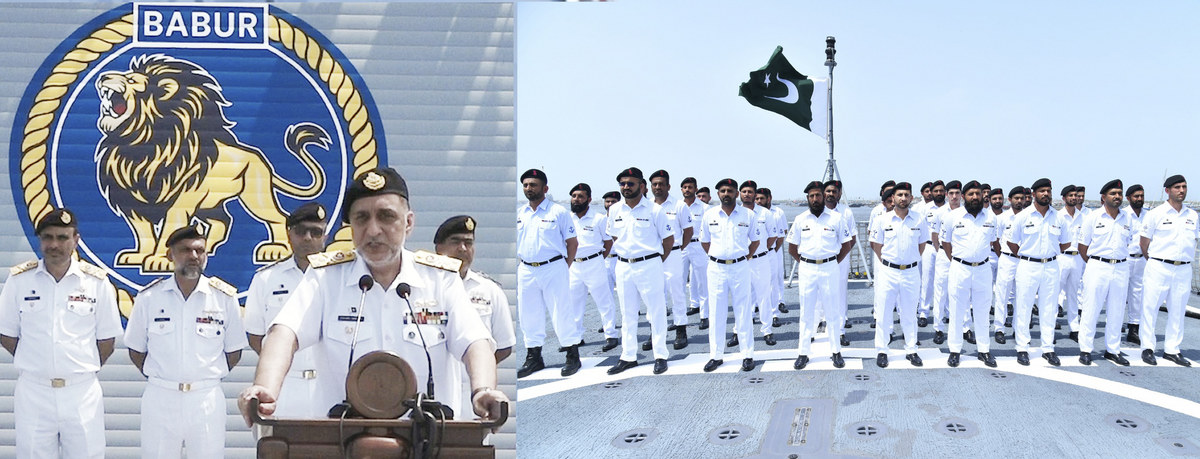


In this handout combination of photos, taken and released by Pakistan Navy, Commander Pakistan Fleet Vice Admiral Muhammad Faisal Abbasi (left) addresses the crew of Pakistan Naval Ship Babur at the Karachi Naval Dockyard in Karachi on June 26, 2024. (Photo courtesy: Pakistan Navy)

 “And reinforce the initiative of Pakistan Navy for independently conducting regional maritime security patrols of the Indian Ocean region.”
Abbasi emphasized that the MILGEM class project is a manifestation of Pakistan and Turkiye’s defense cooperation.
The two countries jointly launched PNS Babur last year, which is part of a four-vessel deal between Islamabad and Ankara.
Turkiye announced in 2017 the two countries had signed a memorandum of understanding for the sale of four Turkish-made corvette warships and 52 Pakistan-made training planes for Ankara’s armed forces. 
Ankara described it as Turkiye’s biggest single military export deal and “a very important day” for the defense industry. The contract was formally signed in 2018.
Under the deal, the Karachi Shipyard (KS&EW) would buy four corvettes made under Turkiye’s MILGEM warship program, aimed at designing and building locally a fleet of multipurpose corvettes and frigates that could replace older ships. 
As per the 2018 contract, two of the ships were to be manufactured in Istanbul and two in Karachi.


Islamabad says Pakistan Saudi Arabia Economic Cooperation Framework initiatives ‘being materialized’

Updated 4 sec ago
Follow

Islamabad says Pakistan Saudi Arabia Economic Cooperation Framework initiatives ‘being materialized’

  • Pakistan, Saudi Arabia agreed to launch framework in October to expand trade, investment ties in priority sectors
  • Pakistan views Saudi Arabia as a vital regional ally that has helped it avert macroeconomic crises over the years

ISLAMABAD: Pakistan’s foreign office spokesperson said on Thursday that certain initiatives related to the Pakistan Saudi Arabia Economic Cooperation Framework “are being materialized,” describing the economic partnership between the two countries as “solid, firmly rooted.”

Islamabad and Riyadh agreed to launch an Economic Cooperation Framework in October, as per the Prime Minister’s Office (PMO), to expand bilateral trade and investment ties. This decision was taken during a meeting between Prime Minister Shehbaz Sharif and Saudi Crown Prince Mohammed bin Salman in Riyadh. 

Sharif’s office had said the framework will see the two countries focus on priority sectors including energy, industry, mining, information technology, tourism, agriculture and food security. 

“Pakistan-Saudi economic partnership is solid, firmly rooted,” Tahir Andrabi, the foreign office spokesperson, said during a weekly news briefing. “There were certain initiatives taken during the visit of our prime minister to the Kingdom of Saudi Arabia and are being materialized.”

Andrabi said Pakistan’s Special Investment Facilitation Council (SIFC) and the Board of Investment are working on “individual investments” between the two countries but did not provide any further details. 

Pakistan’s Finance Minister Muhammad Aurangzeb departed for Riyadh on Wednesday to attend the three-day Global Development Finance Conference, where he is expected to present Islamabad’s perspective on climate adaptation and financing.

“During the conference, Finance Minister Senator Muhammad Aurangzeb will participate in a high-level session on climate adaptation and resilience, where he will join global leaders in discussing how developing countries can secure the capital needed to address climate vulnerabilities,” the Finance Division said in a statement on Wednesday. 

Aurangzeb is also scheduled to hold bilateral meetings with senior Saudi officials, including leadership of the National Development Fund and the Ministry of Finance, to discuss development financing, investment opportunities and broader economic cooperation.

The finance chief will additionally meet Pakistan’s diplomatic mission in Riyadh to review ongoing economic diplomacy initiatives.

Pakistan and Saudi Arabia have long enjoyed close ties but have sought to broaden cooperation in recent months. 

In September, the two countries signed a security agreement pledging that aggression against one would be treated as an attack on both. The move was widely viewed as formalizing longstanding military cooperation into a binding commitment aimed at bolstering joint deterrence.

The Kingdom also hosts more than 2.5 million Pakistani expatriates and serves as the largest source of remittances for Pakistan’s $407 billion economy.