Defense chief says Israel doesn’t want war but warns Hezbollah; cites progress on resolving weapons rift with US

1 / 2
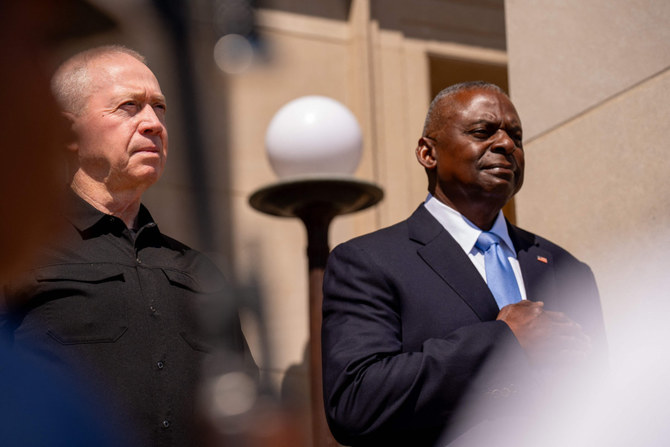
US Secretary of Defense Lloyd Austin and Israeli Defense Minister Yoav Gallant stand during an honor cordon at the Pentagon on June 25, 2024 in Arlington, Virginia. (Getty Images/AFP)
2 / 2
Israeli Defense Minister Yoav Gallant (L) and his delegation meet with US officials led by Secretary of Defense Lloyd Austin (R)at the Pentagon on June 25, 2024 in Arlington, Virginia. (Getty Images/AFP)
Short Url
Updated 27 June 2024
Follow

Defense chief says Israel doesn’t want war but warns Hezbollah; cites progress on resolving weapons rift with US

  • Israel ready to inflict “massive damage” on Hezbollah if diplomacy fails, says Yoav Gallant
  • US in “fairly intensive conversations” with Israel, Lebanon and other actors to avoid a “major escalation”
  • Also reassured that Israel was "committed to and firmly backing" Biden's deal to end the Gaza war

WASHINGTON: Israeli Defense Minister Yoav Gallant said on a visit to Washington that his country does not want war in Lebanon but was ready to inflict “massive damage” on Hezbollah if diplomacy fails.

“We do not want war, but we are preparing for every scenario,” Gallant told reporters during the visit that ended Wednesday.“Hezbollah understands very well that we can inflict massive damage in Lebanon if a war is launched,” he said.

Tensions have been rising, with growing skirmishes along the border between Israel and the Iranian-backed militia, since the October 7 attack by Hamas that prompted a relentless Israeli retaliatory campaign in Gaza.

Gallant said that Israel has killed more than 400 Hezbollah “terrorists” in recent months.
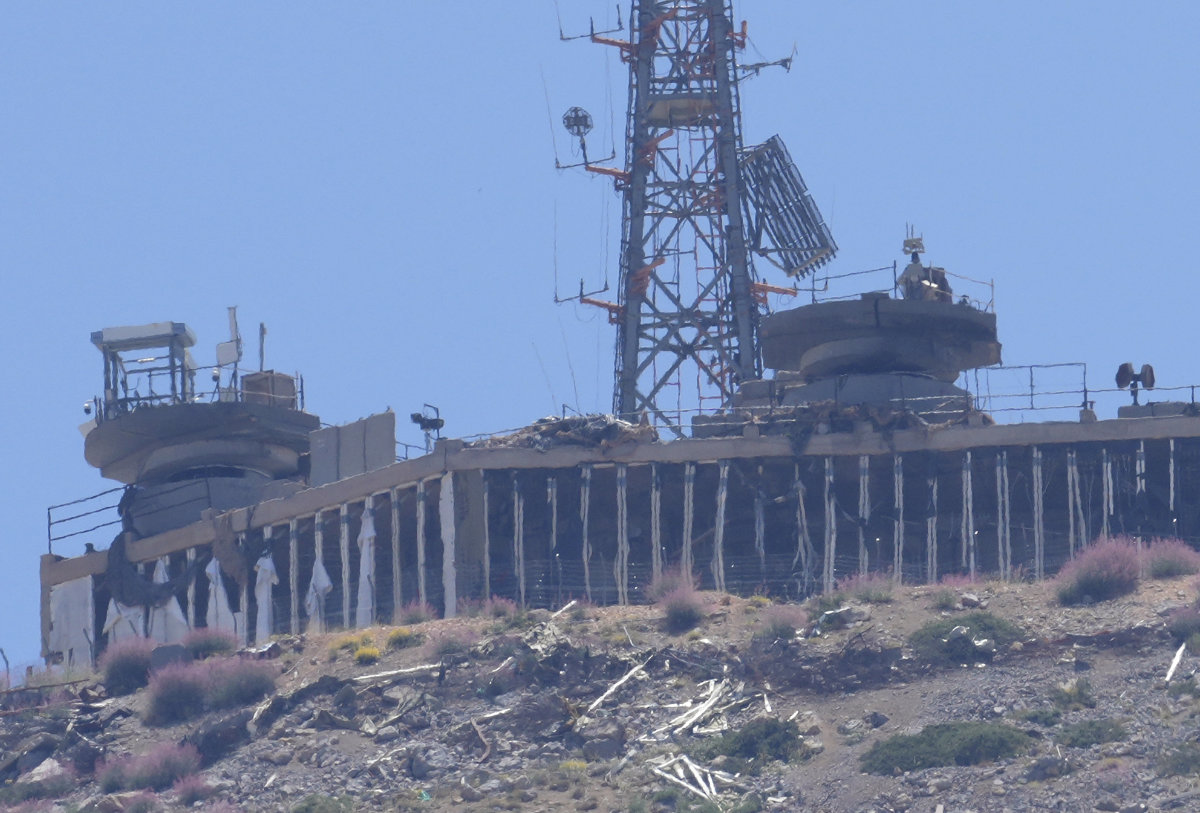


A damaged Israeli military position targeted by Hezbollah fighters is seen on the top of Mount Hermon in the Israeli-controlled Golan Heights, where the borders between Israel, Syria and Lebanon meet. (AP Photo)

The Israeli defense minister was in Washington for three days meeting with officials in a bid to quietly resolve a rift over US weapons shipments, drawing an implicit contrast to Prime Minister Benjamin Netanyahu’s more confrontational approach.

“During the meetings we made significant progress, obstacles were removed and bottlenecks were addressed,” Gallant said after meeting with Jake Sullivan, Biden’s national security adviser.

Gallant said the progress was on “a variety of issues” including “the topic of force build-up and munition supply that we must bring to the state of Israel.”

“I would like to thank the US administration and the American public for their enduring support for the state of Israel,” he said.

Netanyahu in recent days has publicly accused the Biden administration of slowing down weapons deliveries to Israel, which has been at war in Gaza since an October 7 attack by Hamas.

US officials have denied the accusations and showed annoyance, months before an election in which Biden’s support for Israel has become a liability with a left flank of his Democratic Party outraged by the heavy death toll among Palestinian civilians.

The US in early May froze a shipment that included 2,000-pound bombs and Biden warned of a further halt as he pressed Israel not to carry out a wide-scale military assault of Rafah, the southern Gaza city where more than one million displaced Palestinians had sought shelter.

A senior US administration official said the United States has sent more than $6.5 billion in weapons to Israel since October 7, with nearly $3 billion alone in May.

“This is a massive, massive undertaking and nothing is paused other than one shipment,” the official told reporters on condition of anonymity.

The official blamed the rift on misunderstandings of the “complex” US bureaucratic process. He said Gallant’s team and US experts went through “every single case.”

“There was real progress and a mutual understanding of where things stand, of prioritization of certain cases over others, so that we can make sure that we are moving things in ways that meet the needs of the Israelis,” he said.
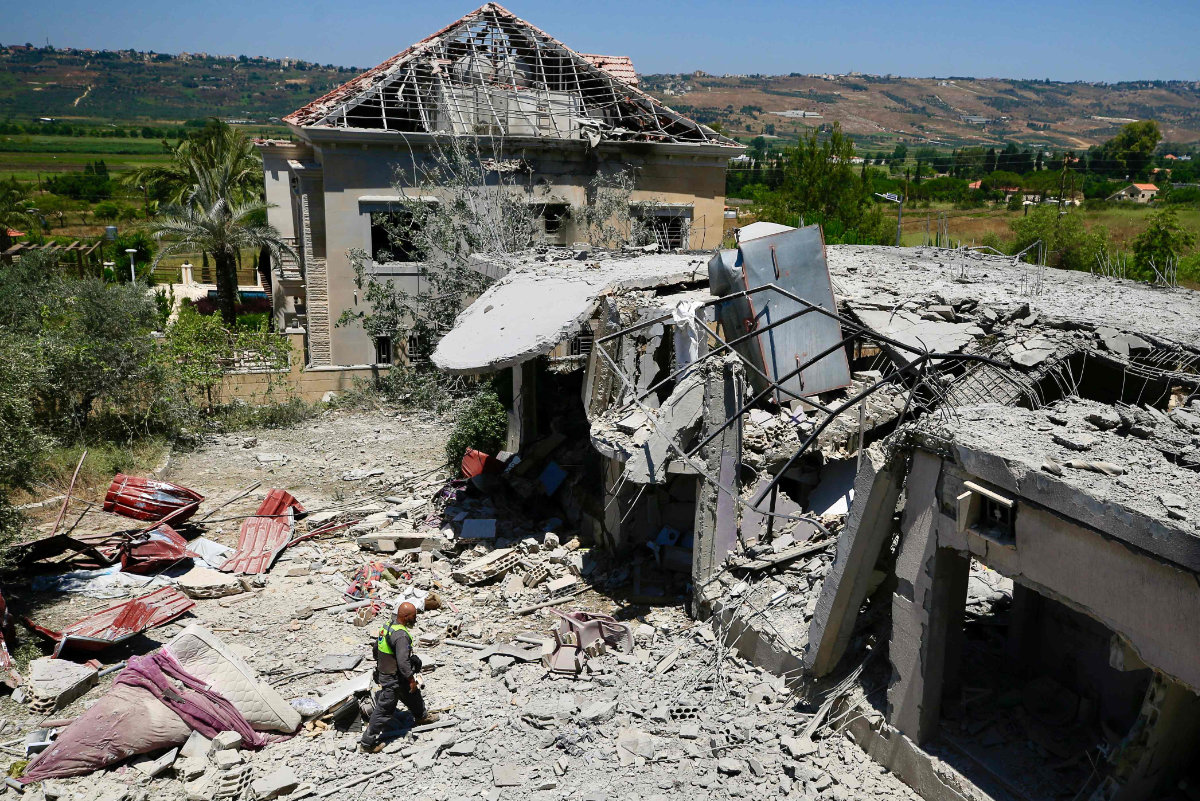


A Lebanese civil defense member inspects the site of an Israeli airstrike on the southern village of Khiam near the Lebanese border with northern Israeli on June 26, 2024. (AFP)

Biden — whose approach to Israel has drawn criticism both from progressives and the right — held off on curbing weapon deliveries after Israel carried out what US officials described as comparatively targeted operations in Rafah.

Netanyahu and Gallant have said the most intense phase of the fighting is over — with Israel set to shift forces toward the border with Lebanon after rising skirmishes with the Iranian-backed militant movement Hezbollah.

The US official said Washington remained in “fairly intensive conversations” with Israel, Lebanon and other actors and believed that no side sought a “major escalation.”

Gallant, who met twice in Washington with Amos Hochstein, the US pointman between Israel and Lebanon, reassured that his country was trying to avoid an all-out war with the Iran-backed Hezbolla militia of Lebanon.

“We do not want war, but we are preparing for every scenario,” Gallant told reporters.

US officials including Secretary of State Antony Blinken have voiced hope that a ceasefire in Gaza could lead to a reduction in tension over Lebanon as well.

Biden on May 31 laid out a plan for a temporary ceasefire and release of hostages, but Hamas came back with further demands.

Despite criticism of the proposal from some of Netanyahu’s far-right allies, Gallant said, “We are all committed to and firmly backing the president’s deal.”

“Hamas must accept it or bear the consequences,” he said.

The Gaza war began with Hamas’s October 7 attack on southern Israel that resulted in the deaths of 1,195 people, mostly civilians, according to an AFP tally based on Israeli figures.

The militants also seized about 250 hostages, 116 of whom remain in Gaza, although the army says 42 are dead.

Israel’s retaliatory offensive has killed at least 37,718 people, also mostly civilians, according to data from Hamas-run Gaza’s health ministry.


Rubio plans to visit Israel next week as US-Iran tensions remain high after latest talks

Updated 5 sec ago
Follow

Rubio plans to visit Israel next week as US-Iran tensions remain high after latest talks

TEL AVIV: Secretary of State Marco Rubio will make a quick trip to Israel early next week, the State Department said, as tensions between the United States and Iran remain high after their latest nuclear talks and American forces gather in the region.
The US Embassy in Israel had earlier urged staff who want to leave to depart, joining other nations in encouraging people to leave the region and signaling that US military action might be imminent. The announcement of Rubio’s visit could indicate a longer timeline for any potential strike.
A confidential report from the UN nuclear watchdog meanwhile confirmed that Iran has not offered inspectors access to sensitive nuclear sites since they were heavily bombed during the 12-day war launched by Israel last June. As a result, it said it could not confirm Iran’s claims that it stopped uranium enrichment after the US and Israeli strikes.
The report was circulated to member countries and seen by The Associated Press.
US President Donald Trump has threatened military action if Iran does not agree to a far-reaching deal on its nuclear program. Iran insists it has the right to enrich uranium for peaceful purposes and denies seeking a nuclear weapon.
Those wishing to leave ‘should do so TODAY’
The State Department said in a statement that Rubio would visit Israel on Monday and Tuesday to “discuss a range of regional priorities including Iran, Lebanon, and ongoing efforts to implement President Trump’s 20-Point Peace Plan for Gaza.” It offered no other details.
Israeli Prime Minister Benjamin Netanyahu has long urged tougher US action against Iran, and has warned that Israel will repond to any Iranian attack.
The announcement of Rubio’s visit came just hours after the US Embassy in Jerusalem implemented “authorized departure” status for non-essential personnel and family members, which means that eligible staffers can leave the country voluntarily at government expense.
In an email, US Ambassador Mike Huckabee urged staff considering departure to do so quickly, advising them to focus initially on getting any flight out of Israel and to then make their way to Washington.
“Those wishing to take AD should do so TODAY,” Huckabee wrote, using an acronym for “authorized departure.”
“While there may be outbound flights over the coming days, there may not be,” he added, in an email that was recounted to The Associated Press by someone involved with the US mission who wasn’t authorized to share details.
On a town hall meeting Friday after the email was sent, Huckabee told staff that he was encouraging airlines to keep flying.
Vance to meet with mediator
Iran and the United States on Thursday walked away from another round of nuclear negotiations in Geneva without a deal. Technical discussions are scheduled to take place in Vienna next week.
US Vice President JD Vance was to meet later on Friday in Washington with Oman’s foreign minister, Badr Al-Busaidi, who has been mediating the talks, according to a person with knowledge of the meeting who spoke on condition of anonymity because the meeting is private.
Earlier, Al-Busaidi said that there had been significant progress made on Thursday, though officials from Iran and the United States haven’t announced steps forward.
Iranian Foreign Minister Abbas Araghchi on Thursday said “what needs to happen has been clearly spelled out from our side,” without offering specifics. Iran has long demanded relief from heavy international sanctions in return for taking steps to limit but not end its nuclear program.
Flights suspended as people are urged to leave

The US has gathered a massive fleet of aircraft and warships in the Middle East, with one aircraft carrier already in place and another heading to the region. Iran says it will respond to any US attack by targeting American forces in the region, potentially including those stationed in US bases in allied Arab countries.
Airlines such as Netherlands-based KLM have already announced plans to suspend flights out of Tel Aviv’s Ben Gurion International Airport, and other embassies have also made plans for authorized departures from Israel and neighboring countries.
Britain’s Foreign Office said that “due to the security situation, UK staff have been temporarily withdrawn from Iran.” It said the embassy was operating remotely.
Australia on Wednesday “directed the departure of all dependents of Australian officials posted to Israel in response to the deteriorating security situation in the Middle East.” China, India and several European countries with missions in Iran have advised citizens to avoid travel to the country.
China’s Foreign Ministry also advised its citizens already in Iran to leave, according to a statement reported by Chinese state media.