

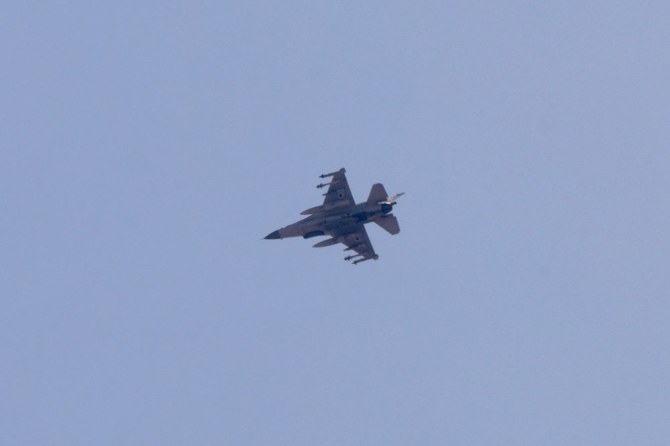

BEIRUT: Fighting between Hezbollah and the Israeli army continued in regions along the border between Lebanon and Israel on Tuesday, with artillery exchanges and drone strikes in both directions.
During a meeting with Ori Gordin, the head of the Northern Command, Israeli Air Force Commander Tomer Bar confirmed “an increase in readiness for any attack on Lebanon,” Russia Today reported.
Meanwhile, Hezbollah said it carried out “an attack with assault drones on a brigade headquarters in Nahal Gershom, targeting the positions and settlement of enemy officers and soldiers.” The group said it also attacked “the Bayad Blida and Birkat Risha sites.”
The Israeli army targeted the outskirts of the town of Khiam and the village of Blida with artillery and warplanes. In the Wazzani area, a Syrian driver was forced to jump from his truck for his life when the Israeli army opened fire on it with machine guns.
Israeli combat drones launched from Misgav Am dropped shells on the border town of Taybeh. No injuries were reported as the town, like many close to the border, has been abandoned by residents.
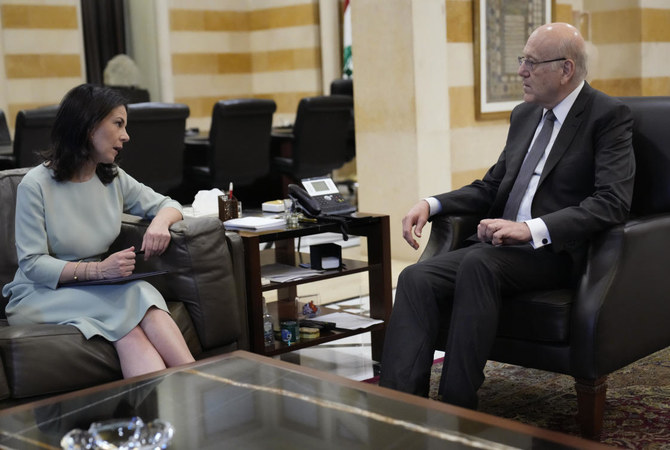
German Foreign Minister Annalena Baerbock arrived in Beirut on Tuesday evening following meetings in Tel Aviv on Monday and the West Bank on Tuesday. She was expected to meet Lebanese officials to discuss the situation in southern Lebanon and Israel’s threats of an expanded war against Hezbollah.
Meanwhile, the Vatican’s secretary of state, Cardinal Pietro Parolin, who is also visiting Lebanon, held talks at the headquarters of the Maronite Patriarchate that focused on “finding solutions for Lebanon and its suffering people.”
He said there is a deep political rift between Christians in Lebanon and Hezbollah over the latter’s decision to go to war without consulting the state, the group’s demands relating to the selection of a candidate to fill the post of president, which has been vacant since October 2022, and the disruptions it has caused during parliamentary sessions to discuss the election of a new president.
The vice president of the Supreme Islamic Shiite Council, Sheikh Ali Al-Khatib, declined an invitation to attend a lunch hosted by the Maronite Patriarchate in honor of Parolin, to which all Islamic and Christian spiritual authorities and the heads of Christian political parties in Lebanon were invited.
A council source said: “The sheikh did not take part in the meeting in protest against positions expressed by the Maronite patriarch, Bechara Al-Rahi, concerning the resistance.”
In his most recent Sunday sermon, Al-Rahi objected to the failure to elect “a president who negotiates according to constitutional powers, and asks the UN Security Council to implement its resolutions. This means that Lebanon will not go back to being a launching pad for terrorist actions that destabilize the region’s security and stability.”
Al-Khatib is considered a supporter of Hezbollah. His representative, Grand Jaafari Mufti Sheikh Ahmed Qabalan, criticized Al-Rahi’s sermon without naming him, saying: “There is no neutrality when it comes to what is right and there should be no bias toward what is wrong.” He also spoke of “the resistance’s role in protecting the church in Syria and Lebanon in the face of Daesh and Al-Nusra attacks.”
When Lebanon’s religious leaders met Parolin, Al-Rahi called on all Christians in the country “to consider next Sunday as a day of prayer for peace in southern Lebanon and Gaza.”
During a ceremony hosted by the Embassy of Malta, Parolin stressed the “importance of the church in Lebanon being a testament to coexistence, which is one of the most significant characteristics of the ‘Land of the Cedars.’”
He added: “Lebanon is suffering from a great vacuum and a diminishing Christian life,” as he called on officials “to elect a president as soon as possible to calm the situation and overcome the current difficulties.”


