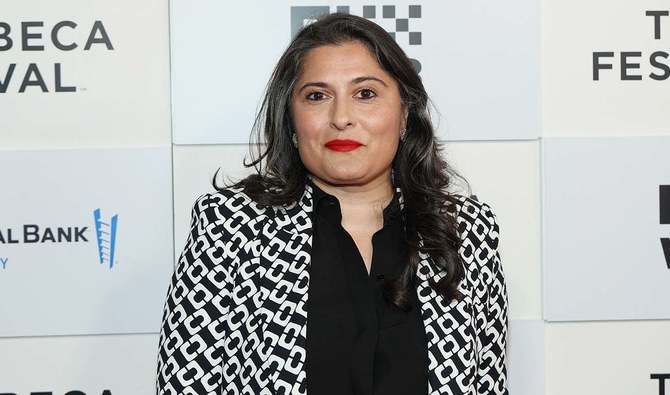

Filmmaker Sharmeen Obaid-Chinoy’s oeuvre defies simple categorization.
She’s made documentaries about acid attack victims and child refugees. She’s focused her lens on the extraordinary life of designer Diane von Furstenberg. She’s spearheaded animated films for and about Pakistani children. She’s directed episodes of “Ms. Marvel” and is developing a Star Wars film. And she’s won two Oscars along the way.
It’s not a conventional resume or trajectory — nothing that anyone would teach or even think to advise in a film school or a masterclass about making it in Hollywood. But for Obaid-Chinoy , it’s working. And it’s made her one of the most interesting storytellers in the business.
“I’ve been able to follow my own yellow brick road to Hollywood,” Obaid-Chinoy said in a recent interview with The Associated Press. “Having Academy Awards has helped that, but most importantly so many young filmmakers around the world write to me and tell me how my unconventional choices ... make them believe that that yellow brick road can be walked on by many people.”
Her newest film is “Diane von Furstenberg: Woman in Charge,” which is streaming on Hulu. With a co-directing credit shared with Trish Dalton, it’s an intimate portrait of the fashion tycoon, who is raw and honest about everything: death, dalliances, ambitions, love, failures and everything in between.
“I hope it’s inspiring to a lot of girls and women to know that they can be the women they want to be,” von Furstenberg said.
They met 12 years ago on stage at Carnegie Hall where von Furstenberg was presenting Obaid-Chinoy with a Glamour Woman of the Year Award and have kept in touch since. When von Furstenberg decided she was ready to tell her own story, she wanted Obaid-Chinoy to do it and gave her full access to herself, her family and her archives.
“I’ve always made films about women who are on the front lines, who are faced with extraordinary circumstances and who rise to that occasion,” she said. “Diane is very much in line with that.”
It’s a busy time for the filmmaker, who is also in early development on Akiva Goldsman’s adaptation of the Marcus Sakey novel “Brilliance” and working with Kathleen Kennedy and Steven Knight on a “Star Wars” film about Daisy Ridley’s Rey at a jedi academy, both of which she’ll direct.
Obaid-Chinoy didn’t start out with filmmaking aspirations, however. Her entry to storytelling was as a teen journalist in Pakistan. The eldest of six, five of whom were girls, she was a naturally inquisitive young person who wanted to know about the world around her. She would pepper her mother with questions: Why did she get to go to school while other kids were begging on the street? Why was there inequality? Why were women forced to live a certain kind of life?
When she was around 14, her mother suggested she start putting these questions in writing. So, she did. Obaid-Chinoy wrote a letter to the local English language newspaper in Pakistan — the first of many letters that would open doors to new opportunities and career advancements. By 17, she was doing investigative reporting for the paper.
It wasn’t until October 2001, as she was nearing her graduation at Smith College, that she realized she wanted to do more visual storytelling. Her first idea was to go to Afghanistan and focus on the ordinary people living there. She sent her proposal out to about 80 organizations and finally got a response, from New York Times Television. With $7,500 from them and $7,500 from her school, she made “Terror’s Children,” which was broadcast on television and won several awards: Suddenly she was a documentary filmmaker to watch.
In 2012, at 33, she made Oscars history as the first Pakistani Academy Award winner for her documentary short “Saving Face,” an eye-opening film about women disfigured by acid attacks and the plastic surgeon trying to help them.
One of its fans was Angelina Jolie, who wrote in Time Magazine that Obaid-Chinoy, one of their 100 most influential people of 2012, was helping to shape the dialogue on Pakistan and inspire change in legislation.
“Giving voice to those who cannot be heard,” Jolie wrote, “she celebrates the strength and resilience of those fighting against seemingly insurmountable odds — and winning.”
A few years later, her film “A Girl in the River: The Price of Forgiveness,” about a teen who survives an “honor killing” attempt by her father and uncle, helped inform the repeal of a forgiveness loophole for perpetrators. It also won the Oscar.
After that, she felt an urge to create something more visual and set up an animation studio in Pakistan.
“I began to work more with actors and narrative work,” she said. “And out of this grew a need to do something that would take my experiences being embedded around the world as a filmmaker and create something that would give life to characters that would be loved around the world.”
So, she wrote another letter, this time to Marvel Studios, raising her hand to help with the Disney+ series “Ms. Marvel.” She directed episodes around the superhero’s trip to modern-day Pakistan and 1947 India.
This new phase of her career has put her in a bigger spotlight, with higher profile opportunities, but it also comes with its downsides — just ask anyone involved in “Acolyte” about toxic fandoms. But she’s unbothered by the noise: She learned long ago from her mother to drown out the voices that aren’t helpful.
The chasm between serious-minded documentaries and fantasies about jedi knights might seem vast from the outside, but for Obaid-Chinoy it’s not so.
“My protagonists ... go on these hero’s journey and that are faced with adversities and that sort of, you know, rise up out of the ashes of that adversity. And in many of my films, they change the trajectory of a country, the trajectory of the community,” she said. “At the heart of it, that is Star Wars. And I’ve been telling that story for the last 20 years.”