

Houthis disappear dozens of UN, NGO staff in civil society crackdown

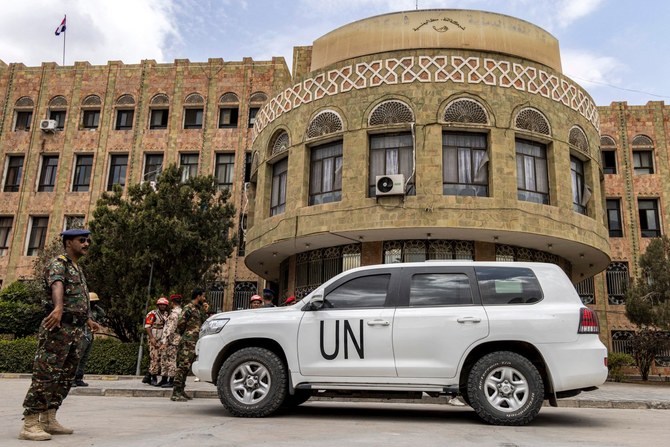
A United Nations vehicle is parked outside as the UN special envoy for Yemen meets with local officials in the country's third city of Taez on February 12, 2024 (AFP)
Short Url
Updated 26 June 2024
Follow

Houthis disappear dozens of UN, NGO staff in civil society crackdown

  • Human Rights Watch calls for immediate release of detainees
  • ‘The Houthis are using arbitrary detentions and enforced disappearances as a political tool’

London: Houthi authorities in Yemen must release dozens of people arrested and forcibly disappeared since May, Human Rights Watch said on Wednesday.

In a report, HRW said the Houthis have forcibly disappeared Yemenis in territory they control, including at least 13 UN staff, as part of a wider crackdown on civil society.

“The arbitrary arrests appear to be based on the detainees’ present or past employment,” HRW added.

Beginning May 31, Houthi forces began arresting employees of several NGOs, raiding homes and offices. One source said more than 60 people had been arrested as of June 12.

In all cases, Houthi forces “arrived unannounced at the homes of those they were aiming to arrest with several armored vehicles and an average of about 10 to 30 armed men,” HRW said.

“Almost all forces were wearing military uniforms and head and face coverings, sometimes with only their eyes showing. In many cases, the forces arrived early in the morning while families were still asleep.”

No search or arrest warrants were presented in any of the cases, and Houthi forces have denied requests from family members asking for the whereabouts of their kin. No formal charges have been brought against any of the detainees.

However, starting June 10, Houthi authorities began releasing a series of videos showing Yemeni men detained between 2021 and 2023 confessing to spying for Israel and the US.

HRW said there is a “high risk” that the confessions were coerced, and sources told the NGO that the timing of the releases was intended to “frame” the recently detained as part of a larger “spy network.”

UN Secretary-General Antonio Guterres and UN High Commissioner for Human Rights Volker Turk have called on the Houthis to release all UN and NGO staff.

Since the start of the raids in late May, many people in Houthi-controlled areas of Yemen have fled.

The existing “brain drain” from Houthi-controlled areas will only worsen as a result of the arrest campaign, one source told HRW.

Another said: “Although I managed to flee … I couldn’t sleep … I’ve had panic attacks every day since I fled from Sanaa … I’m very worried about my friends and colleagues in Sanaa who are just waiting for Houthis to arrest them.”

Since 2014, the Houthis have detained and forcibly disappeared hundreds of people, HRW said, warning that the militia regularly practices torture in detention facilities.

The Houthis have also “carried out significant violations of women’s rights and freedoms, have repressed freedom of speech and assembly, and have detained dozens of journalists, human rights defenders, academics, and political opponents,” the NGO added

Niku Jafarnia, Yemen and Bahrain researcher at HRW, said: “The Houthis are using arbitrary detentions and enforced disappearances as a political tool at a time when the people living in their territories lack even the most basic needs.

“The Houthis should immediately release all of these people, many of whom have spent their careers working to improve their country.

“The international community should be doing everything in their power to ensure that these people are immediately released.

“Many of them have been invaluable members of Yemeni civil society organizations and staff in UN agencies and nongovernmental international groups.”

One Yemeni living abroad told HRW: “It’s almost as if our life in Yemen is over after this. I thought I would move back and start a family there, and now it’s clear to me I can’t do that. We can’t live like this.”


First Ramadan after truce brings flicker of joy in devastated Gaza

Updated 55 min 51 sec ago
Follow

First Ramadan after truce brings flicker of joy in devastated Gaza

  • Ramadan lanterns and string lights appear on streets lined with collapsed buildings and piles of rubble in Gaza City
  • The first holy month since the October ceasefire brings mixed feelings for the many still living in tents

GAZA CITY: Little Ramadan lanterns and string lights appeared on streets lined with collapsed buildings and piles of rubble in Gaza City, bringing joy and respite as Islam’s holiest month began — the first since October’s ceasefire.
In the Omari mosque, dozens of worshippers performed the first Ramadan morning prayer, fajr, bare feet on the carpet but donning heavy jackets to stave off the winter cold.
“Despite the occupation, the destruction of mosques and schools, and the demolition of our homes... we came in spite of these harsh conditions,” Abu Adam, a resident of Gaza City who came to pray, told AFP.
“Even last night, when the area was targeted, we remained determined to head to the mosque to worship God,” he said.
A security source in Gaza told AFP Wednesday that artillery shelling targeted the eastern parts of Gaza City that morning.
The source added that artillery shelling also targeted a refugee camp in central Gaza.
Israel does not allow international journalists to enter the Gaza Strip, preventing AFP and other news organizations from independently verifying casualty figures.

‘Stifled joy’

In Gaza’s south, tens of thousands of people still live in tents and makeshift shelters as they wait for the territory’s reconstruction after a US-brokered ceasefire took hold in October.
Nivin Ahmed, who lives in a tent in the area known as Al-Mawasi, told AFP this first Ramadan without war brought “mixed and varied feelings.”
“The joy is stifled. We miss people who were martyred, are still missing, detained, or even traveled,” she said.
“The Ramadan table used to be full of the most delicious dishes and bring together all our loved ones,” the 50-year-old said.
“Today, I can barely prepare a main dish and a side dish. Everything is expensive. I can’t invite anyone for Iftar or suhoor,” she said, referring to the meals eaten before and after the daily fast of Ramadan.
Despite the ceasefire, shortages remain in Gaza, whose battered economy and material damage have rendered most residents at least partly dependent on humanitarian aid for their basic needs.
But with all entries into the tiny territory under Israeli control, not enough goods are able to enter to bring prices down, according to the United Nations and aid groups.

‘Still special’

Maha Fathi, 37, was displaced from Gaza City and lives in a tent west of the city.
“Despite all the destruction and suffering in Gaza, Ramadan is still special,” she told AFP.
“People have begun to empathize with each other’s suffering again after everyone was preoccupied with themselves during the war.”
She said that her family and neighbors were able to share moments of joy as they prepared food for suhoor and set up Ramadan decorations.
“Everyone longs for the atmosphere of Ramadan. Seeing the decorations and the activity in the markets fills us with hope for a return to stability,” she added.
On the beach at central Gaza’s Deir el-Balah, Palestinian artist Yazeed Abu Jarad contributed to the holiday spirit with his art.
In the sand near the Mediterranean Sea, he sculpted “Welcome Ramadan” in ornate Arabic calligraphy, under the curious eye of children from a nearby tent camp.
Nearly all of Gaza’s 2.2 million residents were displaced at least once during the more than two years of war between Israel and Hamas, sparked by the latter’s unprecedented October 7 attack on Israel.
Mohammed Al-Madhoun, 43, also lives in a tent west of Gaza City, and hoped for brighter days ahead.
“I hope this is the last Ramadan we spend in tents. I feel helpless in front of my children when they ask me to buy lanterns and dream of an Iftar table with all their favorite foods.”
“We try to find joy despite everything,” he said, describing his first Ramadan night out with the neighbors, eating the pre-fast meal and praying.
“The children were as if they were on a picnic,” he said.