

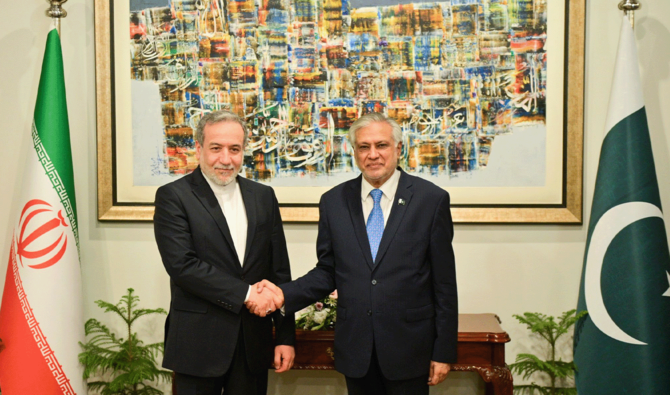

ISLAMABAD: Pakistan’s Deputy Prime Minister Ishaq Dar told Iranian Foreign Minister Abbas Araghchi in a phone call that Islamabad would continue promoting regional peace and stability amid uncertainty over a ceasefire following the recent exchange of military strikes between the US and Iran, the foreign office said on Saturday.
The contact between the foreign ministers comes at a moment when the US and Iran exchanged fresh military strikes following a drone attack on a Singapore-flagged oil vessel. The US said it targeted Iranian drone storage sites and coastal radar installations, while Iran’s Islamic Revolutionary Guard Corps (IRGC) said it struck US military positions in the region in retaliation.
The phone call follows Iranian President Masoud Pezeshkian’s visit to Pakistan earlier on Tuesday, during which he appreciated Islamabad’s role in facilitating the Iran-US Islamabad Memorandum of Understanding and advancing its implementation.
“DPM/FM reaffirmed Pakistan’s commitment to play its constructive role for achieving the goal of lasting peace and stability in the region and beyond,” Pakistan’s foreign office said in a statement after Dar spoke to his Iranian counterpart.
The statement highlighted that Araghchi expressed appreciation for Pakistan’s support in advancing the peace process and thanked Islamabad for facilitating the “safe and smooth” repatriation of Iranian fishermen.
Both the officials agreed to remain in close contact with each other, it added.
The latest violence comes at a delicate moment as Washington and Tehran attempt to negotiate a permanent end to the war under an interim agreement reached last week.
The attack on the Singapore-flagged oil vessel, Ever Lovely, occurred while the International Maritime Organization was evacuating stranded vessels from the Strait of Hormuz via an alternative route along Oman’s coastline.
The UN maritime agency suspended the operation after the attack, saying it would not resume until it received assurances that ships could transit safely.
Iran has increasingly asserted its control over the Strait of Hormuz, through which roughly a fifth of global oil supplies pass.
The latest exchange of fire has raised fresh doubts about whether both sides can maintain the ceasefire long enough to reach a lasting settlement.
Earlier on Friday, Lebanon, Israel and the US signed a trilateral framework agreement aimed at paving the way for a peace deal between the two long-time Middle East adversaries.
With input from AFP


