

Chery joins forces with Aimoga to enter smart robot industry

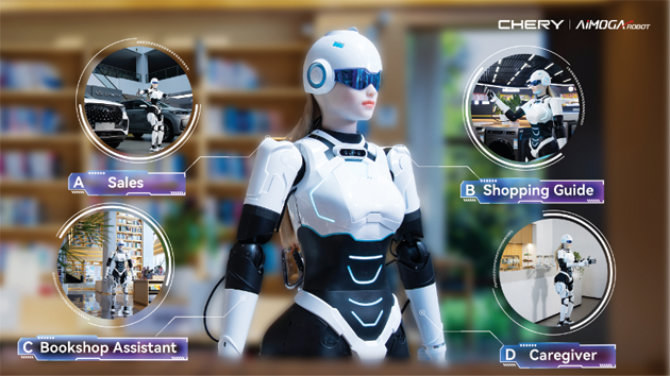
Mornine features a highly biomimetic design, with its face crafted from human-like silicone biomimetic material.
Short Url
Updated 25 June 2024
Follow

Chery joins forces with Aimoga to enter smart robot industry

Boston Dynamics is retiring Atlas, the famous iconic bipedal robot in existence. This news has sparked considerable interest within both the tech industry and the general public, raising questions about the future trajectory of robotics technology and potential development directions. 

As a trailblazer in humanoid robotics, Atlas has achieved global recognition for its remarkable mobility and dynamic balance capabilities, setting numerous milestones along the way. 

The retirement of Atlas serves as a microcosm, reflecting the broader development trajectory of the robotics field.

Meanwhile, a bipedal robot with Embodied AI, Mornine, a product of the collaborative efforts between Chery and Aimoga, is poised to make its debut at an upcoming CEO-themed conference.

Mornine is driven by electric motors and runs on battery power, departing from Atlas’ hydraulic system. While it may not match Atlas’s explosive power and performance on tough terrain, Mornine excels in scalability and cost-effectiveness, making it ideal for large-scale production and commercialization. Mornine features a highly biomimetic design, with its face crafted from human-like silicone biomimetic material. 

This material is engineered to deliver lifelike visual effects and tactile sensations. Moreover, Mornine can simulate human oral and facial muscle movements, articulating expressions like speaking, smiling, and opening its mouth convincingly.

Mornine is equipped with large language models that, when integrated with robotics technology, allow it to harness the model’s capabilities in understanding and generating language. This capability enables Mornine to accurately interpret verbal or written commands from humans and translate them into specific action strategies.

Mornine’s versatility spans across a wide spectrum of application scenarios, positioning it to pioneer a new customer ecosystem service system.

Its evolution unfolds through three transformative stages, each introducing groundbreaking features and expanding application horizons in response to technological advancements and evolving societal demands.

During the initial stage, Mornine serves as a proficient information provider and product adviser. For instance, within settings like automotive sales centers or showrooms, Mornine leverages its extensive knowledge base to deliver precise responses to customer inquiries and provide detailed product insights and recommendations via voice or screen interfaces.

Advancing into the second stage, Mornine integrates advanced capabilities such as visual recognition and autonomous navigation. It can autonomously navigate and guide customers to specific product locations, utilizing its dexterous robotic arms for physical demonstrations and operations, and even assisting customers with product handling tasks.

In its third and final developmental stage, Mornine evolves into a comprehensive home assistant, offering a myriad of services in home care scenarios.


Jeeny launches First–Last Mile Access in partnership with Medina Bus

Updated 19 December 2025
Follow

Jeeny launches First–Last Mile Access in partnership with Medina Bus

Jeeny has announced the introduction of its First-Last Mile Access Program in collaboration with Medina Bus, marking a significant step forward in Saudi Arabia's transportation reform. 

Passengers who buy a Medina Bus ticket can now get discounted Jeeny rides to and from key bus stops, making public transportation more accessible for both residents and pilgrims.

While the initiative appears modest, it represents a far wider vision: the first operational phase of Jeeny's goal to develop Saudi Arabia's next-generation Integrated Mobility Platform, an integrated framework that will eventually connect numerous modes of transportation under one seamless consumer experience.

Medina was chosen as the launch location because of its national importance and growing demand for efficient transportation. 

In 2024, the city's bus network handled 1.72 million people, and demand is predicted to increase further in 2025. 

Medina, being one of the Kingdom's most popular destinations, provides a real-world setting for evaluating concepts that can then be scaled across the country.

“This marks the beginning of a mobility shift in Saudi Arabia, where public transport and private operators can work together to offer a seamless journey,” said Hammad Ehtesham, CEO of Jeeny. “Making it easier for people to reach public transport is the foundation of a future where every mode of mobility in the Kingdom connects effortlessly.”

With millions of rides every year in Saudi Arabia and Jordan, Jeeny has developed into one of the top mobility platforms in the area. 

The company, which employs over 400 people and has one of the biggest active driver networks in the Kingdom, is currently getting ready for its next stage: a nationwide mobility ecosystem that will support buses, ride-hailing, micro-mobility, pilgrim mobility services, and end-to-end travel solutions, including direct flight booking through Jeeny.  

Despite the fact that Medina's First-Last Mile initiative is relatively new, early feedback shows that users are really interested in more accessible transportation options. 

Similar First-Last Mile initiatives can increase public transportation usage by 15 to 25 percent, according to international research, underscoring the wider potential impact as Jeeny considers expanding to more Saudi cities.

“What begins in Medina will become a blueprint for the Kingdom’s connected mobility future,” Ehtesham added. “This is the first step toward a nationwide ecosystem that will make movement simpler, smarter, and more accessible for everyone.”

Passengers on Medina Bus are now able to make use of the Jeeny First-Last Mile Access Program, which supports Saudi Arabia's vision for contemporary, sustainable, and inclusive mobility while providing a new, more convenient means of accessing public transportation.