Libya repatriates 170 Nigeria migrants, plans more returns

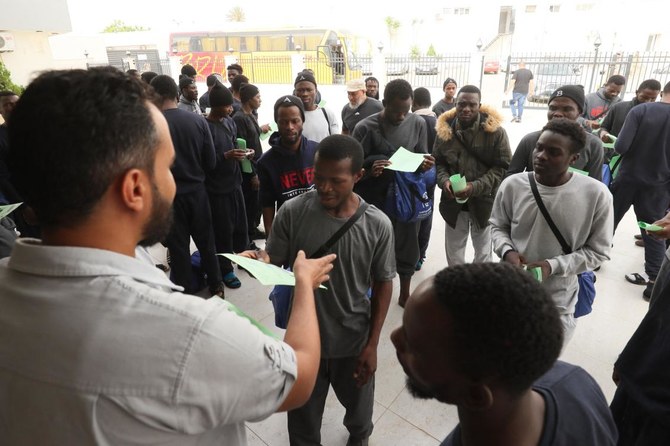
Irregular Nigerian migrants are given documents prior to their departure by coach to Mitiga International Airport from the anti-migration bureau, tasked with coordinating deportations of foreigners who are in the country illegally, in Tripoli on Jun. 25, 2024. (AFP)
Short Url
Updated 25 June 2024
Follow

Libya repatriates 170 Nigeria migrants, plans more returns

  • The operation was announced by Mohammed Baredaa, head of the Libyan interior ministry organization tasked with halting irregular migration
  • These operations would “continue over the coming weeks,” he said

TRIPOLI: Libya said it repatriated 174 irregular migrants to Nigeria on Tuesday, including dozens of women and six children, with further returns planned in the coming weeks.
The operation was announced by Mohammed Baredaa, head of the Libyan interior ministry organization tasked with halting irregular migration.
Baredaa said the department had begun “to repatriate 174 irregular migrants of Nigerian origin,” including 39 women and the six children.
These operations, which are carried out by plane or road depending on the nationality, would “continue over the coming weeks,” he said.
The International Organization for Migration, or IOM, helps vulnerable migrants blocked in Libya or who wish to go home to do so through its voluntary humanitarian return program.
Smugglers and human traffickers have taken advantage of the climate of instability which has dominated Libya since dictator Muammar Qaddafi was toppled and killed in a 2011 NATO-backed uprising.
Libya, about 300 kilometers (186 miles) from Italy, is a key departure point in North Africa for sub-Saharan migrants risking sea journeys to Europe.
“I have been in Libya for three years to work and earn money and move to Europe,” Zakaria Abubaker Shueib, a 20-year-old Nigerian migrant set to be repatriated, told AFP.
An IOM report said migrant deaths or disappearances rose to 4,984 last year on Middle East and North Africa routes, compared with 3,820 in 2022.
“Tunisia accounts for the highest number of incidents recorded followed by Libya with 683 recorded deaths” of migrants, the majority of whom left western Libya, said the report published in mid-June.


Algeria parliament to vote on law declaring French colonization ‘state crime’

Updated 3 sec ago
Follow

Algeria parliament to vote on law declaring French colonization ‘state crime’

ALGERIA: Algeria’s parliament is set to vote on Wednesday on a law declaring France’s colonization of the country a “state crime,” and demanding an apology and reparations.
The vote comes as the two countries are embroiled in a major diplomatic crisis, and analysts say that while Algeria’s move is largely symbolic, it could still be politically significant.
The bill states that France holds “legal responsibility for its colonial past in Algeria and the tragedies it caused,” according to a draft seen by AFP.
The proposed law “is a sovereign act,” parliament speaker Brahim Boughali was quoted by the APS state news agency as saying.
It represents “a clear message, both internally and externally, that Algeria’s national memory is neither erasable nor negotiable,” he added.
France’s colonization of Algeria from 1830 until 1962 remains a sore spot in relations between the two countries.
French rule over Algeria was marked by mass killings and large-scale deportations, all the way to the bloody war of independence from 1954-1962.
Algeria says the war killed 1.5 million people, while French historians put the death toll lower at 500,000 in total, 400,000 of them Algerian.
French President Emmanuel Macron has previously acknowledged the colonization of Algeria as a “crime against humanity,” but has stopped short of offering an apology.
Asked last week about the vote, French foreign ministry spokesman Pascal Confavreux said he would not comment on “political debates taking place in foreign countries.”
Hosni Kitouni, a researcher in colonial history at the University of Exeter in the UK, said that “legally, this law has no international scope and therefore is not binding for France.”
But “its political and symbolic significance is important: it marks a rupture in the relationship with France in terms of memory,” he said.