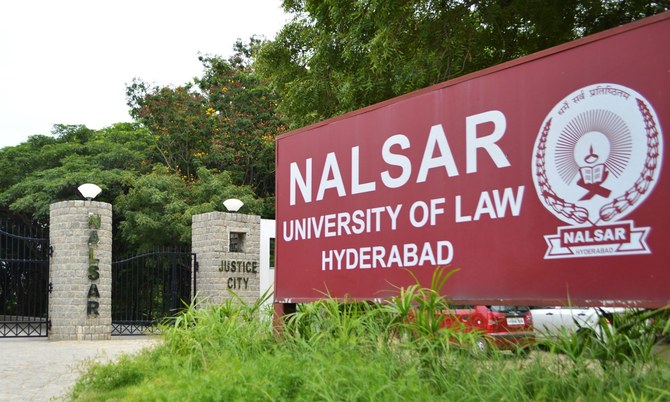

NEW DELHI: Students at India’s top law school have joined the global campus movement to sever ties with Israeli academic institutions, which they accuse of being complicit in Israel’s deadly war on Gaza and atrocities committed against the Palestinian population.
The academic boycott of Israel is part of the Boycott, Divest and Sanction campaign, which started in 2005. Targeting Israeli universities, research institutions and their activities, it has been supported by an increasing number of student communities since the beginning of the war in October.
Students of the National Academy of Legal Studies and Research, a public law school in the southern Indian city of Hyderabad, officially joined the campaign on June 15, with a petition requesting that the NALSAR administration cut ties with Tel Aviv University and Radzyner Law School.
The public petition was signed by 362 people, including 275 students, 70 alumni and 12 faculty members.
“Israeli universities such as Tel Aviv University and the Radzyner Law School have both directly and indirectly either contributed to the current onslaught in Gaza or defended its legitimacy in academic literature,” Hamza Khan, who is completing his degree at NALSAR this year, told Arab News.
“They have played a crucial role in collaborating with defense-tech companies, whose products today are actively deployed by the IDF (Israel Defense Forces) against Palestinians. These institutions continue to be a part of Israeli militarism and contribute to the infrastructure of oppression and open support for Israel’s crimes.”
The petition calls on NALSAR’s vice chancellor to “cut all ties pertaining to International Exchange Programmes with Israeli Institutes: Tel Aviv University and The Radzyner School of Law as a part of complete academic and economic disassociation with the Israeli State and academia that continues to remain not just a mute spectator but an active complicit in the ongoing crisis.”
Israeli forces have in the past eight months killed over 37,000 people in Gaza, wounded tens of thousands of others, destroyed the enclave’s health infrastructure, and cut it off from supplies of water, food, fuel and medical aid.
Israel has also destroyed 80 percent of Gaza’s schools which, coupled with persecution and targeted killings of Palestinian scholars, has been referred to by international rights groups and UN experts as scholasticide, leading to total annihilation of Palestine’s education.
“Remaining silent in the face of such violations would be hypocritical and signal double standards,” Khan said.
“NALSAR’s legacy extends beyond producing corporate lawyers and being a top-ranking national law university. It is about instilling in us humanity, ethics, values, and the courage to speak out against injustice.”
NALSAR is widely considered one of India’s best law schools.
Among some of its prominent alumni are Dr. Anup Surendranath, a leading Indian expert in criminal and constitutional law, Supreme Court lawyer Talha Raman, and Alok Prasanna Kumar, co-founder of the Vidhi Centre for Legal Policy, a leading Indian think tank that advises the government on law, regulation and policy.
Despite India’s historic support for Palestine, the Indian government has been mostly quiet in the wake of the deadly attacks on Gaza and, according to local media reports, has also been selling weapons to Israel.
Students do not agree with the policy and are trying to break the silence.
“We have not shied away from raising questions that matter, questions that are essential to the ideas we believe in,” said Shreyam Sharma, a final-year student and one of the conveners of the students’ action.
“Israel has flouted any convention that exists. The ICJ (International Court of Justice) has already hinted at the possibility of a violation (being) genocidal in nature. Multiple human rights experts have prepared reports based on concrete evidence that conclude that genocide is being committed.”
Akhil Surya, also a final-year student, said they were “ashamed” of their country’s inaction.
“The genocide in Palestine is the most documented and broadcasted in real time. Many of us who have been watching the visuals from Palestine for over eight months now have wondered ... ‘What can we do, being so far away?’” he said.
“Inspired by the BDS movement that sprang up in every corner of the world, we felt that as students, we can do what we can.”
Despite repeated attempts, NALSAR’s vice chancellor did not respond to requests for comment.
Dr. Srijan Mandal, who teaches constitutional history and one of the university’s faculty members supporting the petition, said the students felt they needed to “do something to acknowledge what is happening in Palestine, what Israel is doing in Palestine,” and take any action despite their weak position in the power structure.
“The least we can do is that our institution does not have formal agreement of student exchange and other possible exchanges with Israeli institutions,” he told Arab News.
“This is the least we can do.”