Pakistan calls for ‘sober reflection’ on ties with India as new Modi cabinet takes oath

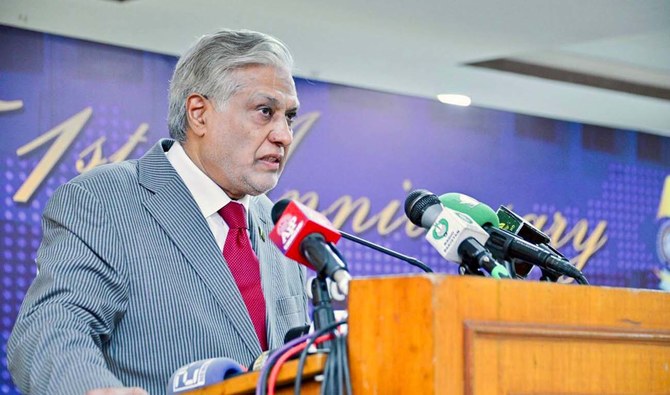
Pakistan Foreign Minister Ishaq Dar addresses the 51st Foundation Day of the Institute of Strategic Studies Islamabad on June 25, 2024. (Photo courtesy: @ForeignOfficePk/X)
Short Url
Updated 25 June 2024
Follow

Pakistan calls for ‘sober reflection’ on ties with India as new Modi cabinet takes oath

  • Pakistan suspended trade with India, downgraded ties after it stripped disputed Jammu and Kashmir territory of its autonomy in 2019
  • Pakistan seeks “good neighborly” ties with India based on mutual respect, just resolution of Kashmir dispute, says Deputy PM Dar

ISLAMABAD: Pakistan’s Deputy Prime Minister Ishaq Dar on Tuesday called for a “sober reflection” on the future of Islamabad’s strained ties with New Delhi, a day after Indian Prime Minister Narendra Modi and his newly elected ministers took oath as lawmakers. 

Modi and members of his Council of Ministers took oath as members of the lower house of India’s parliament during its first session on Monday. Relations between India and Pakistan, two nuclear-armed neighbors who have fought three wars, remain strained since August 2019 when India stripped the disputed Jammu and Kashmir region of its autonomy. 

India and Pakistan claim the Himalayan region in full but administer only parts of it. Both have fought two wars over the disputed territory since gaining independence from British colonial India in 1947. 

Pakistan downgraded ties with New Delhi after it stripped Kashmir of its autonomy in 2019 and suspended trade with its neighbor. Islamabad has ruled out normalizing ties with India unless it revokes its controversial decision, which India has refused to do so. 

“In our view, as the BJP-led NDA government starts a new term, it is time for a sober reflection on the future of India-Pakistan relations and the cross-cutting issues affecting the entire region,” Dar said during an event in Islamabad. 

The deputy prime minister said Pakistan’s relationship with India had historically remained troubled. However, he said Islamabad does not believe in perpetual hostility. 

“We seek good neighborly relations with India based on mutual respect, sovereign equality and a just and peaceful resolution of the long-standing Jammu and Kashmir dispute,” he said. 

While Pakistan has always been receptive to constructive engagement via dialogue to resolve outstanding issues, Dar said Islamabad would never agree to India’s “unilateral approaches” or attempts to impose its hegemony in the region.

“We will also take every step needed to maintain strategic stability in South Asia and would respond effectively and decisively to any ill-considered military misadventure by the Hindutva driven dispensation in New Delhi,” he warned. 

‘PRAGMATIC’ AFGHANISTAN APPROACH

Speaking on Pakistan’s ties with Afghanistan, Dar hoped Kabul would recognize that it is in Afghanistan’s interest to take practical steps necessary to address Islamabad’s concerns.

Relations between Pakistan and Afghanistan have deteriorated since 2021 when the Afghan Taliban seized Kabul. Pakistan has witnessed a surge in militant attacks on its western provinces that share a border with Afghanistan. Islamabad accuses Kabul of sheltering militants that launch attacks on its soil, allegations that Afghanistan have always denied. 

“Since the Taliban takeover in August 2021, Pakistan has followed a pragmatic approach focused on practical cooperation aimed at averting any humanitarian crisis in Afghanistan and facilitating the well-being of the 40 million Afghan people,” Dar noted. 

On relations with China, the deputy prime minister said both countries recently agreed to upgrade their flagship China-Pakistan Economic Corridor (CPEC) project, which he said in the coming years would focus on industrialization, digitalization, green transition agriculture, and people-to-people exchanges.

Beijing is investing over $65 billion in energy and infrastructure projects in Pakistan as part of the CPEC, a key element of its Belt and Road initiative. The corridor will connect China to the Arabian Sea and help modernize Pakistan’s economy through a network of roads, railways, pipelines, and ports.

However, attacks on Chinese nationals in Pakistan over the past few months have caused Beijing to worry about the safety of its citizens in Pakistan. 

“We will do everything possible to ensure the safety and security of Chinese personnel and projects in Pakistan and to safeguard CPEC against the machinations of inimical forces,” Dar vowed. 

Dar said Pakistan is striving to forge deeper partnerships with Gulf states, Turkiye, Iran, and Central Asian states amid Islamabad’s push for foreign investment.

“Our primary focus is on forging closer trade and investment ties and increasing regional connectivity,” he explained. “In this regard, the Special Investment Facilitation Council (SIFC) is playing a significant role,” he said, referring to a government body formed last year to attract investment in Pakistan’s key economic sectors. 


Pakistan raises fuel prices by Rs55 per liter as Middle East conflict drives oil surge

Updated 10 sec ago
Follow

Pakistan raises fuel prices by Rs55 per liter as Middle East conflict drives oil surge

  • Government says adequate fuel stocks in place despite global energy shock
  • Oil prices jump from about $78 to over $106 per barrel amid regional conflict

ISLAMABAD: Pakistan on Friday increased petrol and diesel prices by Rs55 ($0.20) per liter each as escalating conflict in the Middle East sent global oil prices sharply higher and disrupted energy supply routes, officials said.

Global oil markets have been rattled since coordinated strikes by the United States and Israel against Iran began last week, triggering retaliatory attacks across the region, raising fears of disruption to key energy shipping routes and pushing petroleum prices sharply upward.

The price adjustment in Pakistan was announced after a joint press conference by Finance Minister Muhammad Aurangzeb, Deputy Prime Minister and Foreign Minister Ishaq Dar and Petroleum Minister Ali Pervaiz Malik, who said the government was monitoring international energy markets and domestic supply conditions amid the crisis.

“So, the decision we have made by changing the levy a little bit is that we are going ahead with increasing the price of both fuels, petrol and diesel, by Rs55 ($0.20),” Malik told reporters. 

“And as soon as this matter settles, we will revise the prices downward with the same speed and take steps on how to increase people’s income and purchasing power.”

He said Pakistan entered the crisis with “comfortable energy reserves” due to earlier planning but rising global prices had forced the government to adjust domestic fuel rates to maintain supply continuity.

He said international petrol prices had climbed from roughly $78 per barrel on March 1 to around $106.8 per barrel, while diesel prices had risen to about $150 per barrel.

Malik added that the government had taken steps to minimize the burden on consumers, noting diesel plays a critical role in agriculture, transportation and public mobility.

Malik also warned that authorities would take strict action against anyone attempting to hoard fuel or manipulate supply for profiteering.

The minister said Pakistan was working with international partners to secure additional energy supplies, including arrangements with Saudi Aramco and the use of Pakistan National Shipping Corporation vessels to transport crude oil imports.

Finance Minister Aurangzeb said a high-level government committee formed by Prime Minister Shehbaz Sharif had been meeting daily to review developments in global petroleum markets and their potential impact on Pakistan’s economy.

“Pakistan currently maintains adequate energy stocks and macroeconomic stability,” Aurangzeb said, adding that the government’s response was based on preparedness rather than panic.

He said the committee, which includes senior ministers, the governor of the State Bank of Pakistan and other officials, was assessing short-, medium- and long-term implications of the crisis for inflation, foreign exchange reserves and broader economic indicators.

Deputy PM Dar said the regional conflict had significantly disrupted global energy markets, with international petroleum prices rising by as much as 50–70 percent in recent days.

The deputy prime minister added that Pakistan was also engaged in diplomatic efforts aimed at de-escalating tensions and restoring stability in the region.

Petroleum prices will now be reviewed more frequently, potentially on a weekly basis, and any reduction in global oil prices would be passed on to consumers.

Pakistan, which relies heavily on imported fuel to meet its energy needs, is particularly vulnerable to global oil price shocks that can quickly feed into inflation and pressure the country’s external accounts.