

Chinese lunar probe returns to Earth with world’s first samples from far side of moon

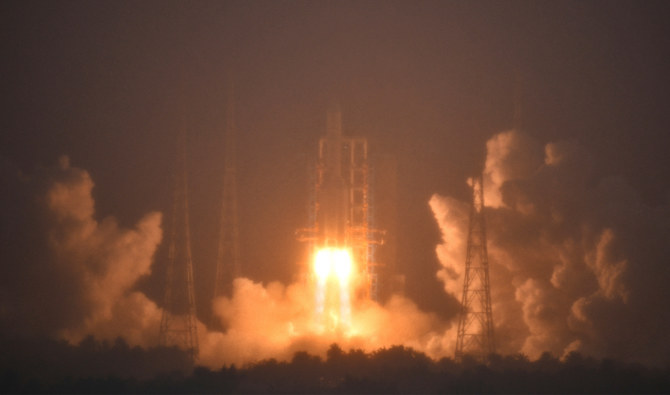
In this photo provided by China's Xinhua News Agency, a Long March-5 rocket, carrying the Chang'e-6 spacecraft, blasts off from its launchpad at the Wenchang Space Launch Site in Wenchang, south China's Hainan Province, on May 3, 2024. (Guo Cheng/Xinhua via AP/File)
Short Url
Updated 25 June 2024
Follow

Chinese lunar probe returns to Earth with world’s first samples from far side of moon

  • Chinese scientists anticipate returned samples will include 2.5-million-year-old volcanic rock, other material
  • Moon program is part of growing rivalry with US, still leader in space exploration, and others including Japan, India

BEIJING: China’s Chang’e 6 probe returned on Earth on Tuesday with rock and soil samples from the little-explored far side of the moon in a global first.

The probe landed in northern China on Tuesday afternoon in the Inner Mongolian region.

“I now declare that the Chang’e 6 Lunar Exploration Mission achieved complete success,” Zhang Kejian, Director of the China National Space Administration said shortly in a televised news conference after the landing.

Chinese scientists anticipate the returned samples will include 2.5 million-year-old volcanic rock and other material that scientists hope will answer questions about geographic differences on the moon’s two sides.

The near side is what is seen from Earth, and the far side faces outer space. The far side is also known to have mountains and impact craters, contrasting with the relatively flat expanses visible on the near side.

While past US and Soviet missions have collected samples from the moon’s near side, the Chinese mission was the first that has collected samples from the far side.

The moon program is part of a growing rivalry with the US — still the leader in space exploration — and others, including Japan and India. China has put its own space station in orbit and regularly sends crews there.

China’s leader Xi Jinping sent a message of congratulations to the Chang’e team, saying that it was a “landmark achievement in our country’s efforts at becoming a space and technological power.”

The probe left earth on May 3, and its journey lasted 53 days. The probe has drilled into the core and scooped rocks from the surface.

The samples “are expected to answer one of the most fundamental scientific questions in lunar science research: what geologic activity is responsible for the differences between the two sides?” said Zongyu Yue, a geologist at the Chinese Academy of Sciences, in a statement issued in the Innovation Monday, a journal published in partnership with the Chinese Academy of Sciences.

China in recent years has launched multiple successful missions to the moon, collecting samples from the moon’s near side with the Chang’e 5 probe previously.

They are also hoping that the probe will return with material that bear traces of meteorite strikes from the moon’s past. With the successful reentry of the probe, scientists will begin studying the samples.


Thousands in Kosovo march against war crimes trials on 18th anniversary of independence declaration

Updated 42 min 14 sec ago
Follow

Thousands in Kosovo march against war crimes trials on 18th anniversary of independence declaration

  • Protesters, many wrapped in red and black Albanian flags, braved cold and snowy weather in the capital, Pristina, to voice their opposition to the proceedings in The Hague
  • PM Albin Kurti added that ‘the KLA-led war was pure, liberation (struggle) and an anti-colonial war ... a just struggle of an occupied and oppressed people under apartheid’

PRISTINA, Kosovo: An air of defiance marked Kosovo’s independence celebrations on Tuesday as thousands of people joined a march in support of former fighters who are facing trial at a Netherlands-based court for alleged war crimes during a 1998-1999 separatist war from Serbia.
Protesters, many wrapped in red and black Albanian flags, braved cold and snowy weather in the capital, Pristina, to voice their opposition to the proceedings in The Hague against former president and rebel leader Hashim Thaci and three others accused of atrocities during and after the conflict that killed some 13,000 people.
Earlier on Tuesday, Kosovo’s security forces paraded in Pristina as part of the independence ceremonies, and Parliament held a special session.
The war started in 1998 when the rebel Kosovo Liberation Army launched its struggle for independence and Serbia responded with a brutal crackdown. The war ended after NATO bombed Serbia for 78 days in 1999, eventually forcing it to pull out its troops from the territory.
Serbia still does not recognize the 2008 declaration of independence of Kosovo and this has been a source of persistent tension in the volatile Balkan region. As both Kosovo and Serbia seek European Union membership, they have been told they must normalize ties before joining.
Prosecutors at the Kosovo Specialist Chambers in The Hague — which formally is part of Kosovo’s judicial system although seated abroad — have asked for a maximum 45-year prison sentence for Thaci and the other defendants. Thaci also faces a separate trial on charges of intimidating witnesses that will begin later this month.
Officials and protesters in Kosovo have criticized the proceedings as political and designed to strike a false balance with Serbia whose political and military leaders previously had been tried and convicted of war crimes in Kosovo by a separate UN court.
Protesters at Tuesday’s march held banners reading “History cannot be rewritten” and “Freedom for the liberators.” They arranged metal fences around a landmark independence monument and placed a sign reading ”Kosovo in Prison” on top of it.
President Vjosa Osmani said in a statement that “truth cannot be changed by attempts to rewrite history or to tarnish and devalue the struggle of Kosovo’s people for freedom.”
Prime Minister Albin Kurti added that “the KLA-led war was pure, liberation (struggle) and an anti-colonial war ... a just struggle of an occupied and oppressed people under apartheid.”
In Belgrade, a Serbian government liaison office for Kosovo described the independence declaration 18 years ago as a “flagrant violation of international law.” The statement alleged “systematic terror” and persecution against minority Serbs in Kosovo.
The United States and most EU countries are among more than 100 nations that have recognized Kosovo’s independence while Russia and China have backed Serbia’s claim on the territory.
Thaci resigned from office in 2020 to defend himself against the 10 charges of crimes against humanity and war crimes.
The court and an associated prosecutor’s office were created after a 2011 report by the Council of Europe, a human rights body, following allegations that KLA fighters trafficked human organs taken from prisoners and killed Serbs and fellow ethnic Albanians. The organ harvesting allegations haven’t been included in indictments issued by the court.