

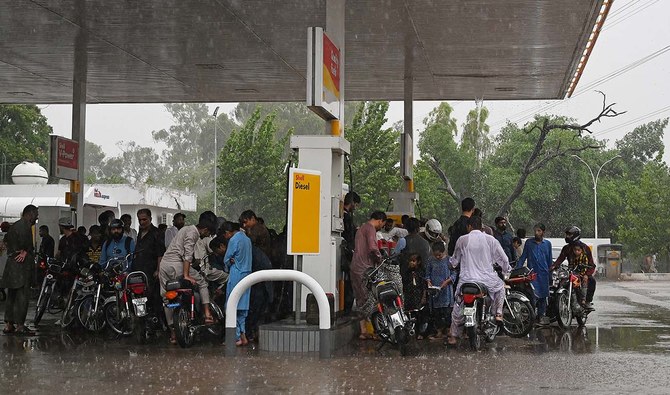

ISLAMABAD: Pakistan’s National Disaster Management Authority (NDMA) on Monday issued a comprehensive monsoon forecast for the month of July, highlighting potential impacts of rainfall across various regions of the country.
The National Emergencies Operation Center (NEOC) was set up in October 2023 and is equipped with the latest tools and technologies, including real-time satellite feeds, to anticipate disasters up to three months in advance. The center, which has been set up at the NDMA, has a multidisciplinary team of experts that harness the power of geographic information system (GIS), remote sensing, climatology, meteorology, seismology, hydrology, and data sciences to monitor and analyze global and local hazards.
The NEOC said in its forecast that various areas of the country may receive moderate to very heavy rains that could cause riverine and flash flooding, urban flooding, landslides in hilly areas, and potential Glacial Lake Outburst Floods (GLOF) events.
“In light of these projections, the National Disaster Management Authority (NDMA) has advised Provincial Disaster Management Authorities (PDMAs), District Disaster Management Authorities (DDMAs), and other relevant line departments to remain vigilant and prepared to respond to any emergent situations,” the NDMA said in a statement.
The NDMA said that as per its forecast, rainfall at isolated places of Mardan, Malakand and Hazara Divisions in Pakistan’s northwestern Khyber Pakhtunkhwa (KP) province is expected in the third week of July while heavy to very heavy rainfall is expected in the fourth week.
In Pakistan’s Punjab province, it said Lahore, Sargodha, Faisalabad and Gujranwala districts and Islamabad are expected to receive 15-50 millimeters of rainfall at isolated places during the first and second weeks of July.
The NDMA warned of potential flooding in Islamabad, Rawalpindi, Lahore, Sargodha, Gujranwala and Faisalabad in Punjab during the fourth week of July.
For Sindh, the NDMA said Mirpurkhas, Karachi, Hyderabad, Nawabshah, Larkana and Sukkur districts are expected to receive 30-75 millimeters of rainfall in the month of July. These same areas are expected to receive heavy to very heavy rainfall in the second and fourth week of the month.
“In 4th week of July Astore District of Gilgit Baltistan and isolated places of Azad Jammu and Kashmir to receive heavy to very heavy rainfall, potential severe flooding in nullahs and rivers,” it said.
The disaster management authority called on government departments to sensitize residents living along riverbanks and nullahs about the expected increase in water flows, and facilitate timely evacuation of at-risk populations from low-lying and flood-prone areas.
“Additionally, citizens are advised to take extreme precautionary measures, such as staying away from electric poles and weak infrastructure, and refraining from driving or walking in waterways,” the statement said.
Pakistan is consistently ranked among the world’s worst-affected countries due to climate change. Unprecedented rainfall and melting of glaciers in June 2022 triggered massive floods across the country that killed nearly 1,700 people and inflicted damages worth $3 billion. Scientists and experts attributed the floods to the adverse effects of climate change.
Pakistan also suffered a severe heat wave last month, which saw temperatures in some regions rise to above 50 degrees Celsius.


