

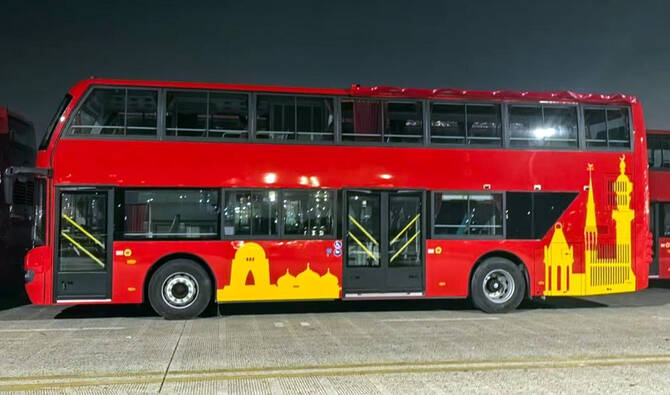
Pakistan launches double-decker buses in Karachi after 65 years to tackle transport woes

The handout photograph released on December 15 shows a double-decker bus parked after arriving at a Port in Karachi, Pakistan. (X/@sharjeelinam/File)
Short Url
Updated 31 December 2025
Follow

Pakistan launches double-decker buses in Karachi after 65 years to tackle transport woes

  • Karachi citizens will be able to travel in double-decker buses from Jan. 1, says Sindh government
  • City faces mounting transport challenges such as lack of buses, traffic congestion, poorly built roads

ISLAMABAD: The government in Sindh province on Wednesday launched double-decker buses in the provincial capital of Karachi after a gap of 65 years, vowing to improve public transport facilities in the metropolis. 

Double-decker buses are designed to carry more passengers than single-deck vehicles without taking up extra road space. The development takes place amid increasing criticism against the Sindh government regarding Karachi’s mounting public transport challenges and poor infrastructural problems. 

Pakistan’s largest city by population faces severe transportation challenges due to overcrowding in buses, traffic congestion and limited bus options. Commuters, as a result, rely on private vehicles or unregulated transport options that are often unsafe and expensive.

“Double-decker buses have once again been introduced for the people of Karachi after 65 years,” a statement issued by the Sindh information ministry said. 

Sindh Transportation Minister Sharjeel Inam Memon and Local Government Minister Syed Nasir Hussain Shah inaugurated the bus service. The ministry said the facility will be available to the public starting Jan. 1. 

The statement highlighted that new electric bus routes will also be launched across the entire province starting next week. It added that the aim of introducing air-conditioned buses, low-fare services, and fare subsidies is to make public transport more accessible to the people.

The ministry noted that approximately 1.5 million people travel daily in Karachi using the People’s Bus Service, while around 75,000 passengers use the Orange Line and Green Line BRT services.

“With the integration of these routes, efforts are being made to benefit up to 100,000 additional people,” the ministry said. 


Pakistan, Japan discuss boosting trade, investment and cooperation in key sectors

Updated 17 January 2026
Follow

Pakistan, Japan discuss boosting trade, investment and cooperation in key sectors

  • The Pakistani side highlighted various opportunities in sectors minerals and mining, agricultural and agri-food products, and IT sectors
  • The development comes as Pakistan steps up economic diplomacy to expand trade, investment ties after emerging from a financial crisis

ISLAMABAD: Pakistan and Japan have held talks on improving bilateral trade and investment and expanding cooperation in key sectors, Pakistan’s Press Information Department said on Saturday.

Both countries held the 8th Pakistan–Japan Government–Business Joint Dialogue and the Pakistan Business Forum in Tokyo on Friday, marking the first convening of the dialogue in the Japanese capital since Dec. 2018.

The dialogue was co-chaired by Prime Minister Shehbaz Sharif’s aide on commerce Rana Ihsaan Afzal Khan and Takuo Komori, Japan’s parliamentary vice-minister of economy, trade and industry, according to the PID.

The two sides exchanged views on strengthening bilateral economic relations, with a focus on improving the trade and investment environment and advancing practical cooperation.

“The Pakistani side outlined Pakistan’s economic priorities and highlighted opportunities for collaboration in sectors such as minerals and mining, agricultural and agri-food products, and information technology,” the PID said in a statement.

“The Japanese side shared perspectives on the operating environment for Japanese companies in Pakistan and discussed areas where continued engagement and follow-up could further facilitate business activity.”

Pakistan steps up economic diplomacy to expand trade ties and attract foreign capital after emerging from a prolonged financial crisis that nearly pushed it into default in mid-2023. Islamabad has since set up the Special Investment Facilitation Council (SIFC), a civil-military body designed to cut red tape and provide a one-window operation for businesses, as it navigates a long path to economic recovery under a $7 billion International Monetary Fund (IMF) program.

Pakistan and Japan established diplomatic and economic relations in 1952. Since then, Japan has been a major development partner, financing infrastructure such as roads, power plants and water systems, while extending technical assistance and yen loans.

The Pakistan–Japan Government–Business Joint Dialogue brought together senior officials and private-sector representatives from both countries, including members of the Pakistan–Japan Business Forum (PJBF) and the Japan–Pakistan Business Co-operation Committee (JPBCC).

Participants reaffirmed the importance of sustained government-to-government engagement, supported by close coordination with the private sector, to advance mutually beneficial economic cooperation between Pakistan and Japan, according to the statement.

Following the Joint Dialogue, the Pakistan Business Forum, co-organized by the Embassy of Pakistan in Tokyo and the Japan External Trade Organization (JETRO), was held in Tokyo that was attended by Japanese and Pakistani business leaders.

The Forum featured selected sectoral presentations highlighting practical cooperation between Japanese and Pakistani partners. It included a presentation by the Trade and Investment Counsellor of the Embassy of Pakistan in Tokyo on “From Trade to Investment: Building Japan–Pakistan Joint Value Chains.”

“The Forum concluded with closing remarks by Mr. Abdul Hameed, Ambassador of Pakistan to Japan, who highlighted the importance of sustained engagement, trust-building, and long-term partnership in advancing Pakistan–Japan economic cooperation,” the PID added.