Tehran: Iranians broadly deplore Western sanctions that have battered the economy, but the country’s six presidential candidates offer differing solutions — assuming the winner gets a say on foreign policy.
Punishing US sanctions, reimposed following Washington’s withdrawal from a landmark 2015 nuclear deal, have brought years of economic hardships, fueling political malaise and wide popular discontent.
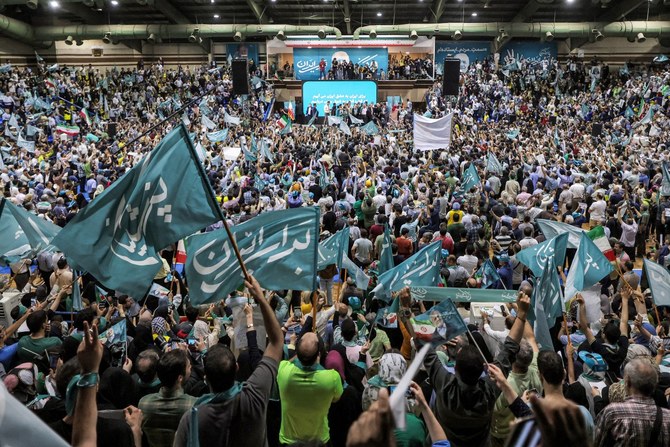
With the June 28 snap election fast approaching, debates between the candidates vying for Iran’s second-highest office have featured a key question: should Tehran mend ties with the West?
Under the late president Ebrahim Raisi, who died last month in a helicopter crash, Western governments have expanded sanctions against Iran over its nuclear program as well as its support for militant groups across the Middle East and for Russia in its war in Ukraine.
The sanctions have sharply reduced Iran’s oil revenues, heavily restricted trade and contributed to soaring inflation, high unemployment and a record low for the Iranian rial against the US dollar.
At Tehran’s bustling Grand Bazaar, shopkeeper Hamid Habibi, 54, said years of sanctions “have hit people very hard.”
“Sanctions should be removed and ties mended with the US and European countries,” he said.
In two televised debates focused on the economy ahead of the presidential polls, “almost all the candidates explained that the sanctions have had devastating effects,” said Fayyaz Zahed, a professor of international relations at the University of Tehran.
“It is crucial to resolve this issue to alleviate the people’s suffering,” he said.
While the six contenders — five conservatives and a sole reformist — have all vowed to tackle the economic hardships, they offered varying views on Iran’s relations with the West.
“If we could lift the sanctions, Iranians could live comfortably,” said reformist candidate Massoud Pezeshkian, considered one of three frontrunners.
Pezeshkian, who is backed by key reformist groups in Iran, called for “constructive relations” with Washington and European capitals in order to “get Iran out of its isolation.”
On the campaign trail, he had the support of Mohammad Javad Zarif, a former foreign minister who helped secure the 2015 nuclear deal with world powers and insists it had positive impact on the Iranian economy.
Since the United States unilaterally withdrew from the accord in 2018, Iran has gradually reduced its commitment to its terms, meant to curb nuclear activity which Tehran has maintained was for peaceful purposes.
Diplomatic efforts to revive the deal have long stalled as tensions between Tehran and the International Atomic Energy Agency repeatedly flared.
Former president Hassan Rouhani, whose government negotiated the deal, said the sanctions cost Iranians “$100 billion a year, directly or indirectly, from the sale of oil and petrochemicals and the discounts they give” — in reference to preferential trade with China, a signatory to the 2015 agreement.
Ultraconservative presidential candidate Saeed Jalili, a former nuclear negotiator, has called for Tehran to press ahead with its long-running anti-Western policy.
“The international community is not made up of just two or three Western countries,” Jalili has repeatedly said in debates and campaign rallies.
He said Iran should bolster its ties with China and Russia, and forge stronger relations with Arab countries, particularly regional powerhouse Saudi Arabia.
Conservative candidate Mohammad Bagher Ghalibaf, the incumbent parliament speaker, has offered a more pragmatic approach, saying Iran should negotiate with Western countries only if it stands to gain an “economic advantage.”
Ghalibaf called for increasing Tehran’s nuclear capabilities, a strategy he said was already “forcing the West to negotiate with Iran.”
Zahed, the international relations professor, said Jalili has positioned himself as “the most inflexible candidate on the diplomatic level.”
In any case, the expert added, the next president will have limited say over strategic issues in the Islamic republic where supreme leader Ayatollah Ali Khamenei, 85, wields ultimate authority.
On Saturday, Khamenei urged the candidates to avoid making any remarks that would “please the enemy” — in reference to the West, mainly the United States.
The president “could only influence foreign policy” if he “earned the trust” of Khamenei and Iran’s most influential government institutions, Zahed said.


![]()

Iran sanctions take center stage in presidential campaign
Short Url
https://arab.news/96qn4
Iran sanctions take center stage in presidential campaign
- Sanctions have sharply reduced Iran’s oil revenues, heavily restricted trade and contributed to soaring inflation, high unemployment


Latest updates



Recommended


© 2026 SAUDI RESEARCH & PUBLISHING COMPANY, All Rights Reserved And subject to Terms of Use Agreement.