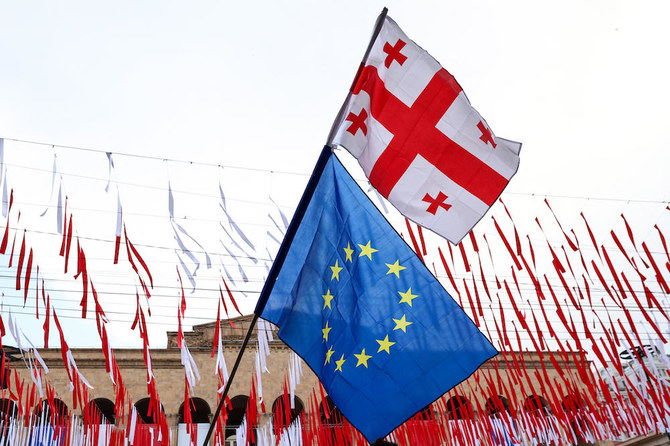
LUXEMBOURG: EU foreign affairs chief Josep Borrell told Georgia Monday that its push to join the bloc could be ended, as Brussels weighs options to punish the authorities over a “foreign influence” law.
“The door for Georgia to become a member of the European Union is open,” Borrell said at a meeting of EU foreign ministers in Brussels.
“But if the government continues on the same track, continues doing what they are doing, this door will be closed, and the Georgian people will pay the consequences, will suffer.”
The ruling party in the South Caucasus country — which formally became a candidate to join the EU last year — adopted a controversial “foreign influence” law this month that critics say is modelled on Russian legislation used to stifle dissent.
The move was condemned by Georgia’s Western supporters, with the United States banning several officials from the South Caucasus nation from visiting.
Concerns were further fueled by proposed new legislation to ban what the ruling party calls “LGBT propaganda,” in another conservative shift that drew fresh comparisons with repressive Russian laws.
The 27-nation EU is now pondering its response to the shifts from the governing Georgian Dream party, but is wary of pushing the ex-Soviet state closer toward Moscow.
Despite the moves from the government, the population in the country remains overwhelmingly in favor of moving closer toward the EU.
Borrell said that initial moves being discussed by ministers could include halting funding for Georgia’s security forces, cutting government financing, or severing high-level contacts.
“We don’t want to affect civilians. We don’t want to put more pain on the civilian people,” Borrell said, adding that no firm decision was expected Monday.
Estonian Foreign Minister Margus Tsahkna said there would also be discussions on Schengen visa bans for high-ranking Georgian officials.
“The situation for Georgia is serious, and all the responsibility lies on the shoulders of the Georgian government,” he said.
“The Georgian people are supporting the way to the European Union.”
Meanwhile, his counterpart from Lithuania Gabrielius Landsbergis complained that stronger measures were not yet being put forward in a paper presented by the EU’s diplomatic arm.
“Unfortunately, there are certain options in the paper that are not mentioned, such as actually stopping Georgia’s EU integration, which I think it has to be mentioned,” he said.


![]()

EU top diplomat warns Georgia door to membership could ‘close’
Short Url
https://arab.news/bvpax
EU top diplomat warns Georgia door to membership could ‘close’
- Ruling party in Georgia adopted a controversial ‘foreign influence’ law this month
- Critics say legislation is modelled on Russian legislation used to stifle dissent


Latest updates





© 2026 SAUDI RESEARCH & PUBLISHING COMPANY, All Rights Reserved And subject to Terms of Use Agreement.