

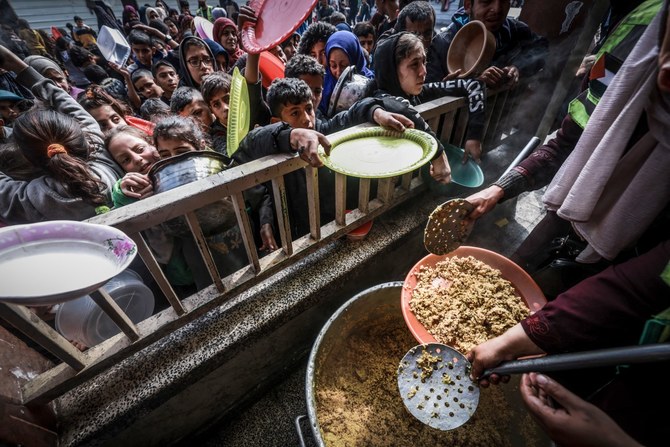

Nearly 166 million people worldwide are estimated to need urgent action against hunger, according to the Integrated Food Security Phase Classification (IPC), a global partnership which measures food insecurity.
That includes nearly everyone in the Gaza Strip, where the Israeli military launched an offensive in October following an attack on Israel by Hamas militants. More than one million of Gaza’s inhabitants face the most extreme form of malnutrition – classified by the IPC as ‘Catastrophe or Famine.’
Seven-month-old Majd Salem is one of them.
Born on Nov. 1, three weeks after Israel launched the offensive, the child was being treated for a chest infection in the neonatal ICU at Kamal Adwan hospital in northern Gaza on May 9. The nurse caring for him said he was suffering from severe malnutrition.
Majd was born at a healthy weight of 3.5 kg (7.7 pounds), said his mother, Nisreen Al-Khateeb.
By May, when he was six months old, his weight had barely changed to 3.8 kg, she said – around 3 kg less than would be expected for a baby his age.
Majd, whose eyes keenly followed visiting reporters in the ward, had to be given antibiotics for the infection and fortified milk to boost his weight, his mother said. Reuters was unable to trace them after May 21, when the hospital was evacuated following an Israeli raid.
One in three children in northern Gaza are acutely malnourished or suffering from wasting, according to the UN children’s agency UNICEF, citing data from its partners on the ground. Ismail Al-Thawabta, director of the Hamas-run government media office, said their records showed 33 people had died of malnutrition in Gaza including 29 children, but added that the number could be higher.
COGAT, an Israeli defense ministry agency tasked with coordinating aid deliveries into Palestinian territories, did not respond to a request for comment for this story. Israel’s foreign ministry in late May issued a detailed statement questioning the IPC’s methods of analysis, which it said omitted measures Israel had taken to improve access to food in Gaza. The IPC declined to comment.
The plight of Gaza’s children is part of a bigger trend. Globally last year more than 36 million children under 5 were acutely malnourished, nearly 10 million of them severely, according to the Global Report on Food Crises, a collaborative analysis of food insecurity by 16 international organizations.
The food shortage in Gaza, while particularly widespread, comes amid a broader spike in extreme hunger as conflicts around the world intensify.
Two other countries – South Sudan and Mali – each have thousands of people living in zones listed on the IPC website as facing famine. Another 35 – including Sudan, Nigeria and the Democratic Republic of Congo – have many people in the IPC’s next-most acute category of food deprivation.
The IPC, a grouping of United Nations agencies, national governments and non-governmental organizations, is expected to update its assessment of the picture in war-torn Sudan in coming weeks. A preliminary projection reported by Reuters earlier this month said as many as 756,000 people in Sudan could face catastrophic food shortages by September.
Gaza’s hunger crisis is also a product of war. The Israeli military invaded the Strip in response to the Oct. 7 cross-border assault by Hamas on Israel. More than 37,000 Palestinians and nearly 1,500 Israelis have been killed since then, Gazan and Israeli tallies show.
The Israeli assault has destroyed swathes of Gazan farmland. In the early days of the war, Israel imposed a total blockade on Gaza. It later allowed some humanitarian supplies to enter but is still facing international calls to let in more.
The International Criminal Court’s prosecutor, in seeking arrest warrants for Israeli and Hamas leaders, last month accused Israeli Prime Minister Benjamin Netanyahu and Defense Minister Yoav Gallant of using starvation of civilians as a method of warfare, among other alleged crimes. Netanyahu, calling that move “a moral outrage of historic proportions,” said Israel is fighting in full compliance with international law and taking unprecedented measures to ensure aid reaches those in need.
Israel has accused Hamas of stealing aid, which Hamas strongly denies. Israel has also said any distribution problems within Gaza are the fault of the international agencies.
Even when children survive, nutrition experts say food deprivation in the early years can do lasting damage.
A child’s brain develops at its fastest rate in the first two years of life. So even if they don’t starve to death or die from illness due to their weakened immune system, children may face delays in growth and development, said Aashima Garg, adviser on nutrition at UNICEF for the Middle East and North Africa.
“While they may be alive, they may not thrive that well in childhood and beyond,” she said.
Three families in Gaza told Reuters about their day-to-day diets, and four global health experts explained how such deprivation affects the growing body. Damage done in weeks manifests over years, they said.
“It can have a long-term impact on their immune system, their ability to absorb good nutrition, and on their cognitive and physical development,” said Hannah Stephenson, global head of nutrition and health at Save The Children, a non-profit.
FIRST DAYS
Gaza has the most households globally in the most extreme stage of food poverty, according to the IPC, which classifies levels of hunger in five categories, the worst of which is famine.
Households in North Gaza, where Majd lives, are already suffering a full-blown famine, Cindy McCain, Executive Director of the World Food Programme, said on May 5.
It can take months for the international measurement system to declare a famine. But the first damage to a child’s body is counted in days.
Nine out of 10 children aged 6 months to 2 years in Gaza live in severe child food poverty, a UNICEF survey in late May found. This means they are eating from two or fewer food groups a day, which UNICEF’s Garg said means grains or some form of milk.
This has been the case since December 2023, with only a slight improvement in April 2024, she said. As many as 85 percent of children of all ages did not eat for a whole day at least once in the three days before the survey was conducted.
The main cause of acute malnutrition in North Gaza is a lack of diversity in the diets of children and pregnant and breastfeeding women, according to a report in February 2024 from the Global Nutrition Cluster, a group of humanitarian agencies led by UNICEF.
This deficient intake, both prior to and during pregnancy and breastfeeding, harms both mothers and infants.
Abed Abu Mustafa, 49, a father of six, was still living in Gaza City in early April. He said people there already had eaten “almost every green plant we could find” and he hadn’t had meat or chicken for at least five months.
In Rafah in the south, Mariam, 33, a mother of five, has been living in a school along with two dozen of her relatives. She described a typical meal for her family before the conflict and what they are currently eating, shown below.
Before the war, Majd’s mother said an average family meal consisted of rice with chicken or meat, along with vegetables such as okra, cauliflower or peas. During the war, flour scarcity forced the family to make bread from animal feed. Recently, bread and canned goods like tuna and beans started to reappear, but these are not widely available.
Unable to find food to feed herself and forced to flee Israeli bombardment early in the war, Khateeb said she had found great difficulty in breastfeeding Majd.
She said she could find neither good quality baby formula nor clean water to mix it, so she fed him various types of powdered feed mixed with rainwater or brackish water from Gaza’s polluted wells, causing diarrhea.
“There is no chance to get proper food to have breastmilk, there is no meat, no proteins, no calcium, none of the elements that produce good milk for the child,” she said.
Garg, the UNICEF adviser, said the nutrition of breastfeeding mothers in Gaza was severely compromised, and with it their ability to produce milk.
“They are not eating fruits and vegetables. They are not eating meat. They are not having much milk,” she said. This lack of nutrients translates into poor quality breast milk. Diluted formula is not safe and risks diarrhea, which itself can be deadly.
Moderately malnourished mothers can still breastfeed, with their bodies effectively sacrificing their own nutritional needs to save the child. But severely malnourished women struggle.
Ahmed Al-Kahlout, the nurse who heads the unit, said Majd’s infection was due to malnutrition.
“There is no immunity, so any disease that the child catches in the shelters … afflicts the child with these severe lung infections,” he said.
Susceptibility to infections typically increases after two weeks with insufficient food.
The body’s consumption of its fat reserves eats away muscle tissue, which is why aid workers in the field use basic tape measures to assess the gravity of children’s conditions.
The tapes measuring Mid-Upper Arm Circumference (MUAC) have been used for decades. If the upper arm’s circumference is 11.5 cm (4 1/2 inches) or smaller for a child between 6 months and 5 years old, the child is assessed as having severe acute malnutrition, according to standards drawn up by the United Nations.
MUAC screening data across Gaza since mid-January found more than 7,000 children aged 6 months to about 5 years were already acutely malnourished as of May 26, the United Nations humanitarian agency OCHA said.
This is how that looks.
Gaza has the most people at risk of starvation, but according to the IPC classifications, many millions are one step behind the enclave in food poverty.
The IPC categorizes the severity and scale of food insecurity and malnutrition. Readings of 3, 4 or 5 on the five-category scale require urgent action.
Households in Phase 3 are in “Crisis,” the IPC says. They have high or more than usual acute malnutrition, or can meet their minimum food needs but only by selling assets or through crisis measures.
Phase 4 is an “Emergency.” Households have either “very high” acute malnutrition and death rates or are only able to make up for the lack of food by taking emergency measures and selling assets.
Phase 5 is “Catastrophe” or “Famine.” Households have an extreme lack of food and/or other basic needs and starvation, death, destitution and extremely critical acute malnutrition levels are evident. An entire area is only classified as in Famine if high food insecurity comes with certain levels of acute malnutrition and mortality.
For the IPC, areas in Famine meet at least two of the following three criteria: * the area has at least 20 percent of households facing an extreme lack of food, * About one in three children there suffer from acute malnutrition, * Two adults or four children out of every 10,000 die each day due to outright starvation, or to the interaction of malnutrition and disease.
The IPC report issued in March projected that the entire population of the Gaza Strip would fall into Phases 3 to 5 between March and July. UN officials told Reuters they expect the next IPC analysis on Gaza to be released on June 25.
South Sudan and Mali are the other two other countries with households projected to fall into the same Phase 5 category as Gaza, based on the IPC’s latest published analyzes.
Overall, the three countries with the largest numbers of people at Phase 3 and above are Nigeria (25 million), Democratic Republic of Congo (23.4 million) and Sudan (17.7 million), according to the IPC website.
The IPC said its latest analysis of Sudan, conducted in December, was too outdated to include in the tables Reuters used for this chart.
As a consequence of severe malnutrition, various complications arise.
This is the impact of starvation after just three weeks. Like many children in Gaza, Majd’s lack of adequate food dates back months.


