JERUSALEM: Israeli Defense Minister Yoav Gallant is headed to Washington on Sunday to discuss the next phase of the Gaza war and escalating hostilities on the border with Lebanon, where exchanges of fire with Hezbollah have stoked fears of wider conflict.
Iran-backed Hezbollah began attacking Israel shortly after Hamas’ Oct. 7 assault sparked the war in Gaza, and the sides have been trading blows in the months since then. Hezbollah has said it will not stop until there is a ceasefire in Gaza.
“We are prepared for any action that may be required in Gaza, Lebanon, and in more areas,” Gallant said in a statement before setting off to Washington, where he said he would meet his counterpart Lloyd Austin and Secretary of State Antony Blinken.
Earlier in June, Hezbollah targeted Israeli towns and military sites with the largest volleys of rockets and drones in the hostilities so far, after an Israeli strike killed the most senior Hezbollah commander yet.
US envoy Amos Hochstein visited Israel and Lebanon last week in an attempt to cool tensions, amid an uptick in cross-border fire and an escalation in rhetoric on both sides. An Israeli soldier was severely wounded on Sunday by a drone strike, the military said.
Some Israeli officials have linked the ongoing Israeli push into Rafah — the southern area of Gaza where it says it is targeting the last battalions of Hamas — to a potential focus on Lebanon.
Gallant appeared to make the same link in his statement.
“The transition to Phase C in Gaza is of great importance. I will discuss this transition with US officials, how it may enable additional things and I know that we will achieve close cooperation with the US on this issue as well,” Gallant said.
Scaling back Gaza operations would free up forces to take on Hezbollah, if Israel were to launch a ground offensive or step up its aerial bombardments.
POST-WAR PLAN
Officials have described the third and last phase of Israel’s Gaza offensive as winding down fighting while stepping up efforts to stabilize a post-Hamas rule and begin reconstruction in the enclave, much of which has been laid to waste.
Gallant, a member of Prime Minister Benjamin Netanyahu’s Likud party, has sparred with the premier in the past few months, calling for a clearer post-war plan for Gaza that will not leave Israel in charge, a demand echoed by the White House.
Netanyahu has been walking a tightrope as he seeks to keep his government together by balancing the demands of the defense establishment, including ex-generals like Gallant, and far-right coalition partners who have resisted any post-Gaza strategy that could open the way to a future Palestinian state.
The head of Israel’s parliamentary Foreign Affairs and Defense Committee, Yuli Edelstein, told Army Radio on Sunday that fighting Hezbollah would be complex either way, now or later.
“We are not in the right position to conduct fighting on both the southern front and the northern front. We will have to deploy differently in the south in order to fight in the north,” said Edelstein, also a Likud member.
Edelstein criticized a video by Netanyahu released last week in which the prime minister said the Biden administration was “withholding weapons and ammunitions to Israel.” The video led to a spat with the White House.
President Joe Biden’s administration paused a shipment of 2,000 pound and 500-pound bombs in May over concerns about their impact if used in densely-populated areas of Gaza. Israel was still due to get billions of dollars worth of UA weaponry.
“I hope that in the discussions behind closed doors much more will be achieved than by attempts to create pressure with videos,” Edelstein said, referring to Gallant’s trip.
Israel’s ground and air campaign in Gaza was triggered when Hamas fighters stormed into southern Israel on Oct. 7, killing around 1,200 people and seizing more than 250 hostages, according to Israeli tallies.
The offensive has killed more than 37,400 people, according to Palestinian health authorities, and left nearly the entire population of the enclave homeless and destitute.


Israel’s defense chief to discuss Gaza war, Lebanon hostilities on US trip

https://arab.news/6zd9x
Israel’s defense chief to discuss Gaza war, Lebanon hostilities on US trip

- Visit comes amid concerns over conflict spreading
- Gallant wants clearer post-war plan for Gaza
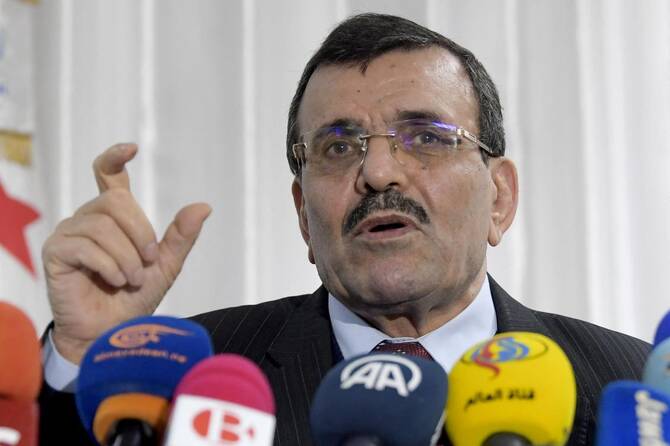
Tunisia court reduces ex-PM’s jail term over terror charges
- Last year, the former premier was sentenced to 34 years in prison.
- An overnight ruling from an appeals court reduced the 70-year-old’s term to 24 years, his defense lawyer Bouthelja said
TUNIS: A Tunisian appeals court has reduced the prison sentence of former prime minister Ali Larayedh by a decade to 24 years after he was found guilty of terrorism charges, his lawyer said Friday.
Since his arrest in late 2022, Larayedh has denied the charges that he helped send militant fighters to Iraq and Syria, and his lawyers have branded the case as politically motivated.
Last year, the former premier was sentenced to 34 years in prison. However, an overnight ruling from an appeals court reduced the 70-year-old’s term to 24 years, his defense lawyer Oussama Bouthelja told AFP.
Larayedh was prime minister from 2013 to 2014. He was a leader in the Islamist party Ennahdha, which briefly governed Tunisia following a popular uprising in 2011 that launched the Arab Spring.
He is a critic of President Kais Saied.
Others prosecuted in the case included former security officials and a spokesman for Ansar Al-Sharia, a group Tunisia designated a terrorist organization in 2013 while Larayedh was prime minister.
The appeals court reduced the sentences of several others in the case, with prison terms now ranging from three to 24 years.
Ennahdha played a key role in Tunisian politics for years before its leader Rached Ghannouchi was hit with multiple prison terms, which include a 22-year sentence on charges of plotting against state security.
Larayedh had already spent 15 years in prison, including 10 in solitary confinement, for plotting against the state under longtime ruler Zine El Abidine Ben Ali, who was toppled during the Arab Spring.
The UN said about 5,500 Tunisians fought with militant groups including the Daesh in Iraq, Syria and Libya between 2011 and 2016.