

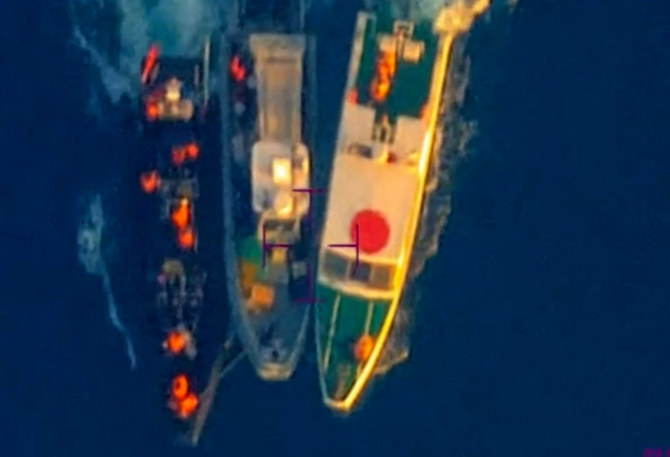

The Philippines said on Monday that its encounter with China last week in the disputed South China Sea, where a Filipino navy officer lost a finger, was a “deliberate act” by Beijing.
Manila said that China disrupted a resupply mission on the contested waters with an “aggressive and illegal use of force” on June 17, with the military releasing videos that showed members of the China Coast Guard using machetes, axes and hammers on Philippine Navy personnel and boats.
The international community, including the US and Japan, has voiced its support for Manila in the latest incident amid a string of maritime confrontations in the South China Sea.
“We see the latest incident in Ayungin not as a misunderstanding or an accident. It is a deliberate act of the Chinese officialdom to prevent us from completing our mission,” Defense Secretary Gilberto Teodoro Jr. said in a press conference, using the local name for the Second Thomas Shoal that is within the Philippines’ exclusive economic zone.
The latest statement came a day after Teodoro and President Ferdinand Marcos Jr. visited troops of the Western Command in Palawan, a province that oversees the resource-rich, disputed waters.
“We would also like to categorically say that our policy on the West Philippine Sea has not changed. As declared by the president in numerous instances, we will not give up an inch, not even a millimeter, of our territory to any foreign power,” Teodoro said, using the local name of the Philippine part of the South China Sea.
“We will continue to defend our territory and exercise sovereign rights thereon as we see fit. We reiterate that we seek neither permission nor consent from anyone in performing our sworn duties in the West Philippine Sea.”
The Philippines will also “continue to find peaceful solutions” to the issue, he added.
In Palawan, Marcos awarded medals to navy personnel who faced last week’s assault by Chinese forces. He said that the Philippines was “not in the business of instigating wars” and would always aim to settle disputes peacefully.
“Our calm and peaceful disposition should not be mistaken for acquiescence … history itself can tell that we have never, never in the history of the Philippines, yielded to any foreign power,” Marcos said on Sunday.
The Philippines and China, along with several other countries, have overlapping claims in the resource-rich waterway, where a bulk of the world’s commerce and oil transits.
Beijing has increased military activity in the area over the past few years, with the China Coast Guard regularly encroaching on the Philippine part of the waters, despite a 2016 ruling by an international tribunal in The Hague dismissing China’s expansive claims.
Stephen Cutler, a security expert and former FBI legal attache to Manila, said that the latest confrontation showcased the Philippines’ ability to defend itself.
“It demonstrates that the Philippines can and should stand up for itself, even in the face of strong aggravation … I see the Philippines growing in ability and willingness to actually stand for its territorial rights. That’s good,” Cutler told Arab News.
“The Ayungin incident shows how quickly things can get very chaotic, very rapidly … the latest incident is significant since it shows a willingness by both sides to be more belligerent and physical. That’s a step up in level from both sides.”


