Two paramilitary soldiers killed in northwest Pakistan by militants ‘infiltrating from Afghanistan’ — police

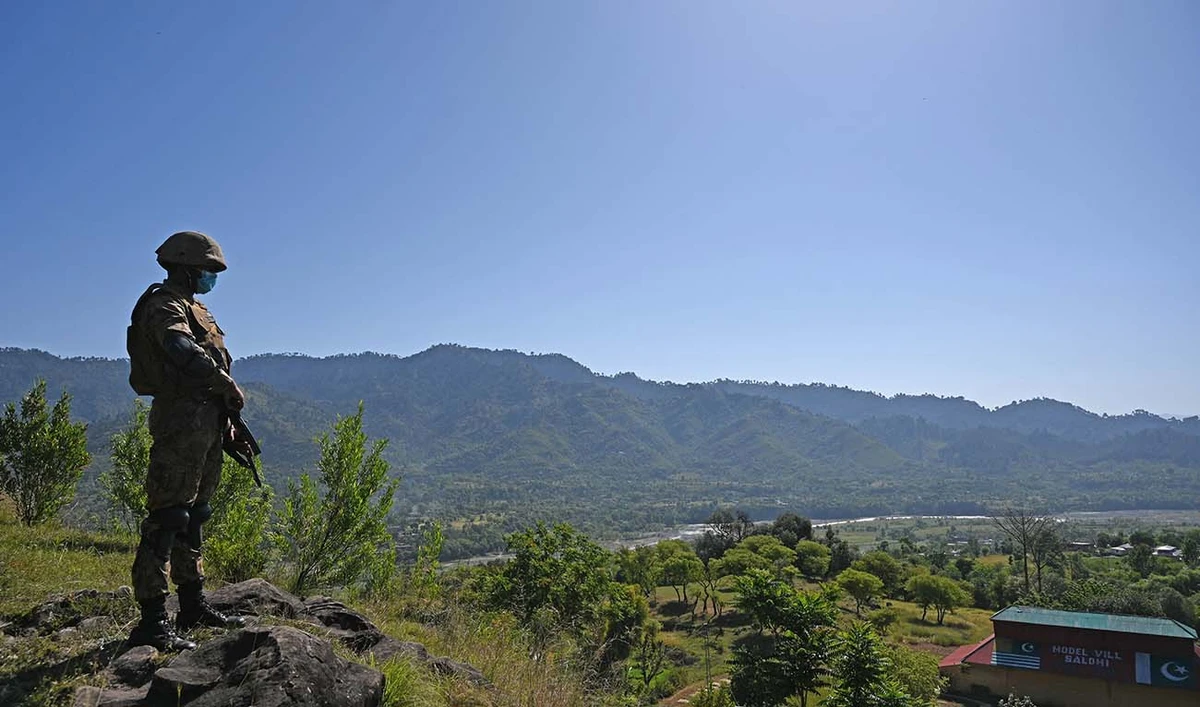
A Pakistani soldier stands guard near the Line of Control, de facto border between India and Pakistan at Salohi village in Poonch district of Pakistan-administered Kashmir on April 26, 2021. (AFP/File)
Short Url
Updated 23 June 2024
Follow

Two paramilitary soldiers killed in northwest Pakistan by militants ‘infiltrating from Afghanistan’ — police

  • Police say clashes reported on Saturday in different locations in Lower Dir but situation now “under control”
  • Islamabad says militants use safe havens in Afghanistan to launch attacks inside Pakistan, which Kabul denies

PESHAWAR: Two soldiers from Pakistan’s paramilitary Frontier Corps had been killed in two days of clashes between local security forces and militants who had allegedly infiltrated from neighboring Afghanistan into Pakistan’s northwestern border regions over the weekend, police said.

Islamabad blames an ongoing surge in militant attacks on Afghanistan, saying Pakistani Taliban, or TTP, leaders have taken refuge there and run camps to train insurgents to launch attacks inside Pakistan. The Afghan Taliban rulers in Kabul say rising violence in Pakistan is a domestic issue for Islamabad and it does not allow militants to operate on its territory.

The TTP pledges allegiance to, and gets its name from, the Afghan Taliban, but is not directly a part of the group. Its stated aim is to impose Islamic religious law in Pakistan, as the Taliban have done in Afghanistan.

Mazhar Iqbal, a district police officer in Lower Dir, told Arab News clashes were reported on Saturday in different locations in the district but the situation was now “under control.”

“Backed by police, FC has been carrying out clearing operations,” Iqbal said on Sunday. “We have no reports of exact number of casualties on either side as of yet … The situation has now returned to normalcy. Security forces and police have started patrolling to thwart any untoward incident.”

A report issued by police in Dir yesterday, Saturday, said two FC soldiers had been killed and another injured in the clashes.

“Both sides are locked in intense fire and a search and strike operation is underway in mountainous areas by police and security forces,” the report said, adding that helicopter gunships were pounding militant hideouts in Lower Dir district on the Pakistani side.

Pakistan’s Dawn newspaper and other media outlets also reported infiltration by militants from the Afghan side via the Shahi border area at Lamotai Top, Suripao and Safarai forest.

“According to locals, members of the banned TTP, hailing from Lower Dir and Swat districts, often use the Shahi and Binshahi route to enter into Lower Dir and move further toward Swat,” Dawn said.

The Pakistan army and FC have not yet commented on the latest clashes. 

The TTP is responsible for some of the bloodiest attacks in Pakistan, including on security forces, churches, schools and the shooting of Malala Yousafzai, who survived the 2012 attack after she was targeted for her campaign against the Taliban’s efforts to deny women education.

Pakistani forces were able to effectively dismantle the TTP and kill most of its top leadership in a string of military operations from 2014 onwards in the tribal areas, driving most of the fighters into neighboring Afghanistan, where Islamabad says they have regrouped. Kabul denies this.
IMF board to meet tomorrow to consider $1.2 billion disbursement for Pakistan

Updated 11 sec ago
Follow

IMF board to meet tomorrow to consider $1.2 billion disbursement for Pakistan

  • Pakistan, IMF reached a Staff-Level Agreement for second review of $7 billion loan program 
  • Economists view disbursement crucial for cash-strapped Pakistan as it tackles economic crisis

ISLAMABAD: The International Monetary Fund’s (IMF) Executive Board will meet tomorrow, Monday, to consider and approve a $1.2 billion disbursement for Pakistan, according to the global lender’s official schedule. 

The meeting takes place nearly two months after the Fund reached a Staff-Level Agreement (SLA) with Pakistan for the second review of its $7 billion Extended Fund Facility (EFF) and the first review of its $1.4 billion Resilience and Sustainability Facility (RSF). 

The SLA followed a mission led by IMF’s Iva Petrova, who held discussions with Pakistani authorities during a Sept. 24–Oct. 8 visit to Karachi, Islamabad and Washington, DC.

“The International Monetary Fund’s (IMF) Executive Board will convene on Dec. 8 to consider Pakistan’s request for a $1.2 billion disbursement under the Extended Fund Facility (EFF) and the Resilience and Sustainability Facility (RSF), according to the Fund’s updated schedule,” the state-run Pakistan TV reported on Sunday.

Economists view IMF’s bailout packages as crucial for cash-strapped Pakistan, which has relied heavily on financing from bilateral partners such as Saudi Arabia, China and the United Arab Emirates, as well as multilateral lenders including the IMF, World Bank, Asian Development Bank and Islamic Development Bank. 

The South Asian country has been grappling with a prolonged macroeconomic crisis that has drained its financial resources and triggered a balance of payments crisis. Islamabad, however, has recorded some financial gains since 2022, which include recording a surplus in its current account and bringing inflation down considerably. 

Speaking to Arab News last month, Pakistan’s former finance adviser Khaqan Najeeb said the $1.2 billion disbursement will further stabilize Pakistan’s near-term external position and unlock additional official inflows. 

“Continued engagement also reinforces macro stability, as reflected in recent improvements in inflation, the current account, and reserve buffers,” Najeeb said. 

Pakistan came close to sovereign default in mid-2023, when foreign exchange reserves fell below three weeks of import cover, inflation surged to a record 38 percent in May, and the country struggled to secure external financing after delays in its IMF program. Fuel shortages, import restrictions, and a rapidly depreciating rupee added to the pressure, while ratings agencies downgraded Pakistan’s debt and warned of heightened default risk.

The crisis eased only after Pakistan reached a last-minute Stand-By Arrangement with the IMF in June 2023, unlocking emergency support and preventing an immediate default.