


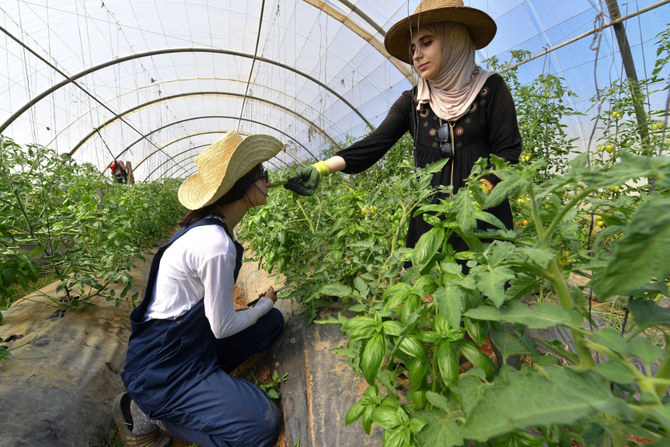


ALGIERS: Ibtissem Mahtout and Amira Messous pick fresh strawberries and tomatoes on the eco-friendly smallholding the two women are working near Algiers, a pioneering initiative in Algeria’s male-dominated agricultural sector.
After graduating from university four years ago, they left the capital and started working on the small patch of land in Douaouda, some 30 kilometers (18 miles) to the west.
“As soon as I’m in the field I’m happy,” said Messous, 28, holding a bundle of fresh beetroot.
“From morning to night, we’re here. To me, it’s the most beautiful job in the world.”
The plant ecology and biodiversity graduates now run one of the country’s rare ecological plots of land, where the produce is grown in harmony with the broader ecosystem and without using pesticides.

Amira Messous (L) and Ibtissem Mahtout (C) speak to a customer at their vegetable and fruit stand during the Friday market at an educational farm in Zeralda on May 30, 2024. (AFP)
Messous said it was challenging at first to “have to integrate” into a sector in which most people who work the land are men.
According to local media, as of last October just four percent of workers registered with the Chamber of Agriculture in Tipaza province where their land is were women.
But some “male farmers are happy to see educated women working the land,” said Messous.
“They take the time to explain things to us, and it brings more value to their own work.”
Her 29-year-old partner, Mahtout, recalls that they launched the project with just 60,000 Algerian dinars (around $445) — “enough to buy basic tools” — after renting the patch of land.
With the help of Torba, an association that promotes ecological farming in Algeria, they “learned to plant, to sow, to work the soil.”
Today, their 1,300-square-meter farm even employs one male worker full-time — and up to eight part-timers at harvest time.
When they are not in the fields themselves, the two women make full use of social media to sell their produce.

Ibtissem Mahtout (C) speaks with a customer who has come to pick up or buy their produce, at the Friday market at an educational farm in Zeralda, west of Algiers on May 30, 2024. (AFP)
On Instagram, they advertise their baskets of seasonal fruits and vegetables each week, and take orders for the produce on WhatsApp.
Come Friday, the first day of the Algerian weekend, clients pick up their orders at a larger farm in nearby Zeralda, where other smallholders also sell produce including flowers.
“We want to eat something healthy from time to time,” said Fatma Zohra, a 72-year-old loyal customer and subscriber to the small farm’s social media account.
“I found these girls very nice, and when I discovered they sell to subscribers, I wanted to encourage them.”
Each week, the pair sell between 10 and 30 baskets of fruit and vegetables that are in season.
The farm in Zeralda where they market their produce is also educational, and runs themed programs for children.
In addition to the Friday farmers’ market, it is also a meeting space for local families and offers cooking classes, entertainment and cultural events.


