

Israel kills Lebanese man ‘responsible for supplying weapons to Hamas’

1 / 2
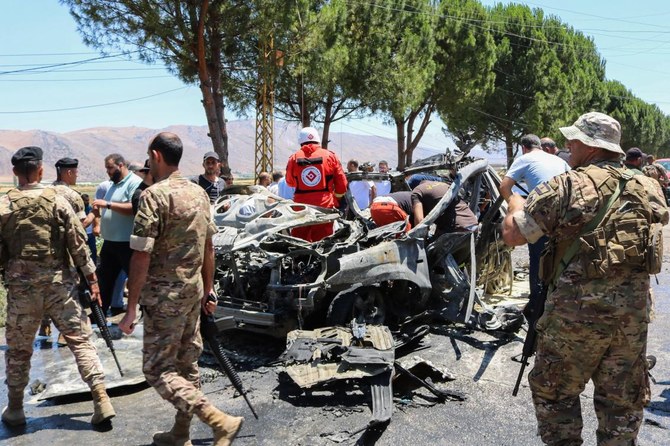
Emergency and security service members and residents gather around the carcass of a car at the site of an Israeli strike in al-Khiyara town in Lebanon's Western Bekaa area on June 22, 2024, which killed a member of the Jamaa Islamiya group according to a Lebanese security source. (AFP)
2 / 2
Emergency and security service members and residents gather around the carcass of a car at the site of an Israeli strike in Al-Khiyara town in Lebanon’s Western Bekaa area on June 22, 2024, which killed a member of the Jamaa Islamiya group according to a Lebanese security source. (AFP)
Short Url
Updated 22 June 2024
Follow

Israel kills Lebanese man ‘responsible for supplying weapons to Hamas’

  • UN peacekeepers warn against attacks on its sites in Lebanon or along the Blue Line
  • Kuwaiti citizens told by Foreign Ministry to leave Lebanon ‘as soon as possible’
  • Hezbollah tells peace delegations: ‘Don’t tire yourselves out; stop the war in Gaza, and all fronts will calm down’

BEIRUT: Israel faced accusations of violating the rules of engagement on Saturday after a military drone attacked a car in Khiara village in western Bekaa, killing the Lebanese driver.

Khiara, about 24 km from Shebaa Farms on the border and 58 km from Beirut, was targeted for the first time since the start of the conflict between Israel and Hezbollah.

A Lebanese security source said the drone strike on a SUV killed the driver, Ayman Ghotmeh, from Lala village in Bekaa.

Reports in Bekaa suggested that the victim had links with Hamas or was affiliated with a radical group allied with Hezbollah.

BACKGROUND

Since the Israel-Hamas war broke out on Oct. 7, Hezbollah movement and other groups allied with the Palestinian fighters have traded near-daily fire with Israel across the southern border.

The Israeli army later said that Ghotmeh was a commander in the Islamic Group in Lebanon, and “was in charge of supplying Hamas with weapons.”

According to Israeli media outlets, the army also targeted Hamas commander Raed Saad in a strike inside Gaza.

Israeli shelling reached Khiam, the outskirts of Deir Mimas, and Kfarkila amid continued confrontations with Hezbollah on Saturday, while Israeli warplanes struck Yaroun with two air-to-surface missiles, with no casualties reported.

Hezbollah said it struck a building used by Israeli soldiers in the Manara settlement.

It has also been reported that UNIFIL was fortifying its military positions in the border area.

Candice Ardell, deputy director of the UNIFIL Media Office, said that “the international forces reject the use of UNIFIL locations or nearby areas to carry out attacks through the Blue Line.”

In an official statement, Ardell said: “Since October, we’ve been witnessing many incidents targeting our locations and vehicles from both sides. In some situations, our peacekeepers sustained some injuries, which fortunately weren’t serious.

“We reiterate to all parties that targeting UN locations or using nearby areas to carry out attacks through the Blue Line is unacceptable and constitutes a violation” of UN Security Council Resolution 1701.

She added: “We have strong measures in place to ensure peacekeepers’ safety and ability to fulfill their duties. This includes updating our buildings when needed.”

The UNIFIL reaction came as Hezbollah parliamentary bloc member MP Hassan Ezzeddine said all the “pressure and intimidation on Lebanon is aimed at pressuring the resistance.”

Ezzeddine said: “We have faced threats and temptations, the aim of which was to give up our heavy weapons in favor of what we want inside Lebanon, but we refused and continued our path.

“The threats made by the enemy against Lebanon are to stop the front of northern occupied Palestine because this front, by everyone’s admission, especially the enemy’s leaders, is very influential in weakening them, paralyzing their capabilities, and preventing them from defeating Gaza.”

Ezzeddine addressed “all those working behind the scenes, and openly, those delegations coming to Lebanon with various initiatives,” saying: “Do not waste your time and efforts in Lebanon, because they are going in the wrong direction, and do not tire yourselves out.

“There is only one way, and that is to go to Israeli leaders and pressure them to stop their aggression on Gaza. Then, all fronts will calm down.

“But if this enemy continues its aggression and expands the scope of this war, the resistance is ready to fight a battle that may ultimately be decisive.”

The Hezbollah MP’s remarks came as the Kuwaiti Ministry of Foreign Affairs advised all its citizens to avoid travel to Lebanon due to security developments in the region.

The ministry asked “Kuwaiti citizens already in Lebanon, with no pressing reasons to remain, to leave the country as soon as possible. Those unable to leave must contact the Kuwaiti Embassy in Lebanon immediately via the embassy’s emergency phone number: 0096171171441.”

Kuwait Airways announced an increase in the capacity of its planes heading to Beirut to accommodate passengers wishing to return to Kuwait.

In a statement on its X account, the airline said: “These measures come in coordination with the Foreign Ministry in light of the current circumstances in the region.”


Last Christians gather in ruins of Turkiye’s quake-hit Antakya

Updated 25 December 2025
Follow

Last Christians gather in ruins of Turkiye’s quake-hit Antakya

  • Saint Peter’s, one of the world’s oldest rock churches, is a sacred rallying point for the isolated Christians still left in quake-hit Antakya in southeastern Turkiye

ANTAKYA: Saint Peter’s, one of the world’s oldest rock churches, is a sacred rallying point for the isolated Christians still left in quake-hit Antakya in southeastern Turkiye, the city known in ancient times as Antioch.
“Since the earthquake, our community has scattered,” said worshipper Mari Ibri.
“Those who remain are trying to regroup. We each had our own church but, like mine, they have been destroyed.”
The landscape around the cave remains scarred by the disaster nearly three years ago, when two earthquakes devastated Hatay province on February 6, 2023 and its jewel, Antakya, the gateway to Syria.
Sad fields of rubble and the silhouettes of cracked, abandoned buildings still scar the city — all enveloped in the ever-present grey dust.
Since the earthquakes, Antakya city has emptied and the Christian community has shrunk from 350 families to fewer than 90, Father Dimitri Dogum told AFP.
“Before, Christmas at our house was grandiose,” Ibri recalled.
“Our churches were full. People came from everywhere.”
Ibri’s own church in the city center was rendered inaccessible by the earthquakes.
Now she and other worshippers gather at the cave on December 24 — Christmas Eve in some Christian calendars.
It is here, they believe, that Peter, the disciple Jesus assigned to found the Christian church, held his first religious service in the 1st century.
The rock church was later enlarged and 11th-century crusaders added a pale stone facade.
It is now a museum, opened to the faithful only on rare occasions.
Christmas Eve is one.
The morning sun was still glowing red in the sky when Fadi Hurigil, leader of Antakya’s Orthodox Christian community, and his assistants prepared the service.
They draped the stone altar and unpacked candles, holy oil, chalices and plastic chairs.
Out in front they placed figurines of Christ and three saints near a bottle of rough red wine, bread baskets and presents for the children.
The sound system played a recording of the bells of Saint Peter and Paul church, which now stands empty in Antakya city center.
“That was my church,” said Ibri, crossing herself. “They recorded the peals.”
Around one hundred worshippers soon squeezed into the incense-filled cave and at least as many congregated outside.
A large police contingent looked on. Sniffer dogs had already inspected the cave and esplanade.
“It’s normal,” said Iliye, a 72-year-old from Iskenderun, 60 kilometers (40 miles) further north. “We’re a minority. It’s to protect us.”
The slow chanting of Orthodox hymns heralded the start of the two-hour service, conducted entirely in chants sung in Arabic and Turkish by Dogum and another cleric.
“It’s very moving for us to be here in the world’s first cave church, where the first disciples gathered,” the priest said.
“There used to be crowds here,” he added.
“In 2022, there were at least 750 people outside, Christians and non-Christians alike.”
Since the earthquakes, the gathering has been much smaller, although it is now starting to grow again.
At the end of the service, when Christmas carols fill the air, Dogum and Hurigil cut a huge rectangular cake.
The Nativity scene at its center — Mary, baby Jesus, the ox and the ass — was edged with whipped cream.
“There’s the religious dimension but it’s also important that people can gather here again,” a worshipper said.
“After February 6, our fellow citizens scattered. But they’re starting to come back. We’re happy about that.”