Pakistan’s Sindh province suspends human milk bank, refers initiative to Islamic Ideology Council

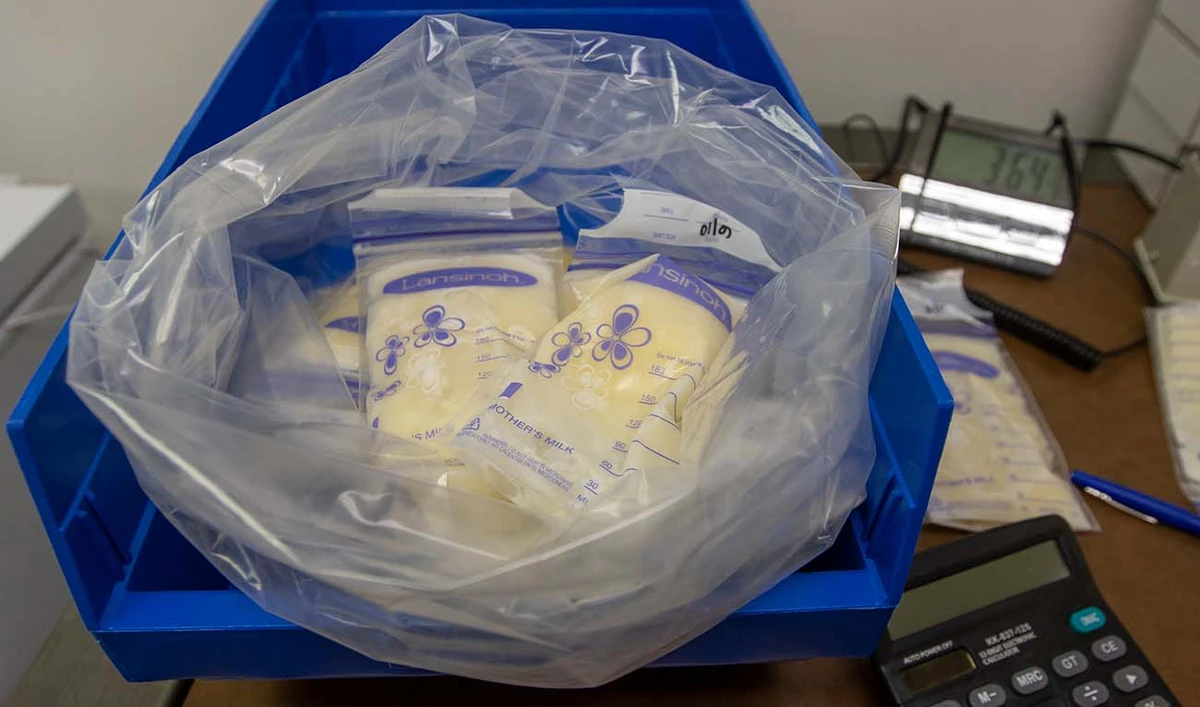
Donated human milk is seen at the Mountain West Mother’s Milk Bank on December 12, 2019 in Salt Lake City, Utah. (AFP/File)
Short Url
Updated 22 June 2024
Follow

Pakistan’s Sindh province suspends human milk bank, refers initiative to Islamic Ideology Council

  • Pakistan’s first human milk bank was set up earlier this month by Sindh Institute of Child Health and Neonatology
  • Facility was established in collaboration with UNICEF, described as “significant milestone in maternal health”

ISLAMABAD: The Sindh Institute of Child Health and Neonatology (SICHN) said this week Pakistan’s first human milk bank established earlier this month had been suspended pending further guidance from the Council of Islamic Ideology.

A human milk bank, breast milk bank or lactarium is a service that collects, screens, processes, pasteurizes, and dispenses by prescription human milk donated by nursing mothers who are not biologically related to the recipient infant. For women who are unable to breastfeed or produce enough milk, pasteurized donor breast milk can be an effective approach to feeding.

SICHN earlier this month announced its human milk bank facility, Pakistan’s first, established in collaboration with UNICEF, describing it as a “significant milestone in maternal health.”

“A recent revised fatwa issued by Darul Uloom Karachi dated 16ht June 2024 has prompted us to discontinue the functionality of the Human Milk Bank. This decision is in compliance with the updated religious guidance and reflects our ongoing commitment to operate within the framework of Islamic jurisprudence,” SICHN said in a statement dated June 21. 

“Moving forward, we will seek further guidance on this issue from both Darul Uloom Karachi and the Council of Islamic Ideology,” the statement added, referring to a religious body that advises the government on the compatibility of laws with Islam.

SICHN said the milk bank was initially set up after seeking and receiving a fatwa from the Darul Uloom Karachi, “which provided us with the necessary religious endorsement to proceed.” 

“This fatwa was critical in ensuring that our efforts were in harmony with Islamic teachings, providing reassurance to the community and stakeholders involved,” the institute said. 

The fatwa cited certain pre-conditions to establish the milk bank including that Muslim children should only be provided milk from Muslim mothers.

Iran is currently believed to be the only country in the Muslim world with a network of milk banks. In general, Islam makes the practice tricky. The opposition centers on a tenet called milk kinship, which states that a parent-child bond is formed when a woman gives milk to a baby who isn’t biologically related to her. 

To avoid future incestuous marriages between so-called milk siblings, the tenet says, the foster relationship must be clearly delineated. Since milk bank donors are typically anonymous and the donations are often combined, the practice is rejected in most of the Muslim world.
Pakistan, ADB sign $730 loan agreements to boost SOE reforms, energy infrastructure

Updated 25 December 2025
Follow

Pakistan, ADB sign $730 loan agreements to boost SOE reforms, energy infrastructure

  • Both sign $330 million Power Transmission Strengthening Project and $400 million SOE Transformation Program loan agreements
  • Economic Affairs Division official says Transmission Project will secure Pakistan’s energy future by strengthening national grid’s backbone

KARACHI: Pakistan and the Asian Development Bank (ADB) on Thursday signed two loan agreements totaling $730 million to boost reforms in state-owned enterprises (SOEs) and energy infrastructure in the country, the bank said.

The first of the two agreements pertains to the SOE Transformation Program worth $400 million while the second loan, worth $330 million, is for a Power Transmission Strengthening Project, the lender said. 

The agreements were signed by ADB Country Director for Pakistan Emma Fan and Pakistan’s Secretary of Economic Affairs Division Humair Karim. 

“The agreements demonstrate ADB’s enduring commitment to supporting sustainable and inclusive economic growth in Pakistan,” the ADB said. 

Pakistan’s SOEs have incurred losses worth billions of dollars over the years due to financial mismanagement and corruption. These entities, including the country’s national airline Pakistan International Airlines, which was sold to a private group this week, have relied on subsequent government bailouts over the years to operate.

The ADB approved the $400 million loan for SOE reforms on Dec. 12. It said the program seeks to improve governance and optimize the performance of Pakistan’s commercial SOEs. 

Karim highlighted that the Power Transmission Strengthening Project will enable reliable evacuation of 2,300 MW from Pakistan’s upcoming hydropower projects, relieve overloading of existing transmission lines and enhance resilience under contingency conditions, the Press Information Department (PID) said. 

“The Secretary emphasized that both initiatives are transformative in nature as the Transmission Project will secure Pakistan’s energy future by strengthening the backbone of the national grid whereas the SOE Program will enhance transparency, efficiency and sustainability of state-owned enterprises nationwide,” the PID said. 

The ADB has supported reforms by Pakistan to strengthen its public finance and social protection systems. It has also undertaken programs in the country to help with post-flood reconstruction, improve food security and social and human capital. 

To date, ADB says it has committed 764 public sector loans, grants and technical assistance totaling $43.4 billion to Pakistan.