Power outage hits Balkan states as heat overloads system, minister says

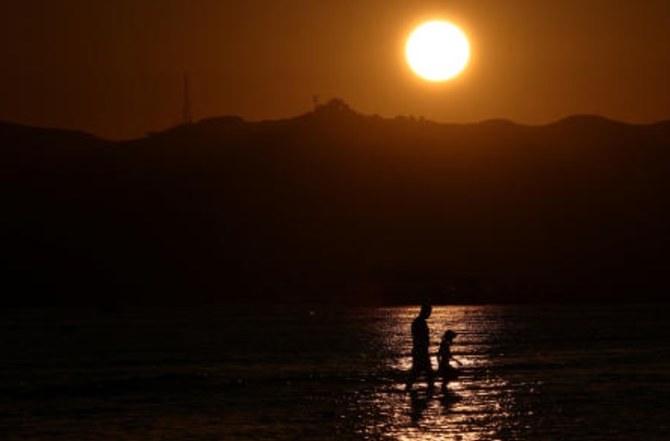
People enjoy the sea during the heat wave in Durres, Albania, June 18, 2024. (Reuters)
Short Url
Updated 21 June 2024
Follow

Power outage hits Balkan states as heat overloads system, minister says

  • Montenegro’s energy minister said the shutdown was caused by a sudden increase in power consumption brought on by high temperatures, and by the heat itself overloading systems
  • Power distribution is linked across the Balkans for transfers and trading

PODGORICA: A major power outage hit Montenegro, Bosnia, Albania and most of Croatia’s coast on Friday, disrupting businesses, shutting down traffic lights and leaving people sweltering without air conditioning in the middle of a heatwave.
Montenegro’s energy minister said the shutdown was caused by a sudden increase in power consumption brought on by high temperatures, and by the heat itself overloading systems. Power distribution is linked across the Balkans for transfers and trading.
“This was just waiting to happen in this heat,” Gentiana, a 24-year-old student in Montenegro’s capital Podgorica, told Reuters. Temperatures hit 40 degrees Celsius (104 degrees Fahrenheit) across the southeastern European region.
Electricity and wifi networks went down from around 1 p.m. (1100 GMT), officials and social media users said. Suppliers in the four countries said they started restoring supply by mid-afternoon and power was largely back by the evening.
At the start of the blackout, traffic light failures caused gridlock in Bosnia’s capital Sarajevo and the cities of Banja Luka and Mostar, Reuters reporters said.
Many lost water in Podgorica as pumps stopped working, locals reported. Air conditioners shut down and ice cream melted in tourist shops.
Cars also ground to a halt in the Croatian coastal city of Split, state TV HRT reported. Ambulance sirens rang out across the city, it added.
“The failure occurred as a result of a heavy load on the network, a sudden increase in power consumption due to high temperature and the high temperatures themselves,” Montenegro’s energy minister, Sasa Mujovic, said in a TV broadcast.
Experts were still trying to identify where the malfunction originated, he added.

RISK REMAINS
Montenegro’s Vijesti TV said a fire had been spotted in a 400KW transmission line in a rugged area along the border with Bosnia — though it was not immediately clear if this could have been the cause of outages or in some way related to them.
The report cited unnamed sources from the electric transmission company CGES which, it said, would need helicopters to access the site.
Albanian Energy Minister Belinda Balluku said there had been a breakdown in an interconnector between Albania and Greece and he had heard there had been similar circumstances in Montenegro and parts of Croatia and Bosnia.
A full investigation would take time, but early analysis suggested that “big volumes of power in the transmission system at the moment and very high temperatures in record levels have created this technical problem,” Balluku added in a video address.
Power in Albania was restored within half an hour, but the country remained at a high risk of further shutdowns as power usage and heat levels were still high, he said.
Shifts in the region’s energy supplies have put strains on its transmission systems, industry officials say.
Western Balkan nations have seen a boom in solar energy investment, meant to ease a power crisis that had threatened a shift away from coal.
But the infrastructure is not prepared for new energy feeds, the president of North Macedonia’s Energy Regulatory Commission and other industry figures told Reuters in April last year.



French forces use tear gas to clear protesters protecting condemned cows

Updated 4 sec ago
Follow

French forces use tear gas to clear protesters protecting condemned cows

LES BORDES SURE ARIZE: Veterinarians arrived at a French farm Friday under police escort to slaughter a herd of cows suffering from a potentially deadly disease, an AFP reporter said, after police used tear gas to clear away angry protesters trying to protect the animals.
Farmers have staged protests in several parts of France in recent days, accusing the authorities of not doing enough to support them.
Hundreds of agricultural workers have demonstrated for two days outside the farm in the southern area of Ariege near the Spanish border.
They set up a cordon around the farm after the authorities on Wednesday said that more than 200 Blonde d’Aquitaine cows at the farm had nodular dermatitis — widely known as lumpy skin disease — and would have to be euthanized.
Gendarmes used tear gas late Thursday to fight their way past dozens of farmers who stayed after nightfall to blockade the farm in the village of Les Bordes-sur-Arize, while protesters hurled stones, branches and other makeshift missiles as hay bales burnt in the background.
Four people were arrested, Interior Minister Laurent Nunez said.
Several farmers and supporters had earlier chopped down trees and set up barricades to stop veterinary staff from entering to carry out the killing.
Regional prefect Herve Brabant said that the brothers who owned the farm had agreed to have the herd slaughtered in line with precautions against the disease.
But Pierre-Guillaume Mercadal, of the local Rural Confederation union leading the protest, said one brother had agreed and one was opposed.
“They are tearing this family apart,” he said.

- ‘In shock’ -

Marina Verge, 33, the daughter of one of the owners, on Wednesday told AFP that killing the cows amounted to destroying “almost 40 years” of their life’s work.
“They’re in shock, it’s unimaginable. They didn’t expect it,” she said.
“You don’t imagine finding yourself without livestock overnight.”
Other cases have also been detected in the region and some 3,000 of the 33,000 cattle in Ariege have already been vaccinated.
Lumpy skin disease, which cannot be passed to humans but can be fatal for cattle, first appeared in France in June. French authorities insist the outbreak is under control and that they are preparing a mass vaccination program.
The World Organization for Animal Health says that cases have also been reported in Italy this year.
According to the European Food Safety Authority, the disease is present in many African countries.
In 2012, it spread from the Middle East to Greece, Bulgaria and the Balkans. A vaccination program halted that epidemic.